Trane Technologies Built a Lab to Figure Out What AI Can Actually Do for Buildings
Artificial intelligence is everywhere in commercial real estate right now, at least in the conversation. Vendors are promising autonomous buildings, self-optimizing HVAC systems, and AI that can predict energy needs before operators even know they have them. The reality on the ground is more complicated. Most of the AI being deployed in buildings today is narrow, task-specific, and dependent on clean data and compatible hardware that many buildings simply don’t have. The gap between what AI can theoretically do for the built environment and what it is actually doing at scale remains significant, and closing it requires something the industry has rarely invested in: dedicated infrastructure for figuring out what works before it gets deployed.
Trane Technologies is one of the largest building systems companies in the world. Its AI systems have been deployed across more than 68,000 commercial buildings on five continents, a footprint that encompasses office towers, hospitals, data centers, industrial facilities, and residential properties across virtually every major market. The company acquired BrainBox AI in January 2025, incorporating its AI-powered autonomous HVAC controls and generative AI building technology into its broader product portfolio. Trane and BrainBox had been working together for more than two years before the deal closed, combining BrainBox’s AI engine with Trane’s advanced building management capabilities.
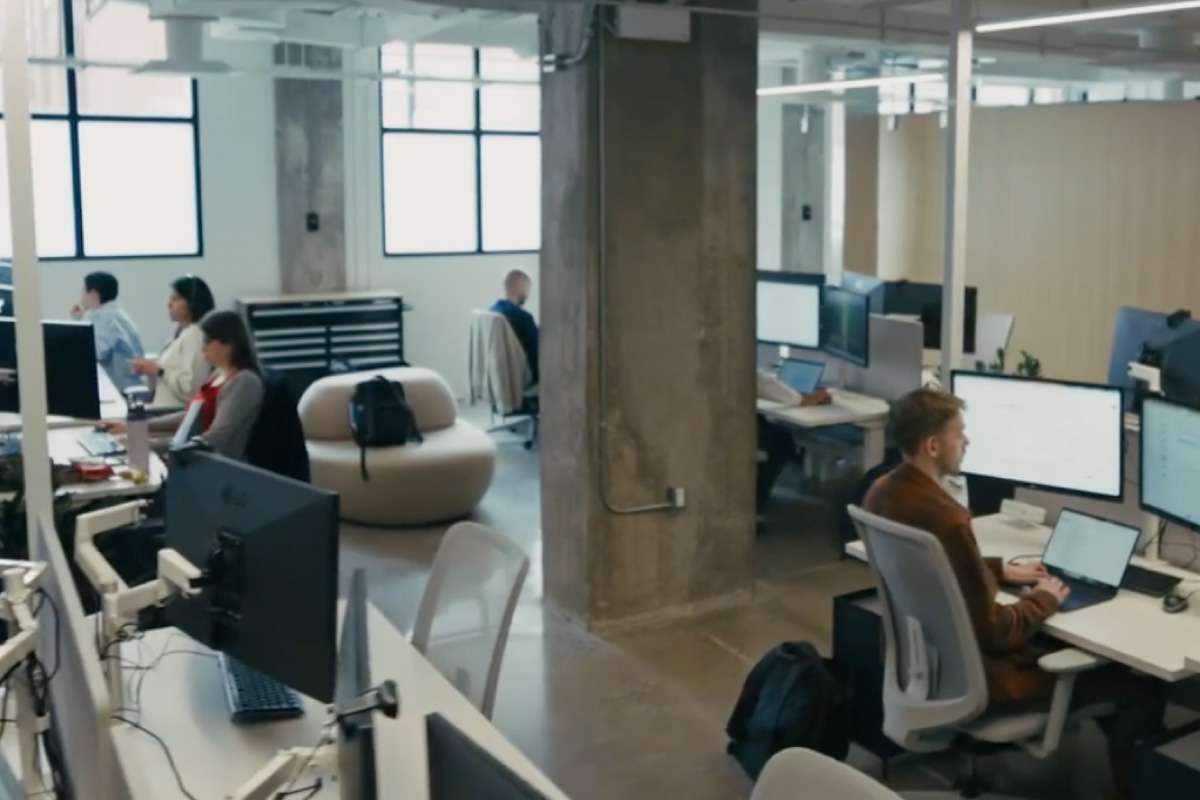
The BrainBox AI Trane Technologies AI Lab, announced in August 2025 and formally opened in May 2026 in Montreal, is the physical expression of that commitment. The facility is home to roughly 100 of the Montreal team’s approximately 200 employees, working across software engineering, data science, AI research, machine learning development, and AI engineering. Montreal was a deliberate choice, given its position as one of the world’s premier AI hubs, with renowned research institutes, a strong network of university programs producing top-tier AI talent, and a thriving innovative ecosystem. The lab is designed not just for internal development but as a platform for the kind of external collaboration that accelerates the pace of discovery in ways that a closed research environment can’t.
The academic and industry partnerships embedded in the lab are central to how it functions. The lab operates with support from AWS, IVADO, and Concordia University. Those relationships are designed to move research in both directions. “We like to develop partnerships with universities and large companies so we can help them develop systems for their own buildings that suit their own individual needs,” said Jean-Simon Venne, Founder, President, and CTO at BrainBox AI and Head of the AI Lab. The goal isn’t purely academic. It’s practical: getting institutions that manage complex buildings into the development process early so that the solutions being built map onto the operational realities those organizations actually face.
The facility also includes a showroom designed to support the customer side of that process. “We have space to bring our customers in to see exactly what they want and how they use these tools,” Venne said. “An open channel between the customer and the engineers is so critical to grow our tech well.” Building technology has historically been developed in relative isolation from the people who use it, tested in controlled environments and deployed into buildings whose complexity only becomes apparent after installation. A physical space where customers can interact with working systems, ask questions of the engineers who built them, and give feedback before a product is finalized compresses that feedback loop in ways that matter for what eventually ships.
One of the lab’s core functions is hardware compatibility testing, which is considerably less glamorous than AI research but arguably just as important. The commercial building market is filled with decades of legacy equipment from hundreds of manufacturers, running on protocols that were never designed to interoperate. Getting AI to control a building means connecting to whatever equipment that building actually contains, which is rarely the clean and standardized environment that product demonstrations suggest. “We interface with hardware constantly so we need to stay agnostic,” Venne said. “We need to be able to connect, extract, and control every possible type of hardware. It’s a jungle of products that we need to always be aware of.” The lab gives Trane a controlled environment to test its AI against that reality systematically, rather than discovering compatibility problems during a customer installation.
The energy dimension of running AI at building scale is something the lab is also thinking about carefully. The conversation around data center energy consumption has become unavoidable in any discussion of AI’s environmental impact, and any organization deploying AI across tens of thousands of buildings has to reckon with the computing cost. Venne’s framing of that tradeoff is direct. “We see how much energy we use with AI on the cloud level and it is less than five percent of what we can save on the building level,” he said, “so it can be a huge gain.” BrainBox AI’s systems have been shown to reduce building energy consumption by up to 25% and greenhouse gas emissions by up to 40%, which puts the energy cost of the AI itself in a very different context. The computing required to optimize a building’s systems is a fraction of what that optimization recovers.
What the lab ultimately represents is a recognition that the next generation of building technology requires a different kind of development process. HVAC equipment was engineered to move air and manage temperature. The intelligence layer being built on top of it has to handle prediction, automation, interoperability, and real-time control simultaneously, across thousands of different building configurations. Trane and BrainBox have set a goal of reducing energy waste from buildings by 30%, and the lab is where the work of figuring out exactly how to get there is actually happening.
The post Trane Technologies Built a Lab to Figure Out What AI Can Actually Do for Buildings appeared first on Propmodo.