



Title Companies Are Becoming Property Data Companies
Every title insurance policy issued in the United States rests on a search. Before a policy gets written, someone has to establish who owns a property, what claims exist against it, whether prior transfers were valid, and what encumbrances survive the transaction. Title companies have been doing that work for well over a century, building the archives, indexing systems, and verification processes required to answer those questions reliably across thousands of counties with wildly inconsistent record-keeping practices. The result is one of the most comprehensive and rigorously maintained bodies of property information in the country, assembled originally as an internal cost of doing business.
That infrastructure is increasingly being packaged and sold as a product in its own right. First American Data & Analytics, a division of First American Financial Corporation, maintains what it describes as the nation’s largest property intelligence dataset, spanning ownership records, deeds, mortgages, foreclosures, assignments and lien releases, homeowner association information, and parcel boundaries. The underlying title plant collection contains more than 7 billion recorded documents, growing by more than 5 million new document images monthly. In July 2026, the company made those datasets available inside the ArcGIS ecosystem, delivering parcel boundaries, ownership information, precise address points, building footprints, transaction intelligence, tax data, valuation, and land use data as web feature layers that GIS analysts can pull directly into their workflows.
What distinguishes title-derived data from other property databases is the standard it was built to meet. “We are betting our balance sheet on the quality of our data every time we use it,” said Matt Key, VP of Property Data at First American Data & Analytics. That framing captures something structurally different about the source. A data provider that sells information bears reputational risk if the data is wrong. A title insurer that underwrites a policy based on its own research bears financial liability. Every error becomes a claim. The verification discipline that emerges from that exposure is difficult to replicate in a business where the data is the product rather than the input to a risk decision.
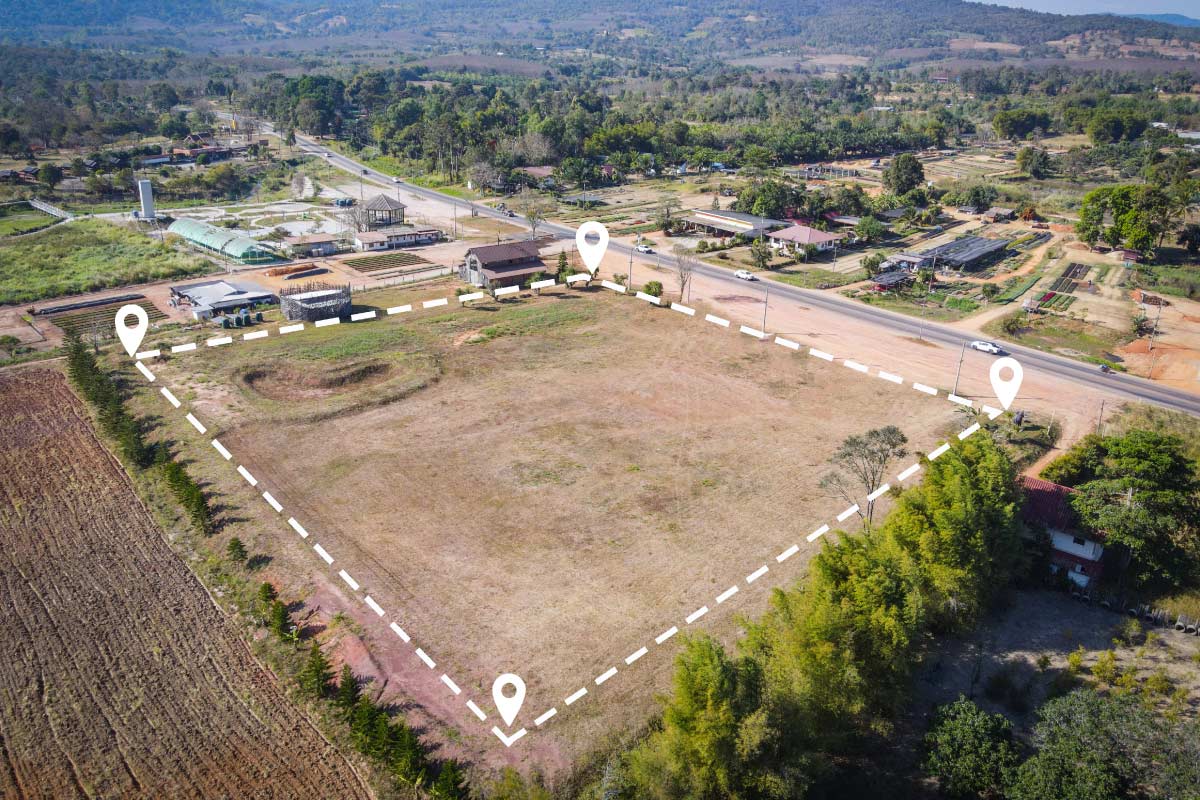
The place where that ownership expertise is proving most immediately valuable is land, a category that has become unusually active. “There is a lot of interest right now for land, both from traditional commercial developers and those looking for particular uses like data centers or alternative energy sites,” Key said. Land assemblage is a fundamentally different research problem than acquiring an improved property. There is no rent roll, no tenant list, and often no broker relationship to start from. The critical questions are who owns the parcels, whether adjacent parcels share ownership, and whether the owner is likely to sell. Answering those questions requires exactly the ownership chain research that title companies have spent a century systematizing.
The specific capability that matters most in land work is seeing through the ownership structures that obscure who is actually making decisions. Land is frequently held in LLCs, trusts, and family partnerships with names that reveal nothing. Recorded documents, however, carry signatures. “We look at the signature of the documents to get an idea of who the decision makers are behind the LLCs and trusts,” Key said. That is a research technique that only works if you have the underlying document images and the systems to search them, which is precisely what a title plant is. For an investor watching a market where a data center developer has begun quietly acquiring parcels, identifying the individual behind those entities and mapping their other holdings is the difference between recognizing an assemblage in progress and finding out about it after the announcement.
First American is also building an automated valuation model for vacant land, which addresses one of the more persistent gaps in property data. Improved properties have well-established valuation methodologies supported by abundant comparable sales. Vacant land is considerably harder. Transactions are less frequent, parcels are less comparable, and value depends heavily on entitlement status, utility access, and the range of uses a site could support. A land AVM built on comprehensive parcel, ownership, transaction, and land use data would give developers and investors a systematic way to evaluate sites at scale rather than one at a time, which matters enormously in a market where energy and data center demand has made land pricing genuinely difficult to assess.
The strategic logic here extends beyond any single company. Title insurers sit on data assets that were built for a regulated, liability-driven purpose and that happen to answer questions the broader real estate market is increasingly willing to pay for. The infrastructure is already built, the maintenance is already funded by the core business, and the marginal cost of packaging it for external use is comparatively low. As property research becomes more central to how investors, developers, and lenders make decisions, the companies that have been quietly maintaining the underlying records may find that the data operation they built as a cost center has become one of the more valuable things they own.
The post Title Companies Are Becoming Property Data Companies appeared first on Propmodo.