Spain sweats over its isolated territories in Africa
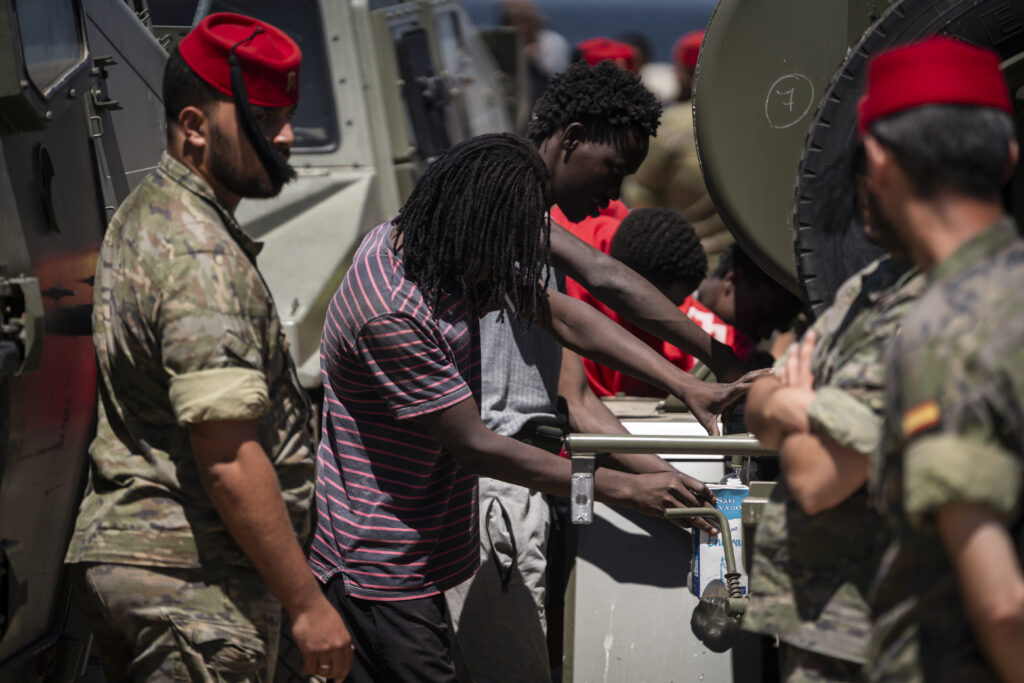
The surge of migrants into the Spanish exclaves of Ceuta and Melilla last week has thrown Madrid onto the defensive over the status of its two autonomous cities in northern Africa — and Morocco’s long-standing claim to them.
The ease with which tens of thousands of migrants penetrated the border has ramped up a sense of vulnerability to hybrid attack. And that alarm has only been amplified by a fear that traditional NATO allies in the U.S. and the EU are no longer fully dependable because of their political feuds with Socialist Prime Minister Pedro Sánchez.
Buoyed by an increasingly warm relationship with U.S. President Donald Trump, Rabat is seizing the moment and doubling down on its claims to Ceuta and Melilla, which it sees as occupied territory, in Morocco’s state-aligned press.
But, more alarmingly for Madrid, that argument is no longer coming exclusively from Rabat. Questions over Spain’s centuries-old control of the fortress cities have also been raised in a U.S. Congress report, and by Israel’s ambassador to the U.N.
It is a sign of the level of concern in Madrid that the government is now having to make public declarations on a point of international law that — only a week ago — it would have thought was self evident.
“Ceuta and Melilla are not to be touched,” Defense Minister Margarita Robles said during a press conference on Monday. “Everyone must be very clear that Spanish territorial integrity and sovereignty are not up for debate.”
The government’s rejection of Morocco’s claims has done little to reduce concerns in Spain over what would happen if Rabat dials up the pressure. This week, national newspapers have been filled with columns expressing fears of a “Green March 2.0” — pointing out the parallels with Morocco use of a mass popular mobilization to take over the province of Spanish Sahara in 1975.
José Manuel García-Margallo, who served as Spain’s foreign minister between 2011 and 2014 and is a member of the center-right People’s Party, said it was vital for Spain to show its control over the cities is not negotiable.
“Do you think the British would have allowed 60,000 Spaniards to enter Gibraltar?” he asked. “I’d encourage this government to be a little bit more British.”
“We should aim to be friends with Morocco,” he added. “But it’s important to ensure that even your friends understand that there are red lines that simply cannot be crossed.”
Imperial legacies
Ceuta and Melilla are among the few remaining vestiges of the vast Spanish Empire. They have been under Madrid’s rule since 1668 and 1497, respectively, and are fully-integrated parts of Spain — and the European Union.
But since gaining independence from France in 1956, Morocco has consistently claimed sovereignty over both settlements, which it characterizes as “colonies” that are “occupied” by Spain. And those territorial aspirations have been underscored in the country’s largely state-aligned press following last week’s events.

“The central question is no longer whether these cities will be reintegrated into their natural environment, Morocco, but how long it will take and how many human tragedies will have to be endured in the meantime,” wrote Le360, a publication considered close to the Moroccan royal household.
Morocco’s claims on Ceuta and Melilla have lately been boosted by Rabat’s international allies — among them, a prominent Republican politician in the U.S.
In an interview with Spanish newspaper El Español in April, U.S. Congressman Mario Díaz-Balart, who serves on the powerful Committee on Appropriations, stated “Ceuta and Melilla are in Moroccan territory” and questioned whether the autonomous cities “are part of Spain or should be part of Morocco.”
He also noted that while Spanish Prime Minister Sánchez was “jeopardizing” the alliance between the U.S. and Spain by opposing the war in Iran, Rabat had been Washington’s steadfast ally.
Weeks later, as U.S. lawmakers prepared an appropriations bill that included a proposal to allocate $40 million to Morocco for defense and security expenditures, Díaz-Balart submitted a congressional report noting “the Spanish-administered cities of Ceuta and Melilla are located in Moroccan territory and remain the subject of Morocco’s longstanding claim.”
The document additionally expressed support for “diplomatic engagement” on “the future status” of the autonomous cities.
Speaking to POLITICO, Díaz-Balart denied the congressional report had been intended to signal a major shift on Ceuta and Melilla.
“It’s been an issue of dispute for some time. Morocco has been a strong ally of the United States — it was the first country to recognize the United States. And we’ve had good ties with Spain over the years. All we were asking is for Secretary [of State Marco] Rubio to keep an eye on this and be sure that both sides are talking about this issue,” he said.
But the congressman’s willingness to give a platform to Rabat’s claims on Ceuta and Melilla reflects how close Morocco and the United States have become since 2020. That year, Trump took the landmark step of recognizing Rabat’s claim to the disputed territory of Western Sahara in exchange for the normalization of relations between Morocco and Israel.
Last week, Trump reaffirmed that recognition in a statement issued by the U.S. Embassy in Rabat at the same moment as the migrants surged into Ceuta. Rabat showed its pleasure with this decision by announcing that it had renamed a major highway after the president.
Adding to Spain’s concerns about its territories in North Africa, Israeli Ambassador to the United Nations Danny Danon reacted to the images of last week’s migrant influx by hitting back against Madrid’s criticism of the war in Gaza and challenging Spain’s presence in Ceuta and Melilla.

“Maybe before it continues lecturing us, it’s time it explained to the world why it still maintains colonial enclaves in Africa,” he wrote on X.
Israel’s head of mission in Madrid, Dana Erlich, later clarified that Danon’s comments did not represent an official position.
García-Margallo said the problems with Díaz-Balart and Danon were a consequence of Sánchez’s foreign policy.
“I’m also not surprised that those claims are being amplified in other parts of the globe … The current government’s relations with the Trump administration and with the government of Israel have deteriorated tremendously in recent times,” he said. “When you make a point of showing you’re against specific countries, consequences are to be expected.”
The specter of the ‘Green March’
For Spaniards, the idea that Morocco could engineer a situation to annex territory is far from theoretical speculation. Many still remember Morocco’s 1975 “Green March,” an operation that forced the handover of Spanish Sahara.
“Rabat deployed tens of thousands of civilians to overwhelm border posts in Spanish Sahara in 1975 as dictator Francisco Franco lay dying,” said José Luis Rodríguez Jiménez, history professor at Madrid’s Rey Juan Carlos University and author of a book on the fall of Spanish Sahara.
“At the time, it wasn’t clear who was running — or would run — Spain, and Morocco took advantage of the weakness of the Spanish state to take over the province,” he said.
Half a century later, he said, Morocco’s King Mohammed VI had detected similar weakness in Sánchez, whose minority government is unable to pass major legislation and whose inner circle is caught in web of embarrassing corruption scandals.
As former Foreign Minister García-Margallo put it: “I don’t have the slightest doubt that the current government’s weakness has contributed to this crisis.”
Historian Rodríguez Jiménez said Rabat had sporadically tested Madrid’s willingness to defend its territories in northern Africa.
In 2002, a squad of Moroccan marines launched an “invasion” of Perejil Island, an uninhabited Spanish islet off the coast of Ceuta, sparking a week-long crisis that only concluded when Spanish special forces were deployed to evict them.
And in a strikingly similar incident to last week’s massive influx of migrants into Ceuta, in 2021 some 8,000 people surged into the autonomous city after Morocco abruptly withdrew its gendarmes from the border.

Rodríguez Jiménez argued Sánchez had blundered by responding to that incident by reversing Spain’s historic support of Western Sahara’s self-determination and accepting Morocco’s bid to control the disputed territory.
“The government opted to placate Rabat, failing to understand that this was seen as a sign of weakness in Morocco, a country which is not our friend, and which has every interest in exploiting our vulnerabilities,” he said.
“What happened last week was a dress rehearsal for an eventual invasion,” he added. “And Rabat has noted Madrid’s complete inability to repulse that attack.”
Spanishness ‘beyond all doubt’
Spanish officials reject the accusation that the Ceuta crisis has made Madrid look weak, with Interior Minister Fernando Grande-Marlaska on Tuesday insisting the crisis showed the country to be a “strong” and respected regional player.
That ability to project strength to Rabat is increasingly important as NATO’s commitment to defending Ceuta and Melilla appears less certain than it once did. Back in 2022, then-Secretary General Jens Stoltenberg specifically listed the North African cities as falling under the alliance’s aegis.
But things have changed since then. Trump has cast doubt on NATO’s commitment to common defense and his relationship with Spain, which he has repeatedly lambasted for its lackluster defense spending and failure to support the Iran war, is particularly rocky.
When asked about NATO’s position now, an official said: “We don’t speculate on hypothetical scenarios,” while adding the alliance was “ready and well-postured to protect and defend all allies.”
García-Margallo said that NATO’s common defense commitment is only as strong as “our allies’ willingness to support us … the interpretation of the terms of any treaty is ultimately a political decision.”
POLITICO asked the Spanish foreign ministry what measures the government had taken to address concerns about the international conversation over Ceuta and Melilla, especially in relation to Díaz-Balart’s congressional report.
The ministry did not answer the questions directly, but hit back at any assertion that the cities’ sovereignty could be negotiable.
“The Spanishness of Ceuta and Melilla is beyond all doubt and is recognized as such by international law and the entire world,” a spokesperson said.
Eric Bazail-Eimil contributed reporting from Washington. Victor Jack contributed reporting from Brussels.