Meet the married couple who helped make the UK social media ban a reality
Meet the married couple who helped make the UK social media ban a reality
How husband-and-wife team Daisy Greenwell and Joe Ryrie caught Keir Starmer’s attention on banning social media for kids.
By MIZY CLIFTON
in London

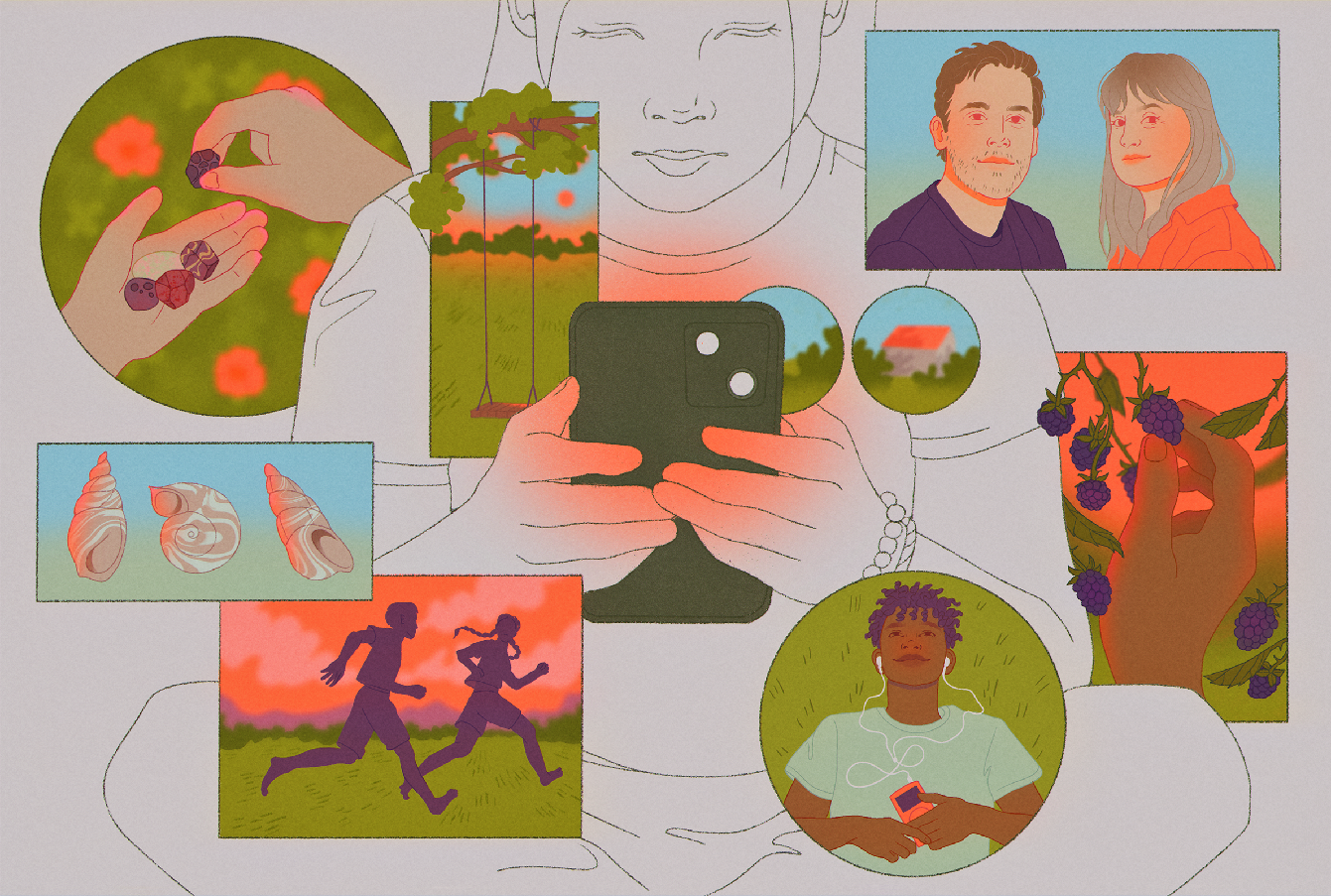
Illustration by Manon Louart for POLITICO
Daisy Greenwell and Joe Ryrie were headed to Davos to talk about screen-free childhoods at the invitation of philanthropist Margarita Louis-Dreyfus when the dam broke.
Rumors reached the married couple during their drive along the M25 motorway that Keir Starmer’s government — facing both a potential backbench rebellion and an embarrassing defeat in the Lords — was preparing to make a major online safety-related announcement.
The husband and wife are the co-founders and directors of Smartphone Free Childhood, a charity advocating for delaying children’s access to smartphones and social media. At just two-and-a-half years old, the group has in the last six months influenced the direction of online safety policy in the U.K. perhaps more than any other.
Advertisement
More than a dozen of Smartphone Free Childhood’s regional leaders were given a front row seat in the Downing Street press room to watch then Prime Minister Keir Starmer unveil a raft of new restrictions on children’s access to social media. Civil society groups like the Molly Rose Foundation and NSPCC, key stakeholders in the development of the U.K.’s online safety regime who had expressed more skepticism about the idea of a ban, weren’t invited.
Back in December 2025 the U.K. distanced itself from Australia’s social media ban for under 16s — but a month later, the political calculus had completely shifted.
Greenwell fielded messages and calls from her laptop in the passenger seat. “A lot of people were texting us saying we needed to do something right now,” she told POLITICO during an interview from her and Ryrie’s Suffolk home.

Sure enough, as the couple were going through security at Heathrow, a press release landed – saying the Department for Science, Innovation and Technology would consult on whether to raise the minimum age for social media. Ryrie and Greenwell were up until 3 a.m. their first night in Switzerland drafting responses.
“I got on stage [the next day] and I thought: ‘this is so relaxing, I can’t move, and no one can contact me,’” Ryrie said.
Humble(ish) beginnings
Smartphone Free Childhood is a grassroots movement that began almost by accident in February 2024, when a WhatsApp group Greenwell and her friend Clare Fernyhough set up for parents worried about their kids’ screentime habits went viral, reaching 1,000 people within 24 hours.
The group owes much of its success to people with the right skills being in the right place at the right time (frantic motorway journeys aside).
Greenwell spent a decade writing and commissioning features at The Times of London newspaper, then nearly two years helming media outlet Positive News. Ryrie ran his own branding studio for consumer startups.
Together, the couple knew a fair bit about storytelling. So after the WhatsApp group exploded, “we had some core skills that meant we were able to just throw ourselves at it,” Ryrie said. “At that time there was no funding, no nothing, but we just thought, ‘if we do a good enough job at this, then some funding will come, one way or another’ and it did.”
Advertisement
£20,000, to be precise, after philanthropist David Graham spotted the project and offered them an advance on winning the 2024 Tenacious Awards, which is run by Graham and provides funding and mentoring to campaigners and journalists.
That grant allowed Greenwell and Ryrie to call in their friend from the next town over, Nancy Waters, an editorial director who advised the likes of Chanel and Stella McCartney on content strategy. An old colleague of Ryrie’s, Joe Smith, joined as head of design, followed by marketing expert Andy Cockburn as head of grassroots growth.
“Straight from the off, we were like, ‘we have to treat this like a really professional operation,’” Ryrie said. “We didn’t want to be rattling tins for our community.”

Smartphone Free Childhood now receives funding from a mix of philanthropic donors, family offices, and foundations. Many of those sources remain anonymous — a funding transparency statement doesn’t give much away — but everything is “very much above board,” Ryrie said. There are “absolutely” red lines about who Smartphone Free Childhood will accept money from, he said. Tech companies, unsurprisingly, are a big no-no, as is “anything that is trying to influence us politically.”
Today, Smartphone Free Childhood’s network of WhatsApp groups boasts more than 100,000 members. Overseeing a community this size can be all-consuming — Ryrie admits he and Greenwell sometimes “argue until midnight about exactly how to message a WhatsApp group” — but its structure is mostly decentralized, a “crazy cobbled together thing” rather than top-down, micromanaged organization.
From their rural East Suffolk HQ (Greenwell and Ryrie’s family home) the team feed content once or twice a week into a central WhatsApp of 150 volunteers across the U.K., who then disseminate it across 168 regional WhatsApp communities housing 5,000 school-specific groups.
Advertisement
“Everyone was talking about how to make [social media] safe for your child, just assuming your child was going to be on it. The pent-up feeling from all the parents who joined was that thing of saying, ‘maybe we don’t have to accept this, it’s not good enough, it’s not getting safer, I’m not seeing any different in my children’s lives, we need something more urgent and we need it now,’” Greenwell said.
The groups are really “just people sharing tips and advice, experiences they’ve had,” Waters said. “Sometimes this seems like a bigger thing than what it actually is, because we have such an engaged wider community that are really active in doing things, it means that probably whoever you are, wherever you live, you’ve probably heard of SFC,” she added. “There’ll be something happening near you, no matter where you live, and we’ll probably know nothing about it.”
From group chat to campaign
What started as a hands-off community for parents transformed into a campaigning force that played a big part in Starmer’s decision to ban social media for under-16s — though it took time.
The core team was initially reticent to weigh in on policy debates — for a start, they had no public affairs experience, plus Smartphone Free Childhood’s emphasis has “always been on cultural change,” Greenwell said. She hadn’t even heard of the U.K.’s Online Safety Act when the original WhatsApp group ballooned; Helen Burrows, a former policy director at BT Group, soon came on board to mentor on the legislation’s dizzying ins and outs.
“Not because we didn’t think policy was going to help, just because we felt like we needed to build the public-facing support, and we wanted to help people immediately,” Ryrie explained.
Their first foray into politics ended in disappointment in March 2025 when Labour MP Josh MacAlister’s private member’s bill to ban smartphones in schools and raise the digital age of consent was watered down at the last minute by ministers, despite attracting significant cross-party backing.


“We got a strong sense that the Labour hierarchy were not interested in doing anything at that point,” Ryrie said. Smartphone Free Childhood wasn’t alone in “banging against closed doors,” as he put it: other civil society groups, like the Molly Rose Foundation, had long been pushing the government to address what they viewed as systemic weaknesses in the Online Safety Act, to no avail.
Then, ten months later, along came Elon Musk’s Grok.
The government’s wait-and-see approach to online safety became increasingly untenable after the scandal over sexualized deepfakes created by the AI assistant exposed long warned-about holes in the existing regime — and Smartphone Free Childhood spied an opening.
In the first few weeks of 2026, the dangers of social media — far beyond the specific issue of AI-generated intimate image abuse — were suddenly top of the political agenda. Conservative Leader Kemi Badenoch said her party would back a social media ban for under-16s and found an unlikely ally in Andy Burnham (who was still mayor of Greater Manchester at the time). Crusading peers threatened to force the issue via a vote in the House of Lords.
On the afternoon of Jan. 13, two days after Badenoch’s intervention, Greenwell, Ryrie, Waters, and Cockburn decided to rally the troops. Within just a few hours they’d produced an email template and circulated it across Smartphone Free Childhood’s WhatsApp network.
Advertisement
“We thought we’d get a good response. We thought we might get 50,000, 100,000 maybe if it went really well,” Ryrie said.
By Jan. 15, more than 100,000 constituents had contacted their MP urging them to back a social media ban (Smartphone Free Childhood said the final number reached around 250,000). Over the weekend 61 Labour backbenchers, including several select committee chairs, penned an open letter to Starmer telling him to “show leadership.” The government launched a consultation the next day.
Smartphone Free Childhood went from struggling to get in the room with ministers to hosting then-Technology Secretary Liz Kendall for an in-person Q&A session in April. At that session Kendall, who in December had expressed personal skepticism to MPs about the idea of kicking kids off their phones, seemed to have come around to the idea of a social media ban.
The charity’s strategy from the get-go, Ryrie said, has been to “build a big enough movement, and the politicians won’t be able to ignore you.”
Shaping the future
While Smartphone Free Childhood campaigned in favor of a ban, other influential online safety groups, including the Molly Rose Foundation, opposed one, arguing that it risked letting Big Tech companies off the hook for making their platforms safe by design.
But Smartphone Free Childhood objects to the narrative that civil society is split along the line of “people who want to ban it” versus “people who want to make it safe,” Ryrie said.
“We didn’t really see it as that black and white,” he explained. “Probably where we differ is that we were always saying that there needs to be a hard cut off and a reset” akin to a “product recall.”
He added that they are “fairly comfortable” with the prospect of children being able to access social media in the future, provided companies demonstrate that their services are safe — i.e. “100 percent educational” and “non-addictive.”
Advertisement
Britain’s new Prime Minister Andy Burnham restated his support for a social media ban at a Labour hustings before taking office. Still, the details — starting with the definition of “social media” — need to be worked out, and Smartphone Free Childhood intends to stay active in influencing policy.
Rather than pursue a blanket ban, the U.K. could take a leaf out of Canada’s proposed Safe Social Media Act, which looks to age-restrict platforms unless and until they have “adequate safeguards” in place to protect children — an alternative compliance pathway that may (at least in theory) encourage companies to clean up their act.
There are signs the respective “camps” might unite around this approach. Towards the end of the consultation period Smartphone Free Childhood worked with more ban-skeptical child safety organizations to agree the shared principle of “safety before access.”
Whatever happens, the team is optimistic that Smartphone Free Childhood will be given a seat at the table going forward. “We’re getting a sense that the establishment in that [civil society] space is sort of warming to us,” Ryrie said. “Whether or not they agree with the exact objectives we’ve had or the approach we’ve taken, they can see that we’ve had some impact,” he said. “Now it’s more like, ‘OK, you’re here to stay,’” Greenwell added.