


Europe’s 27 leaders to take on AI — finally
BRUSSELS — European leaders are set to confront artificial intelligence as a defining strategic and security challenge, with plans to hold their first dedicated discussion on it before the end of the year.
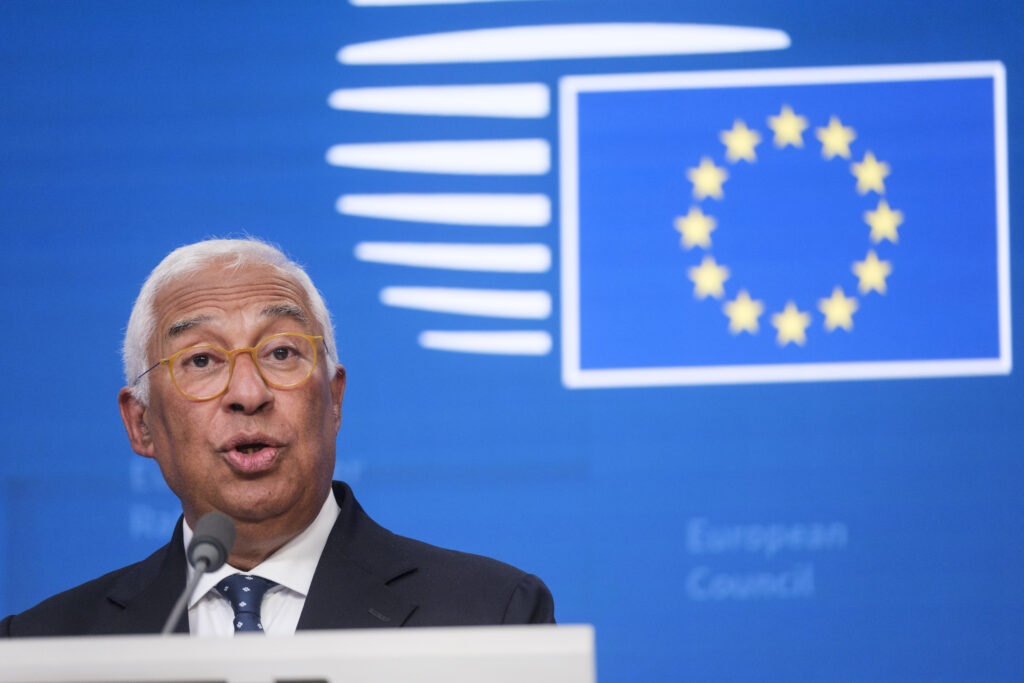
European Council President António Costa intends to schedule the debate among the heads of the 27 member countries at one of the EU’s three remaining summits this year — on Oct. 15, Nov. 13 or Dec. 17 — his office confirmed to POLITICO. Preparations are already underway, although the agenda has yet to be finalized.
The move reflects a growing recognition in Brussels that AI has outgrown the confines of digital regulatory policy, increasingly seen as an urgent question of economic competitiveness, national security and geopolitical influence — one that now demands the attention of Europe’s presidents and prime ministers.
The commitment to a first-ever AI roundtable of national leaders is a sign that the EU is mobilizing on a key issue, but some might question why it took so long.
The rise of powerful cyber-capable models that can exploit software vulnerabilities has turned AI into a topic of national security concern, focusing the attention of global leaders, technologists and ordinary citizens alike.
But the “who” and “how” questions around its regulation remain largely unanswered as both the U.S. and China jostle for technological supremacy.
Chinese leader Xi Jinping called for greater AI cooperation in a landmark speech on Friday, a day after a coalition of more than two dozen countries , including major players from the Global South, gathered in Shanghai to agree to let China lead the way in how the technology is developed. Meanwhile, last week, Google DeepMind founder Demis Hassabis called for the establishment of a U.S.-led regulatory body to set standards for testing AI models.
The European Council, which consists of the government leaders of its 27 member states, will now also have its say. Until now, digital affairs rarely featured on the agenda of the leaders’ meetings, and when it did, it was mostly as part of wider discussions around Europe’s economic competitiveness.
Scheduling AI as a separate topic shows the subject is gaining prominence, but the timeline still has to follow the EU’s machinery. Experts regularly warn that just a few months is a long time in AI development. One global AI safety study said early this year that the complexity of tasks that AI models can take on doubles every seven months.
Geopolitical turbulences, like the war in Iran, have also drowned out other topics at gatherings of EU leaders in the first half of this year.
Getting the message
Pressure has been growing in recent months for the EU’s top political body to sink its teeth into the topic.
In late June, dozens of lawmakers, led by Dutch Greens European Parliament lawmaker Reinier van Lanschot, called on Costa to “convene a special European Council summit dedicated to artificial intelligence as soon as possible.”

AI is “the most consequential structural transformation of our era” but currently “left without the room it requires,” the letter, seen by POLITICO, said. They urged Costa to take a comprehensive look at the topic, covering “innovation, security, ethics, societal, environmental, and geopolitical dimensions.”
More than 100 experts backed up that call last week, in a report they penned on frontier AI at the request of the European Commission. They pushed to “[elevate] frontier AI to a priority at the highest political level.”
“Sustained attention at the highest level was described as a precondition for implementing the other recommendations,” the report stated. One of the recommendations was an accelerated build-up of AI compute power across the bloc.
Apparently, Costa got the message. “I will propose a discussion on this subject at one of our next European Councils,” he posted after a July 2 meeting with French Economist Philippe Aghion. He argued that the development of AI “must go hand in hand with ethics and respect for our digital sovereignty and our social model.”
Costa met last week with a group of “high-level European experts and practitioners,” among them the top lobbyist of French AI darling Mistral, Audrey Herblin-Stoop.
After the meeting, he said that the EU “must strengthen its digital sovereignty, facilitate investment, and promote lifelong learning,” while also “protecting minors and safeguarding our values.”
EU leaders have dipped in on artificial intelligence policy in the past, but mainly through the lens of simplification. Several leaders weighed in on a recent effort to roll back or delay some of the provisions of the EU’s Artificial Intelligence Act.
In June 2025, Swedish Prime Minister Ulf Kristersson was one of the first EU leaders to call for a pause on a key part of the EU’s AI rules, while Belgian Prime Minister Bart De Wever’s book called out European “overregulation” in the field of AI.
And most notably, German Chancellor Friedrich Merz made a last-minute push during the negotiations in April on the EU’s AI simplification package to secure a carve-out for industrial applications.