EU and China reopen trade talks as Brussels hardens its stance
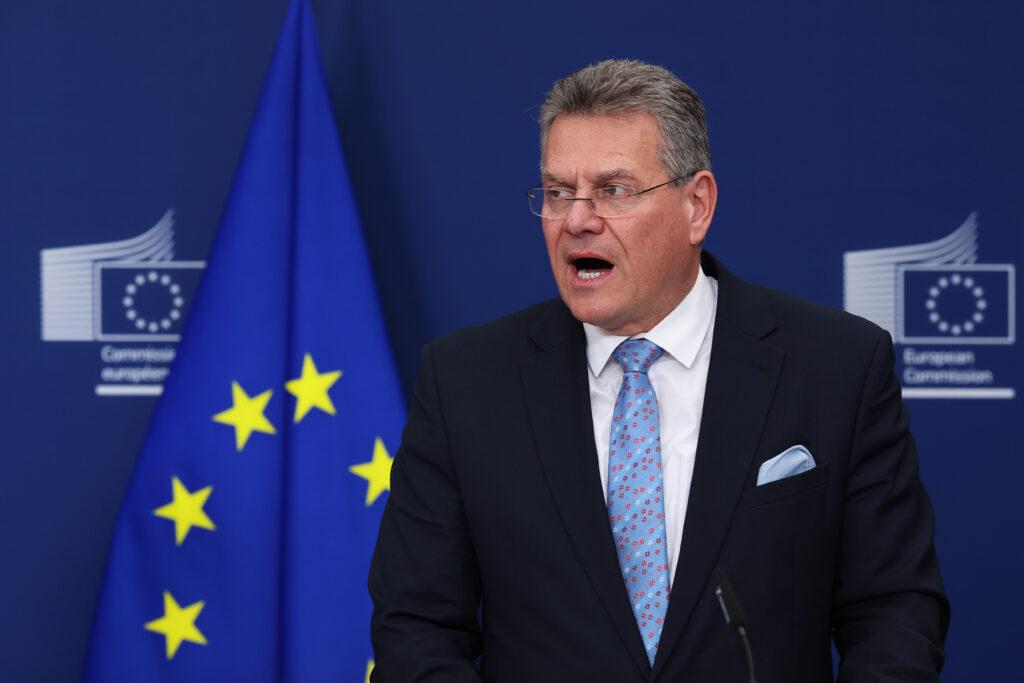
BRUSSELS — When EU Trade Commissioner Maroš Šefčovič meets his Chinese counterpart on Monday, he will hope to demonstrate that, this time, Europe means business.
Šefčovič hosts Commerce Minister Wang Wentao in Brussels armed with a mandate from EU leaders to strengthen the bloc’s trade defenses against soaring Chinese exports. As the two sides re-engage after a lengthy standoff, Brussels wants that leverage to push Beijing toward meaningful dialogue — and not an all-out trade war.
EU leaders, meeting earlier this month, signaled they were ready to back European Commission President Ursula von der Leyen’s more confrontational stance. Still, Brussels is seeking a negotiated solution in which China reins in its industrial overcapacity and relies more on domestic demand.
“Dialogue is important — but it has to deliver,” said one EU diplomat, granted anonymity to speak freely, after the meeting of EU leaders. “The status quo won’t do.”
China’s trade surplus with the EU reached €360 billion in 2025 and is already running 10 percent above last year’s pace. The Asian economy now manufactures nearly a third of all goods produced globally.
That export glut is putting huge strain on European manufacturing — from automakers to chemical producers and machine builders. Recent data shows that in April nearly one out of every 10 cars purchased in Europe was from a Chinese brand, double the share from a year ago.

Europe’s biggest carmaker, Volkswagen, reportedly plans to slash up to 100,000 jobs and close four plants in Germany as Chinese competition and the costly transition to electric vehicles cut into margins.
President Xi Jinping has called manufacturing “the foundation of the real economy” and has shown no inclination to address what is seen in the West as China’s excess production and deficient demand.
Two-track approach
The EU executive is pursuing a two-track approach on China, Berlaymont officials told POLITICO. The first is to beef up the EU’s trade defenses. It has already taken steps in this direction, with proposals to favor local bidders in public procurement and to shut Chinese tech champions like Huawei out of strategic telecommunication networks.
Still, Brussels is leaving the door open to talks — hence the ministerial visit.
Chinese and European officials discussed setting up a trade and investment consultation mechanism at a lower-level meeting earlier in the month. Two Commission officials, granted anonymity to speak freely, indicated that the EU’s executive is keen on the idea.
What shape the mechanism might take, and how binding it would be, has yet to be decided. A previous “EU-China High Level Economic and Trade Dialogue,” launched in 2008, achieved no lasting breakthroughs.

Any workable solution would require sweeping changes to the EU-China trade relationship that go beyond dialogue. The thinking in the Berlaymont is that China needs to understand that the status quo is unsustainable and that it faces a choice between a negotiated agreement and a potentially damaging confrontation.
Šefčovič is already preparing new trade defense tools, such as a “diversification instrument” that would require European companies to have at least three suppliers of critical inputs to ease reliance on China. New sectoral import quotas, which would limit foreign competition in industries like chemicals or machine tools, are also in the works.
According to a second EU diplomat, when von der Leyen presented her strategy to EU leaders in Brussels this month, she didn’t rule out activating the Anti-Coercion Instrument, the EU’s trade “bazooka” that allows the bloc to restrict access to its market in response to economic coercion.
While the EU executive has received a solid mandate to explore countermeasures, it remains to be seen whether it has sufficient backing among member countries to use them. Spain, for example, has courted Chinese investment and opposed retaliatory action. And designing new instruments will take months, if not years.
“The Chinese think we’ll blink — that’s what they’re betting on,” said a third EU official, adding that the EU needed to show Beijing that talk was no substitute for action.
Beyond trade
Much will depend on whether the bloc’s largest economy, Germany, swings behind the harder line.
Berlin has traditionally been reluctant to take on China, its top trading partner, but this month Chancellor Friedrich Merz suggested that Beijing needed to revalue its currency.
A Goldman Sachs report published in May argued the renminbi is undervalued by 20 percent against the U.S. dollar. A revaluation would make Chinese exports more expensive and give Chinese households more purchasing power.
Brad Setser, an economist who has long tracked China’s external surpluses, said any serious currency bargain would have to happen above the level of trade officials — with finance ministers, central bankers and ultimately leaders involved.
“The ultimate ask is for China to be richer, and have more external purchasing power,” said Setser, a senior fellow at the Council on Foreign Relations. He admitted that this would likely result in pain for Chinese businesses linked to a slowdown in exports.
China’s state-run paper, the Global Times, has attacked calls for a settlement modeled on the Plaza Accord — the 1985 agreement between the U.S., Japan, West Germany, France and Britain to engineer a weaker dollar and stronger Japanese yen and German mark — which it saw as the cause of Japan’s decades-long economic stagnation.
French President Emmanuel Macron persuaded China to take part in a call with other major economies ahead of this month’s G7 summit in Evian, France, to discuss “macroeconomic imbalances.”
The main outcome of the outreach session was to call for debate at the G20, a broader intergovernmental group that includes China whose finance ministers and central bankers will meet in August. It is in forums like this that the wider rebalancing discussion will need to happen if Monday’s Brussels meeting is to avoid becoming just another talking shop.
Camille Gijs contributed reporting to this article.