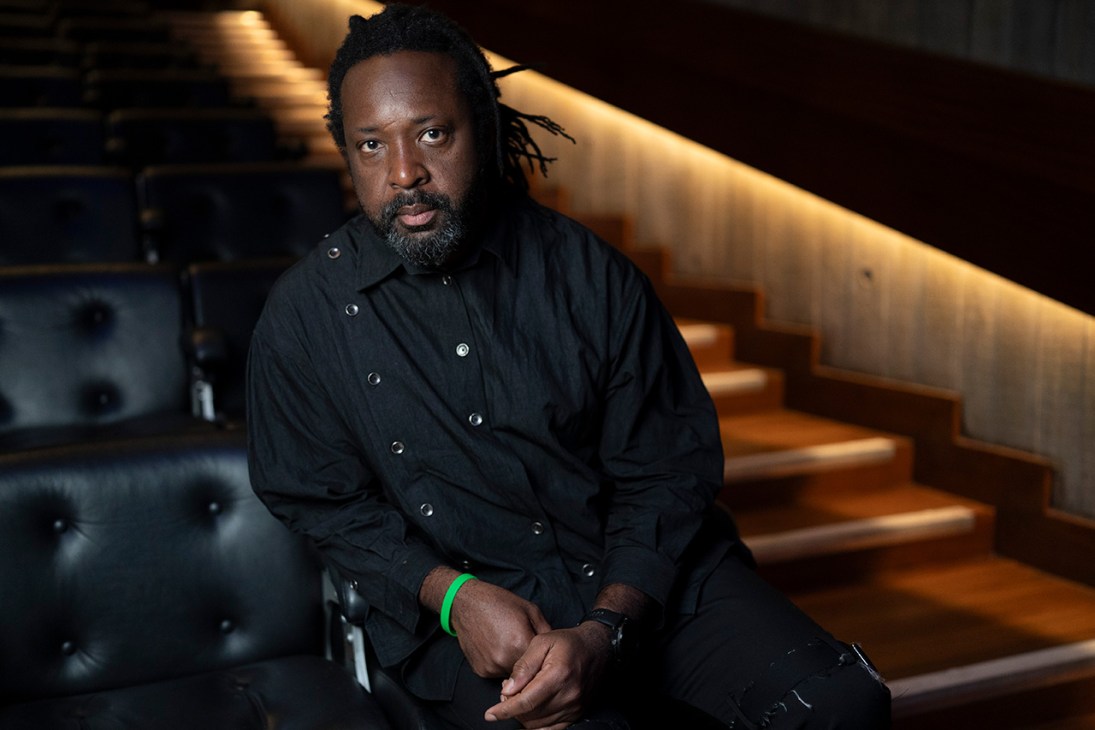
‘Disappearing is an an agreement to silence’: Marlon James on ‘The Disappearers’ and the Booker Prize
Marlon James grew up in Kingston, Jamaica, and nearly gave up writing altogether after his first novel was rejected more than 78 times. He went on to become the first Jamaican writer to win the 2015 Man Booker Prize for A Brief History of Seven Killings and followed it with African fantasy novels Black Leopard, Red Wolf and Moon Witch, Spider King. His latest book, The Disappearers, revisits Jamaica and has been placed on the shortlist for this year’s Booker Prize.
The novel begins in Kingston in 1988, where eight gay men come together to rehearse John Herbert’s Fortune and Men’s Eyes, a groundbreaking play about sex, identity and power inside a men’s prison. Their secret rehearsals give them a place to be themselves. Then a homophobic mob attacks them. One man is killed, others are badly injured and two later disappear. The novel follows what happens to the survivors over the years that follow, through sex, revenge, Aids, exile and the search for the men who vanished.
James joined Monocle’s Georgina Godwin on Meet the Writers to discuss the book, James Baldwin’s influence and how to write about gay sex. This conversation has been edited for clarity and length.

Tell me where ‘A Brief History of Seven Killings’, which won the Booker Prize in 2015, began for you.
It began for me in 1991 when I had just left college. There was an article in Spin magazine that Timothy White wrote, where he presented new information about what happened to the boys who tried to kill Bob Marley. Most of them were killed within months but the ones who survived went on to become pivotal members of the crack trade. I was fascinated with that story, largely because there are so many holes in it. I’m attracted to the holes because fiction can slip in and fill them. Typical colonial history cut out all the incriminating bits and I saw an opportunity to come in and build an alternative history. That’s how A Brief History of Seven Killings came about.
Your new book, ‘The Disappearers’, is full of fantastic literary references. One of those is James Baldwin. When did he first become important to you?
Baldwin is a centring presence. He remains our smartest model of resistance. He remains our smartest model of inquiry. One of the things that happen a lot in America is that somebody will drop a bad-faith argument and we just respond with outrage: “How dare you say that?” Baldwin went beyond that. He was always interested in justice. It’s easy to forget that he was always optimistic. He actually did believe in the best of human nature, despite being constantly reminded of the worst. And he died convinced that the only way we can do this is together.
Your partner, Nicholas Boggs, suggested John Herbert’s ‘Fortune and Men’s Eyes’, which is the play that the men rehearse in ‘The Disappearers’. Baldwin actually produced it himself in Turkey. What did you find within the play when Nicholas gave it to you and how did it become the centrepiece of the novel?
It’s funny. My editor has the only copy of the first draft when it was still a gay version of Pygmalion that I called My Fair Brady. I thought it was great. I made lots of cool gay jokes where Elijah’s father shows up and they go, “Is he your father or just a daddy?” and things such as that. It was a lot of fun writing but it was too distant from what happens next, to the point where it made it seem contrived. [It was as though I was trying to make the story] as pretty as possible before I made it ugly. Not that I’m trying to make everything ugly but I think that the best surprises in a novel are when, in hindsight, you realise how inevitable they always were.
The story gets incredibly ugly. So the inciting incident, if you like, is a homophobic attack on these men who are rehearsing the play. You’ve called it the story that you were never allowed to live. What do you mean by that?
I’m not talking about the atrocities and the tragedies, even though that’s a part of it too. I didn’t come out officially until I was 44. Looking not at the suffering of people like me but instead at the triumphs and the day-to-day survival, there is an aspect of living that I have not experienced.
After interviewing so many men – men who are married to men, men who have been living in domestic partnerships for 20 to 30 years, men who have experienced heartbreak – the stuff that we consider part of the fabric of straight life, I realised that it was gay life: gay men get heartbroken too. There was a richness to the existence that includes the good and the bad and the questionable that I didn’t experience.
You interviewed all these people and they were telling you about what it was like to be gay in Jamaica in the 1980s.
I never met the people [involved in the incident] but I did meet a Jamaican lawyer living in Toronto, who confirmed that it happened. The guy who was blinded lives now in Spain. I didn’t need any more information because I didn’t want to intrude on anybody’s lives. It was enough for me to know that the gravity of this novel was true.
I am somebody who has been gay-adjacent my whole life but for the first time it made me really understand gay sex; how, for many gay men, shame is a very close companion of pleasure. You write about this incredibly well but it’s also really funny.
Gay sex is hilarious. I find few things more ridiculous than gay sex. The thing about writing gay sex is that you have to hit a balance between not overselling or underselling the scene. If you oversell the scene, you’ve written porn. If you’ve undersold the scene, you’ve written an autopsy. You have to go somewhere in between, [leading with] desire. If you add intimacy and explicitness, you get a sex scene. But if you subtract one, you get porn.
What about the shame?
Even the characters who are defiant are just doing an inverse version of shame. Shame is still the context, whether you are explicit or hiding it, because shame [is not just] attached to homosexuality, it’s attached to sexuality. In Jamaica, we don’t have a homosexuality crisis – we have a sexuality crisis. We have a homosexual-identity crisis. We have a masculine-identity crisis and it plays out in the ways in which sexuality and shame go together.
The book takes several different points of view and one of the ways you write it is from the perspective of the perpetrators of this terrible attack. Tell me about going into the heads of those people.
That was hard. It’s no coincidence that it’s the shortest section in the book. We sometimes let mobs off the hook by saying “I didn’t know what I was thinking”, or else they become this lumbering beast. The thing about dissecting the mob is that you identify them and you expose them. I’m not exposing anybody. These are not real people but they could have been.
Let’s talk about the gutter queens – the transvestites living in the gutters and sewers beneath the city. They’re looking after Aids victims.
This was the time when Aids was prevalent. One of the benefits of having a writer as a partner is that he can point out my short sightedness. I said, “I don’t think that Aids is going to appear in my book.” He said, “Aids appeared everywhere.” And then I came to Jamaica [and I asked my sources]: “Tell me about Aids.” And some of those men had been waiting 20, 30 or 40 years to talk about it. One of the ways in which disappearing happens is just an agreement to silence.
It’s now 11 years after you won the Booker. ‘The Disappearers’ has put you back on the shortlist. ‘The New York Times’ – you must be so sick of people quoting this at you – said that this masterpiece is the ‘novel of the decade’, if not the century.
It’s really extraordinary. I’m like, you guys know superlatives.
What does it feel like being back on that list and getting all this effusive praise?
It is still surreal because the book is still so new. The difference between this and the first novel was that [the first one] happened a year after the book came out. I had already been through the hype, the cycles, the best-of lists. By the time the Booker came around, I was already exhausted by all of that. This [time it’s] everything all at once and it is overwhelming.
Before we close, you spent part of your youth trying to disappear. I wonder what you were most wanting to put back into the record with this book about you – or perhaps about those men.
The one thing that they all have in common, including those who disappeared or were gone, is that they all loved life until somebody told them not to. We have to be better brothers, sisters, parents, friends, schoolmates and school principals because there’s nothing like seeing somebody whose joy has been blown out. I want to think that we’re all responsible for everybody’s joy – not to sound hippie or anything but we are accountable to each other. That’s something that we should remember.
The post ‘Disappearing is an an agreement to silence’: Marlon James on ‘The Disappearers’ and the Booker Prize appeared first on Monocle.