Tokenized Markets Face the Liquidity Test
Deeper liquidity, infrastructure and market structure are still needed to support broader use of tokenized assets, according to executives from Fidelity Investments, Robinhood, Alpaca and Cahill.
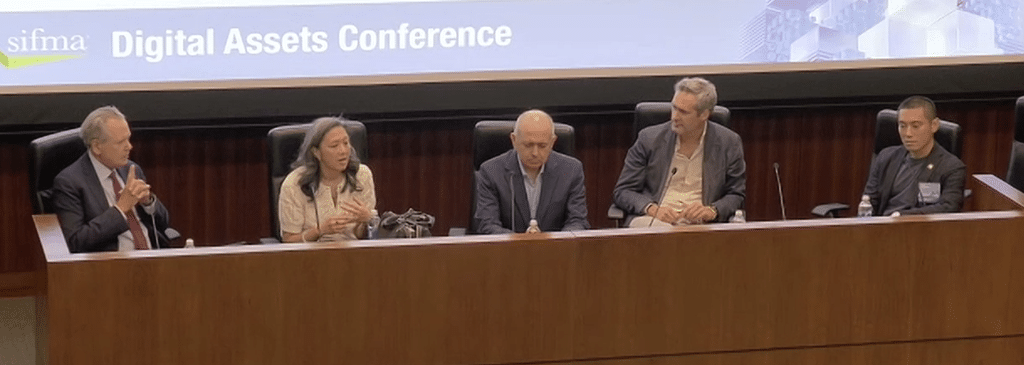
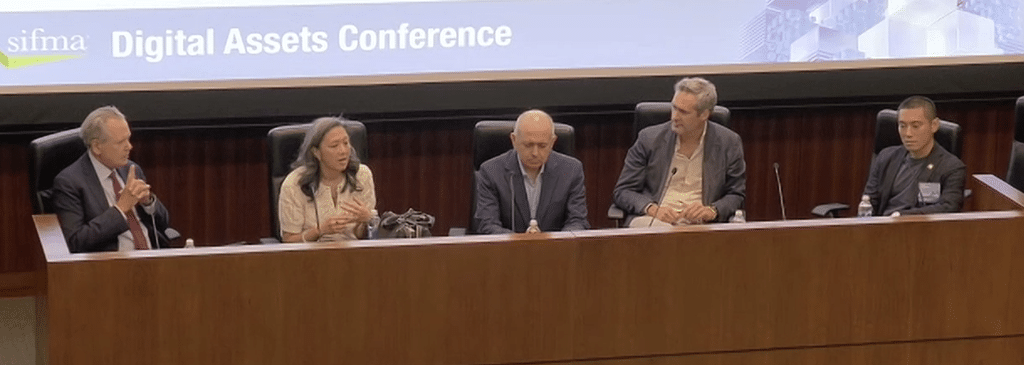
Speaking during SIFMA’s Digital Assets Conference on September 23, they discussed institutional participation, interoperability with traditional markets, 24/7 trading and new ways to distribute investment products.
Cynthia Lo Bessette, Head of Fidelity Digital Asset Management at Fidelity Investments, described the market as not yet having a “minimum viable ecosystem.”
The industry has demonstrated that assets and their ownership characteristics can be represented on-chain, she said, but other pieces of the market still need to develop, she said. “How do we ensure that those tokens are tradable? That there is liquidity to be able to allow for this idea of 24/7, and how do we price that liquidity?” Lo Bessette said.
She pointed to price discovery, derivatives that allow for hedging and liquidity that enables market makers to operate at scale as parts of that ecosystem. “They need to exist on chain so that we now will ultimately have one market,” she said. “It won’t be a tokenized on-chain market and a traditional market.”
Zeke Vince, Global Head of Business Development for Institutional Crypto at Robinhood, also focused on liquidity. Robinhood launched stock tokens on July 1 and has around 200 active tokens, he said. While crypto-native market makers currently provide most of the liquidity, Vince said traditional high-frequency market makers are moving into the market. “This is the first time I’ve actually seen market makers who were from the traditional side sprinting to get into a market to provide depth,” he said. “These cycles are compressing. I think this market will be deep and liquid faster than it will be available onshore.”
Yoshi Yokokawa, Co-Founder and CEO of Alpaca, also identified liquidity as important and discussed the need to connect tokenized stocks with their traditional counterparts. “Bridging those things and creating interoperability creates better liquidity,” he said.
Yokokawa said the ability to redeem tokenized stocks into traditional shares can provide institutions with a way to hedge. He also pointed to questions around pre-funding and the difference between tokenized markets and traditional markets operating on T+1 settlement. He drew a distinction between different types of institutional participants. Market makers may enter when there are arbitrage opportunities and infrastructure that allows them to hedge, while asset managers have different requirements, including custody infrastructure for holding tokenized assets, he noted.
Demand for 24/7 Trading
The panel also examined how demand for tokenized securities could relate to the move toward round-the-clock trading. Vince said he expects demand for U.S. assets outside the country to develop before 24/7 trading in the underlying traditional market. “I think 24/7 is going to come after. I think this distribution and the demand for, for us, U.S. assets offshore is going to drive the demand that is going to drive market makers to hold the inventory.”
Yokokawa also pointed to demand outside the U.S. He said access to U.S. capital markets is not as easy in many other countries and argued that tokenization can provide another way for investors to own those assets.
Lewis Rinaudo Cohen, Partner at Cahill, said technology could also affect demand for continuous trading. He compared the development of agentic trading with the way smartphones equipped with GPS made services such as Uber possible. “We now have technology through the use of agentic trading that all of a sudden makes 24-hour, seven-day-a-week trading much more practicable,” Cohen said.
For asset managers, Lo Bessette said the considerations extend beyond trading hours. She said Fidelity looks at whether tokenization can provide better access to investment opportunities and additional utility for investors. One example she discussed was the ability for an investor to use tokenized portfolio exposure as collateral in another on-chain application without selling the underlying investment.
Institutions also need their own infrastructure to support those activities, she added: “Before we get to 24/7, there is an investment in infrastructure, operating infrastructure, that we need to make within our own systems in order to be able to custody these tokens and be able to trade these tokens.”
New Distribution Models
The discussion also turned to how tokenization could affect the distribution of investment products. Lo Bessette pointed to on-chain structures known as “vaults,” which she said can provide investors with access to professional investment management while allowing more flexibility in how investments are accessed and moved. “That I think is the beginning of what the future of access and wealth management is going to look like,” she said, adding that this does not mean intermediaries will disappear, but that the interfaces through which investors access products and customer services can evolve.
Vince described decentralized finance as “a new distribution channel” and said tokenization could allow firms to offer existing investment strategies to different groups of investors. “If you have an ETF that’s not taking off, but you think it’s so good, maybe I tokenize it and I give it to this entirely brand new demographic,” he said.
He also pointed to private markets and fractional ownership as an area he expects to develop. “Buying small pieces of private assets, I think it’s going to be definitely the trend,” Vince said.
Cohen also raised questions about how existing regulations apply when tokenized securities can move across borders. He said U.S. rules governing offshore securities transactions were developed when markets were more geographically separated. He specifically pointed to Regulation S and the way securities issued outside the U.S. can now move between jurisdictions much more quickly. “The internet and tokens know no bounds,” he said.
Cohen said the issue requires policymakers to consider where U.S. jurisdiction begins and ends rather than relying on technology alone to address differences between markets. He also highlighted anti-money laundering, sanctions and know-your-customer requirements in discussing liquidity in secondary markets. Requiring individual investors or institutions to go through separate whitelisting processes can make it more difficult to create network effects, he said. “We have to work together to explain how we can have robust BSA compliance, sanctions compliance, which is absolutely critical, while at the same time not having just an impossible non-network effect,” Cohen said.
Focus on Investor Use
Asked what market participants should prioritize as tokenization develops, Lo Bessette said firms should start with the utility a product provides to the end investor. “Technology is a wonderful thing. Markets are still markets. Finance is still finance,” she said.
She said firms need to identify what a tokenized product allows an investor to do differently from products already available. “If we can’t think of something that’s different than what we currently offer, then it’s just technology innovation theater,” Lo Bessette said.
Vince said he expects fractionalization, particularly the ability to buy smaller pieces of private assets, to be a major area of development over the next two years.
Whereas, Yokokawa said tokenization can provide investors, including those outside the U.S., with another way to access assets. “Tokenization basically creates another path for the people to own assets,” he said.