



Why Meta’s $18B settlement may hit YouTube harder
Meta Platforms has agreed to an approximately $18 billion settlement amount that can change how millions of children use Instagram and Facebook.
And Wall Street is already considering whether resolving the case could clear the way for Meta’s next wave of products.
The agreement imposes some of the most significant restrictions yet on how a major social media company engages with young users. This includes daily time limits, overnight blocks, and restrictions on notifications during school hours.
It follows years of allegations from state attorneys general that Meta designed Facebook and Instagram with features intended to keep young users engaged.
All this, while downplaying potential risks to their mental and physical well-being.
Meta denied wrongdoing.
The settlement was announced on Aug. 26 and has since received court approval, putting the new requirements into effect across participating states and territories.
Meta said the agreement involves approximately $18 billion in payments distributed over 10 years.
About 70%, or roughly $12.7 billion, will go to participating states over the decade. The remaining roughly $5.3 billion is contingent on TikTok and YouTube adopting specified youth protections and making matching payments.
But the size of the settlement is only part of its significance.
Regulators are targeting the mechanics that keep children scrolling.
TheStreet/Pew Research/Attorney General Meta announcement
Instagram and Facebook will work differently for teens
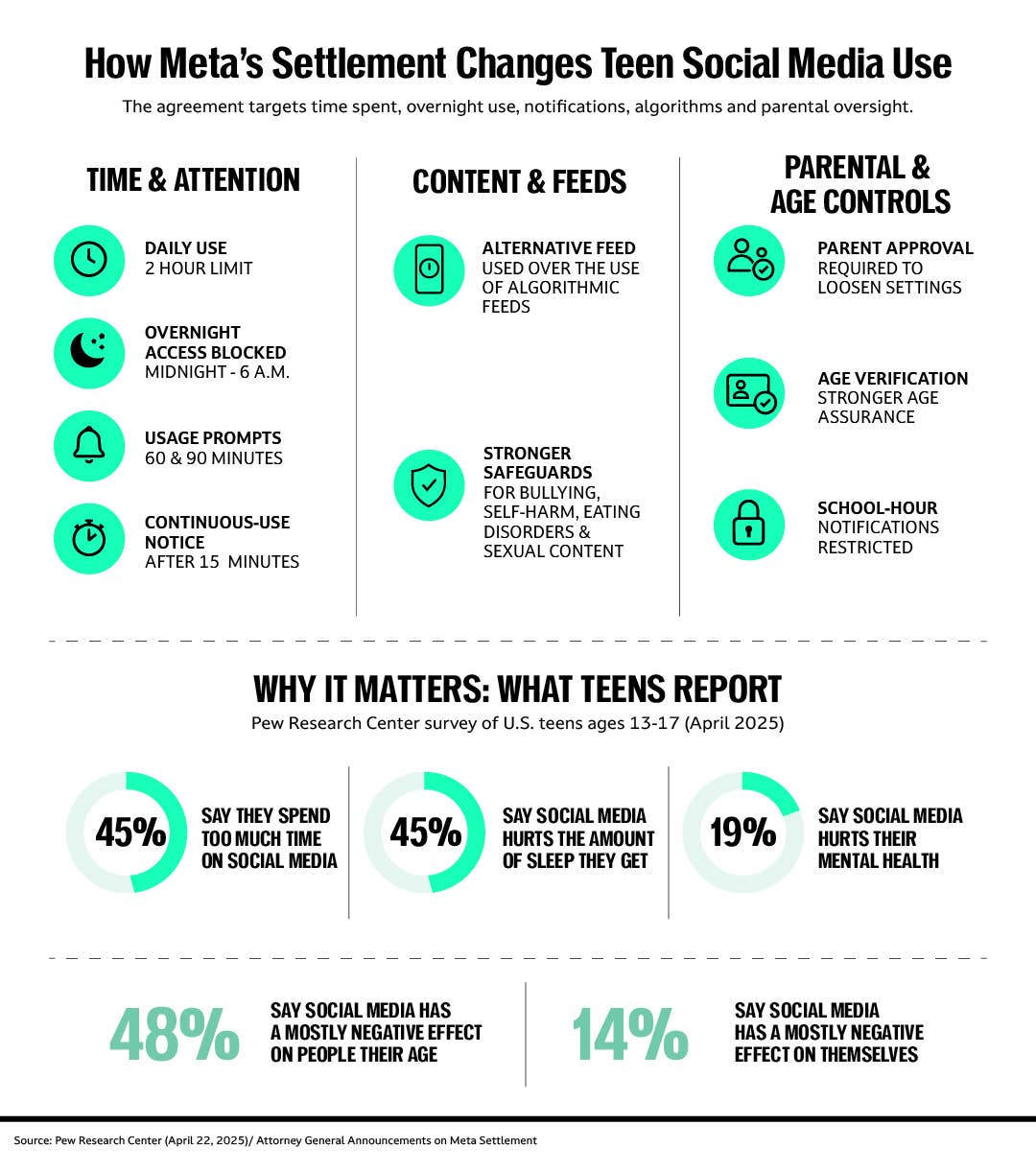
Users under 18 will now face a default daily limit of two hours across Facebook and Instagram, according to the new guidance.
Time spent scrolling across both platforms counts toward the same limit, including time spent across multiple accounts when Meta detects they belong to the same user. Teens will only be able to turn off that restriction with parental permission.
Meta will also block teens from viewing or posting content between midnight and 6 a.m., although direct messaging will remain available.
During school hours, from 8 a.m. to 3 p.m., push notifications will be muted by default, except for direct messages and account-security or safety alerts.
Meta will also interrupt extended use. Teen users will receive prompts every 15 minutes of continuous activity, and additional prompts when cumulative daily use reaches 60 and 90 minutes.
Other provisions focus on what young users see and how content reaches them.
Teens will be able to set a non-algorithmic feed as their default, meaning content will not be personalized by Meta’s recommendation systems.
Related: Meta just turned teen safety into a competitive advantage
Teen users will be able to disable autoplay, while likes and reactions on posts will be hidden by default.
Meta will also block teens from using cosmetic surgery and extreme makeup filters.
The company must strengthen its age-assurance systems to better identify users under 13 and teen accounts that claim to be adults.
Meta said it will maintain age-appropriate content restrictions and protections to limit potentially unwanted contact from adults.
Many of these measures are built on Teen Accounts, which Meta introduced in 2024. The difference now is that the protections are part of a legally enforceable agreement.
Wall Street sees the settlement as a potential clearing event
The agreement is also beginning to draw attention from investors for what it could mean for Meta beyond child safety.
Morgan Stanley analyst Brian Nowak called the teen-engagement settlement a “clearing event” in a note on Monday, Aug. 31.
Nowak said youth-engagement ceilings like those included in the agreement could ultimately pose a greater headwind for Google’s YouTube than for Meta.
One reason could be that Meta has several platforms, with viewing restrictions spread across them. Meanwhile, for YouTube, long viewing sessions are vital to its business model and can directly pressure engagement.
He also questioned whether resolving such a major legal overhang could accelerate Meta’s product pipeline, drawing a comparison with Alphabet’s burst of product launches last year.
Nowak maintained an Overweight rating and $775 price target on Meta shares.
The idea adds another dimension to a settlement largely framed around platform safety. Large lawsuits and regulatory battles can affect how aggressively technology companies roll out new products.
Removing one source of uncertainty could shift investor attention back toward Meta’s pipeline, particularly as the company continues to invest heavily in artificial intelligence.
The deal will still carry a high near-term cost.
Meta said it expects to record approximately $10 billion in legal expenses during the third quarter related to the agreement. That charge was not included in the expense range Meta provided during its second-quarter earnings call, although the company said its other guidance ranges remain unchanged.
Meta wants TikTok and YouTube to follow
The agreement is unusual because a major portion of Meta’s potential payment depends on what its competitors do next.
Meta is pushing for the settlement’s protections to spread beyond Facebook and Instagram.
The agreement is structured to encourage YouTube and TikTok to adopt comparable teen-safety measures.
Meta said roughly $5.3 billion of the approximately $18 billion settlement is contingent on those platforms adopting measures, including:
- One-hour daily limits
- Nighttime restrictions
- Age-assurance requirements
Meta has argued that restrictions on one service have a limited effect if teens can simply move to another app, and has publicly urged YouTube and TikTok to adopt the same protections.
If YouTube and TikTok join the framework, Meta’s own restrictions would also become tougher, including a shift from a combined daily limit of two hours across Facebook and Instagram to a one-hour limit for each platform.
Nighttime restrictions would expand from midnight through 6 a.m. to 10 p.m. through 7 a.m.
The current Time Limit and Night Mode requirements initially run for five years. If industry peers join the framework, those requirements would extend to 10 years.
That makes the agreement both a settlement with Meta and an attempt to pressure the broader social-media industry into adopting similar standards.
So far, the two companies have not made an official statement in response to Meta’s request.
Teens report both benefits and costs
Research on social media and youth mental health does not show that social media use is uniformly harmful.
The American Psychological Association has said outcomes depend on factors including a young person’s circumstances, vulnerabilities, the content encountered, and how platforms are used.
But researchers continue to raise concerns about unrestricted use, social comparison, recommendation systems, and features that make it difficult to disengage.
More Meta:
- Meta sent a warning to its glasses pranksters
- Meta layoffs take disturbing turn in new lawsuit
- Meta business model in trouble from $1.4 trillion lawsuit
Similar concerns were also raised in the Meta lawsuit. A 2025 Pew Research Center survey found 45% of U.S. teens said social media hurt the amount of sleep they got.
Another 40% said it hurt their productivity, while 22% said it hurt their grades, and 19% said it negatively affected their mental health.
Separately, 45% said they believed they spent too much time on social media, up from 36% in 2022.
But the experience is not uniformly negative. Nearly three-quarters of teens said social media made them feel more connected to friends, while 63% said the platforms gave them a place to show their creative side.
That contradiction helps explain why regulators are increasingly focusing on platform redesign rather than trying to prevent teenagers from using social media altogether.
Meta is part of a broader child-safety crackdown
Meta’s settlement comes amid growing legal pressure across the technology industry over how companies treat younger users.
Just days before Meta announced its agreement, TikTok and its parent company, ByteDance, agreed to pay $400 million to settle federal litigation alleging the companies violated the Children’s Online Privacy Protection Act, or COPPA.
The Justice Department described the agreement as one of the largest recoveries ever obtained in a COPPA case.
In 2019, Google and YouTube paid $170 million to resolve allegations that YouTube illegally collected children’s personal information without parental consent.
At the time, it was the largest COPPA penalty ever imposed.
Governments are tightening rules for social-media users
Meta’s settlement also arrives as governments across the world are imposing broader restrictions on how children use social media.
Australia has gone further than the Meta agreement.
Since Dec. 10, 2025, major platforms, including Facebook, Instagram, TikTok, Snapchat, YouTube, X, and Reddit, have been required to take reasonable steps to prevent Australians under 16 from maintaining accounts.
In a similar move, the U.K. government has also decided to ban social media for users under 16, with the first set of regulations to take effect by the end of 2026.
But these new changes will be implemented in spring 2027.
Several U.S. states have also enacted laws requiring age verification, parental consent, or additional safeguards for younger social media users, although many of those measures face court challenges.
The trend shows that regulators are increasingly moving beyond rules governing what content children can see. They are also questioning whether the same features companies use to maximize engagement should operate the same way for teenagers as they do for adults.
Related: Mark Zuckerberg sends shocking message to Meta employees