Who’s Buying Russian Oil? UBS Has The Answer
Who’s Buying Russian Oil? UBS Has The Answer
President Trump’s US-Russia deal to export diesel and crude cargoes has drawn considerable scrutiny from Western elites as the first shipments could soon reach US shores. Ukrainian drone strikes on Russian refineries, combined with disruptions in the Strait of Hormuz, have intensified pressure on the global energy market and refining capacity ahead of the US midterms.
UBS chief economist Arend Kapteyn published new data tracking Russian oil exports. Before reading the note, the assumption would have been that Western sanctions and Ukraine’s efforts to cripple Russia’s export capacity had delivered a massive blow. In fact, Moscow simply reconfigured its supply chain to send crude and energy products east.
Kapteyn titled the note “Who Is Buying Russia’s Oil?”
He said, “The most visible effect of the restrictions on Russia’s oil exports seems to have been to redistribute the global supply of oil.”
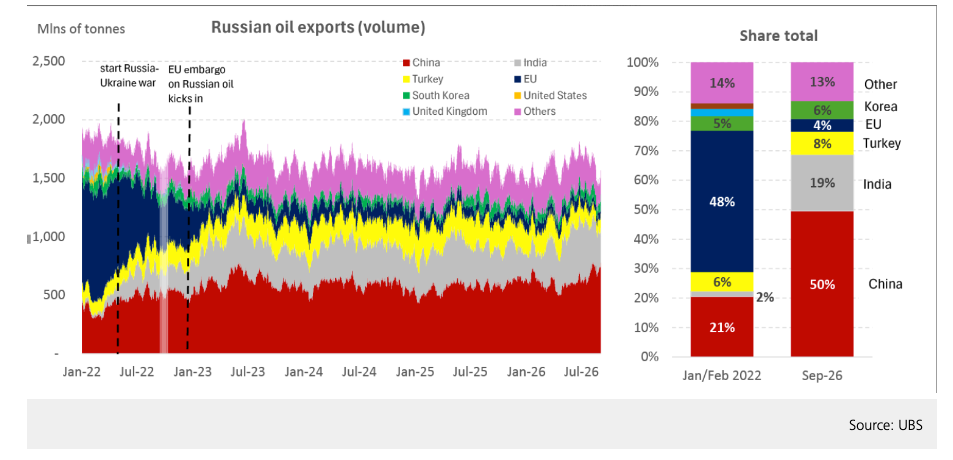
The biggest shift in Moscow’s exports has been in their destinations. The EU’s share of Russian crude exports collapsed from 48% before the war in Ukraine to just 4% by September, while the combined share purchased by China, India and Turkey jumped from 29% to 77%.
Kapteyn added more color:
In recent months, Russia has begun importing significant volumes of refined petroleum products, reflecting the damage Ukrainian strikes have inflicted on its domestic refining capacity. That is highly unusual for one of the world’s largest exporters of diesel, fuel oil and naphtha, and is one factor helping to keep global gasoline prices elevated.By contrast, Russia’s crude oil exports have proven remarkably resilient. Despite the EU embargo and the G7 price cap regime, export volumes remain only around 10% below pre-war levels. An estimated 61% of Russian crude now leaves on the so-called “shadow fleet”. We note this operates outside Western financing and insurance systems and thereby reducing the effectiveness of the sanctions and price-cap regime. However, it is worth noting that these sanctions are jurisdictional rather than global, which we understand means they do not apply to countries that have not imposed them.
So who is buying all that Russian oil? Today’s chart shows one set of estimates (Russia itself stopped publishing data in 2022), which corresponds roughly to the import data of trade partners. The left side of today’s chart shows 14-day average export volumes by destination, while the right side compares market shares between January-February 2022 and the latest data. The EU’s share of Russian crude exports has collapsed from 48% to just 4% (though for now it is still the largest buyer of Russian LNG), while the combined share of China, India and Turkey has surged from 29% to 77%. Those gains came largely at the expense of other suppliers. In China, Russia’s share of mineral fuel imports rose from about 18% before the war to 27% since February 2022, displacing imports from Australia, Iran, South Korea, Saudi Arabia, Singapore and the EU. In India, Russia’s share jumped from just over 1% to 24%, alongside sharp declines in imports from Nigeria, Iran and Saudi Arabia. All this highlights the fungibility of oil markets: while the sanctions never intended to reduce global supply their most visible effect has been to redistribute the map of global supply.
The immediate takeaway is that Western sanctions and Ukrainian drone strikes have disrupted Russia’s energy sector without crippling its crude exports.
Moscow’s pivot toward Asian buyers and reliance on a shadow fleet of tankers have allowed it to continue business as usual, exposing the limits of Western financial warfare and kinetic warfare.