



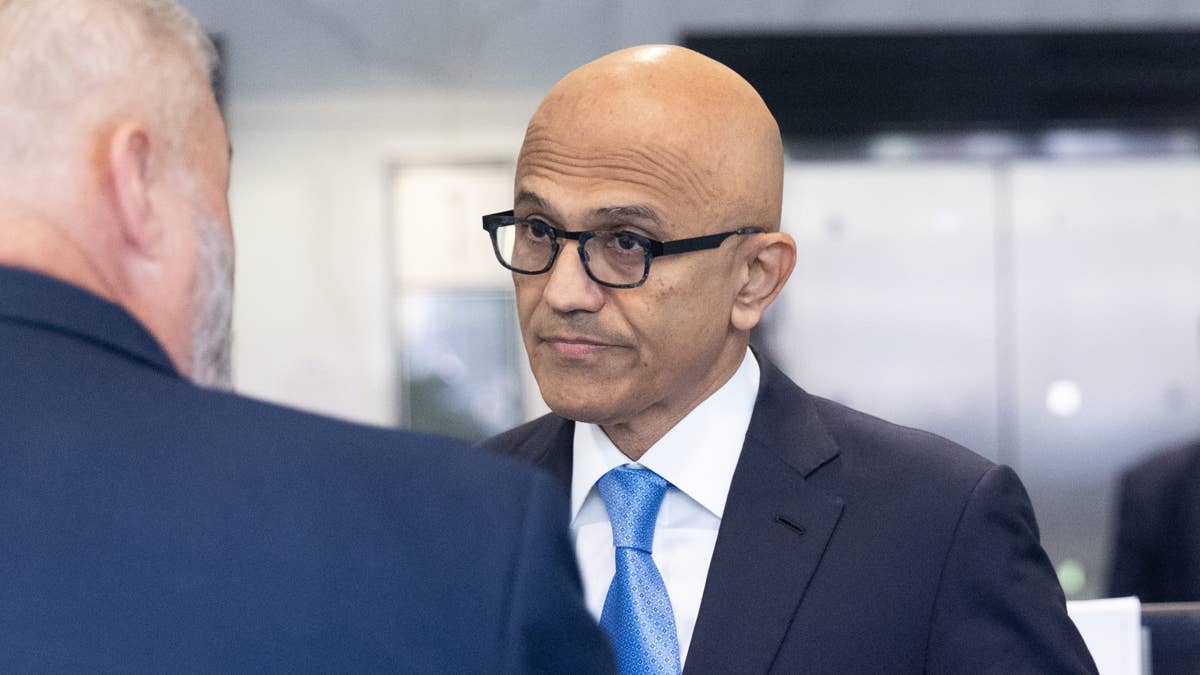
Wells Fargo resets Microsoft stock price target
There is a pattern that keeps repeating in this AI earnings cycle. A company spends heavily on infrastructure. Analysts get nervous about whether the spending will ever pay off. Targets get trimmed. Then the results come in and the conversation shifts.
July 29 was Microsoft’s turn to go through that cycle, and the way it came out the other side is what Wells Fargo is responding to.
Microsoft went into the print with its stock down more than 20% for the year. Wells Fargo had cut its own target from $650 to $625 in mid-July, citing concerns about the pace of capital spending and cloud market share.
The mood heading in was cautious. Then Azure, Microsoft’s cloud computing platform, crossed $100 billion in annualized revenue and grew 43% in constant currency.
The stock surged 9% on July 30. And Wells Fargo analyst Michael Turrin put the $650 target right back where it was.
Wells Fargo raises Microsoft price target to $650 after Q4 earnings beat
Turrin lifted his price objective back to $650 from $625, keeping an Overweight rating, after Microsoft’s fiscal fourth-quarter results cleared the bar investors had been nervous about.
“The company is better positioned at the software layer than it’s getting credit for,” Turrin wrote in a note obtained by CNBC, “and making the right moves to catch up on capacity, models and Copilot.”
That framing matters. The bear case on Microsoft this year hasn’t been about whether the company is good at AI. It’s been about whether the enormous capital spending on data centers and infrastructure would ever produce returns that justify the cost.
Related: Microsoft just took sides in AI policy fight
Turrin is saying the evidence is starting to tip the other way.
Microsoft reported adjusted earnings of $4.74 per share on revenue of $90.01 billion for the quarter, beating consensus estimates of $4.24 EPS and $87.63 billion in revenue.
Azure grew 43% and pushed Intelligent Cloud segment revenue up 32% to $39.3 billion. The stock gained nearly 9% in after-hours trading on July 29.
It’s worth noting that a $3.2 billion gain on Microsoft’s investment in Anthropic added $0.27 to diluted EPS, so part of the beat was one-time. But the Azure number and the guidance were the real story.
What Azure’s $100B milestone means for the AI investment thesis
Azure crossing $100 billion is not just a round number. It’s a milestone Wells Fargo and other bulls have been pointing to as the moment the AI infrastructure investment starts to look like a real business rather than a capital consumption story.
For most of 2026, the debate around Microsoft has been whether hyperscaler capital spending would translate into revenue growth fast enough to justify valuations.
Every time a major cloud company raised its capex guidance, the stock got sold. Alphabet fell after its own earnings despite posting Google Cloud’s strongest quarter on record, because investors looked at the $195 billion to $205 billion capex guidance and didn’t like what they saw, as TheStreet reported.
More Microsoft:
- Microsoft offers laid-off employees generous package
- Microsoft’s retirement offer is a wake-up call for workers
- Microsoft cuts thousands as Xbox faces rude awakening
Microsoft’s Q4 changed that framing, at least for now. Azure’s 43% constant-currency growth was ahead of the 41% Wells Fargo had been modeling. Copilot paid seats reached 30 million. Management guided Q1 FY2027 Azure growth to 45% in constant currency, stronger than Q4’s 43%.
The company’s ability to convert AI infrastructure spending into cloud and software revenue is looking more credible than it did three months ago, according to 24/7 Wall St.
How Citi, Bernstein and Barclays responded to Microsoft stock after Q4
Wells Fargo wasn’t the only firm moving its target after the print.
Citi raised its Microsoft price target to $600 from $570, keeping a Buy rating, and called the report “a solid rebuttal to the bear case.” Just two weeks earlier, Citi had cut its target from $620 to $570 on capex concerns, as TheStreet reported.
Bernstein nudged its target to $647 from $646 at Outperform. Piper Sandler moved to $550 from $540 at Overweight, specifically citing Azure’s 43% constant-currency growth and the Copilot seat count.
The outlier was Barclays, which trimmed its target to $512 from $545 while keeping Overweight. The Barclays analyst argued investors would revisit the shares after Q4 rather than chasing the post-earnings move. That’s a more cautious read on the same numbers, not a negative call on the business.
The analyst price target range on Microsoft now runs from $400 at the low end to $870 at the high end, with an average around $561.
That spread reflects genuine disagreement about how much of the AI upside is already priced in and how much more the company can grow into its valuation from here, according to 24/7 Wall St.
Craig/Getty Images
What Wells Fargo’s Microsoft note means for AI stock investors
Wells Fargo has previously projected that Microsoft’s AI business alone could reach $100 billion in revenue.
With Azure now crossing that threshold on an annualized basis, the question is no longer whether the investment is producing results. It’s how fast those results can grow and whether the capital spending required to sustain that growth stays under control.
Turrin’s $650 target implies substantial upside from Microsoft’s current trading level. The Overweight rating says Wells Fargo expects the stock to outperform the broader market from here. That’s a meaningful call given that the stock is still down more than 20% on the year and carries a premium multiple even after the selloff.
The broader message from this earnings cycle is starting to come into focus. Microsoft is showing that aggressive AI infrastructure spending can produce real cloud revenue acceleration.
That’s the link investors have been waiting to see close. Wells Fargo’s higher target is a bet that the link holds.
Related: Morgan Stanley resets Microsoft stock forecast ahead of earnings