


WaveSave and its portable rubber dam
As sea levels rise and flood risks worsen due to global warming, WaveSave’s easy-to-erect portable dam offers a quick-response tool. People can use the dam to protect themselves and their property, and it can also store freshwater for later use. Communities in Europe, Africa, and Southeast Asia have deployed it successfully. Now, the company is expanding into other water-related services to help vulnerable places become more resilient.
One in five people globally are at high risk of being exposed to serious floods. Many live in communities without proper protection and can’t afford to evacuate during a flood or relocate permanently. Climate change-driven extreme weather and sea-level rise is only exacerbating the problem.
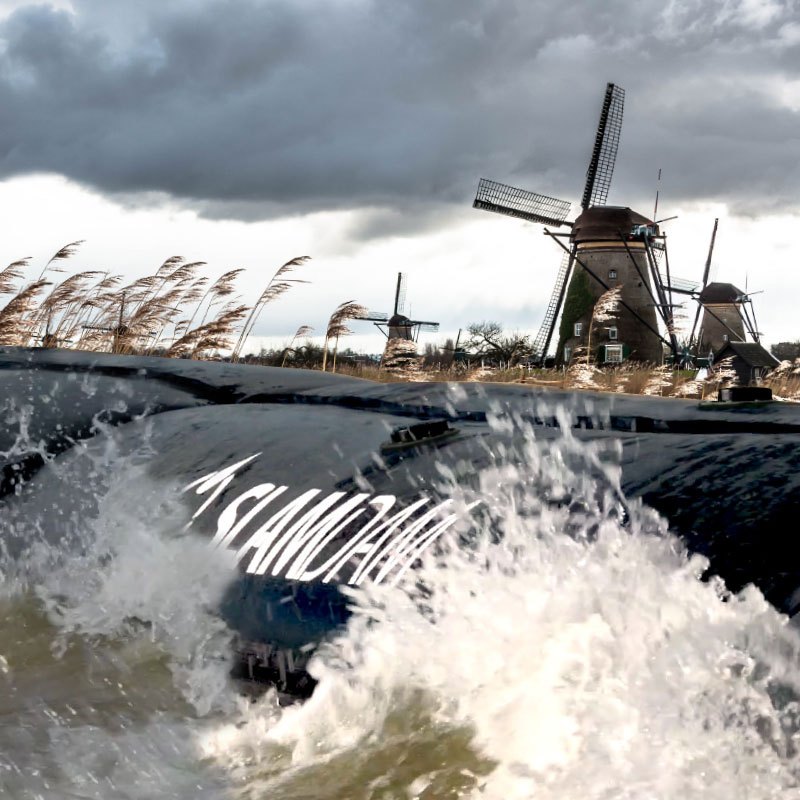
WaveSave makes a portable rubber dam called SlamDam that customers can quickly install in the early hours of a flood. Anyone can unfurl it on the ground along a riverbank or shoreline and pump it full of water until it swells into place. And there it stands, up to 1.3 meters high, shielding nearby property or structures from damage as waters rise.
Developed in 2013 in the Netherlands, SlamDam was initially tested and is still used today by regional water authorities in that country. WaveSave has since expanded into Africa and Southeast Asia, and customers have now deployed SlamDam in at least a dozen countries.
Key indicators
- Industry: Flood barriers
- Year the company was founded: 2017
- City and country of headquarters: Eindhoven, the Netherlands
- Notable fact: WaveSave is demoing its SlamDam product on New York City’s Governors Island as one of seven winners in a competition for urban climate adaptations. The barrier is installed at a site where high tides and waves from passing ferries often wash ashore.
Potential for impact
Due to both climate change and population growth, nearly 2 billion people will be exposed to floods by 2100—an increase of 300 million from 2020, according to one estimate.
A SlamDam is designed to help protect farmland and personal property as well as critical facilities like hospitals or water treatment plants. It’s cheaper in the short term than more permanent modifications like building levees or rebuilding facilities on higher ground. And its temporary nature means it can be deployed as needed, and then stored away.
To fill the SlamDam, a local installer can use any portable water pump they may have on hand. With a lifespan of more than 40 years, the flood barriers can be used again and again.
This low-tech solution has another important benefit, at least when it comes to freshwater floods: In the weeks and months after a flood, residents can tap the water stored inside the mobile dam to irrigate crops. This is particularly helpful during the dry season or in drought-prone regions. At the rural Mpanda commune in Burundi in East Africa, where a SlamDam was deployed during the 2022 flood season, farmers with access to the water inside produced more crops that year and doubled their incomes, according to a UN report.

Caveats
Companies like AquaFence, MegaSecur, and NOAQ Flood Protection also make mobile flood barriers. WaveSave distinguishes itself in part by focusing on rapid emergency deployment in developing countries, and by emphasizing SlamDam’s ability to store water for later use.
But one research team that analyzed SlamDam’s use in Kenya found a series of challenges to getting communities there to adopt the technology. One was figuring out who should own and deploy the dam.
Another ongoing challenge is the up-front cost. SlamDam is already on par with or more affordable than many alternatives: It costs between €1,000 and €3,000 (about $1,140 and $3,400) per five-meter section, and comes in a range of heights. Protecting a single entrance to a home or facility might require only 10 meters, while surrounding a facility (such as a hospital) or shielding a farm or neighborhood might take 200 to 300 meters. But the price is still too high for many communities or farmers. WaveSave’s managing director Omar Saleh says the company is looking into offering SlamDam as a service and deploying it on demand to make protection more affordable.
Next steps
Right now, an external partner manufactures all SlamDams in the Netherlands; they are then shipped to customers based elsewhere. But WaveSave aims to open a local production facility for SlamDams in Southeast Asia in early 2027, followed by a similar facility in East Africa, which could help lower costs. The company recently won contracts for four new projects totaling about $5.3 million in Burundi, Djibouti, and Guinea, with a “substantial pipeline” developing in Southeast Asia and Latin America, according to Saleh.
The company is currently self-financed and only has seven employees. Saleh says he plans to grow organically by investing profits back into the firm.
Part of that growth will involve offering new services such as advising communities on how to install and operate simple, off-the-shelf rainwater harvesting and irrigation systems, as part of a more comprehensive approach to managing water in climate-stressed regions.