



VOL REPORT: Demarcating Perpetual Futures and 0DTE Options
While perpetual futures and zero-day-to-expiration (0DTE) options are often grouped together, differences in risk, payoff structure and investor use cases make them fundamentally distinct products, according to a recent Cboe Volatility Insights report.
Co-authored by Mandy Xu, Cboe’s Head of Derivatives Market Intelligence, and Edward K. Tom, Senior Director of Derivatives Market Intelligence, the report stated: “We’ve received many inbound requests from investors looking to better understand the differences between perpetual-style futures contracts and zero-day-to-expiration (0DTE) options,” adding that “focusing on these surface similarities obscures much more important differences.”
The topic has drawn renewed attention following the CFTC’s move to bring a bitcoin perpetual futures contract into the U.S. regulated market structure.
On May 29, 2026, the CFTC issued an order permitting Kalshi to list a bitcoin perpetual futures contract, the first perpetual futures contract approved on a U.S.-regulated exchange. In a statement published on the CFTC’s website, Chairman Michael S. Selig said the action “charted a path for one of the most liquid segments of the crypto asset markets to exist within the U.S. regulatory framework” and described the Commission’s approach as “a framework that can limit excessive leverage, volatility and systemic risk, rather than pushing those risks offshore to unregulated venues.”
The statement also notes that perpetual contracts were first theorized in a 1992 discussion paper by economist Robert Shiller.
The CFTC’s Office of Customer Education and Outreach separately published a one-pager on crypto asset perpetual contracts, describing perpetual contracts as instruments with “no fixed expiration date” that maintain price parity with an underlying spot price through periodic funding-rate payments between long and short positions.
Unlike traditional futures contracts, perpetual futures, or ‘perps’, do not expire. Instead, they rely on recurring funding-rate payments between long and short positions to help keep the contract price aligned with the underlying spot market, making funding rates a defining feature of the product.
The document states that “leverage is not inherent to the product” but notes that, historically, “crypto asset perpetual contracts have been commonly offered on offshore trading venues with large amounts of leverage.”
Among its listed best practices for traders: “understand how leverage and margin requirements affect liquidations and liquidation thresholds,” and “never risk more than you can afford to lose.”
The CFTC’s standing customer advisory on virtual currency trading states that “entering into futures contracts through leveraged accounts can amplify the risks of trading the product,” noting that participants in margin accounts typically fund only a fraction of a contract’s underlying value.
April Case Study
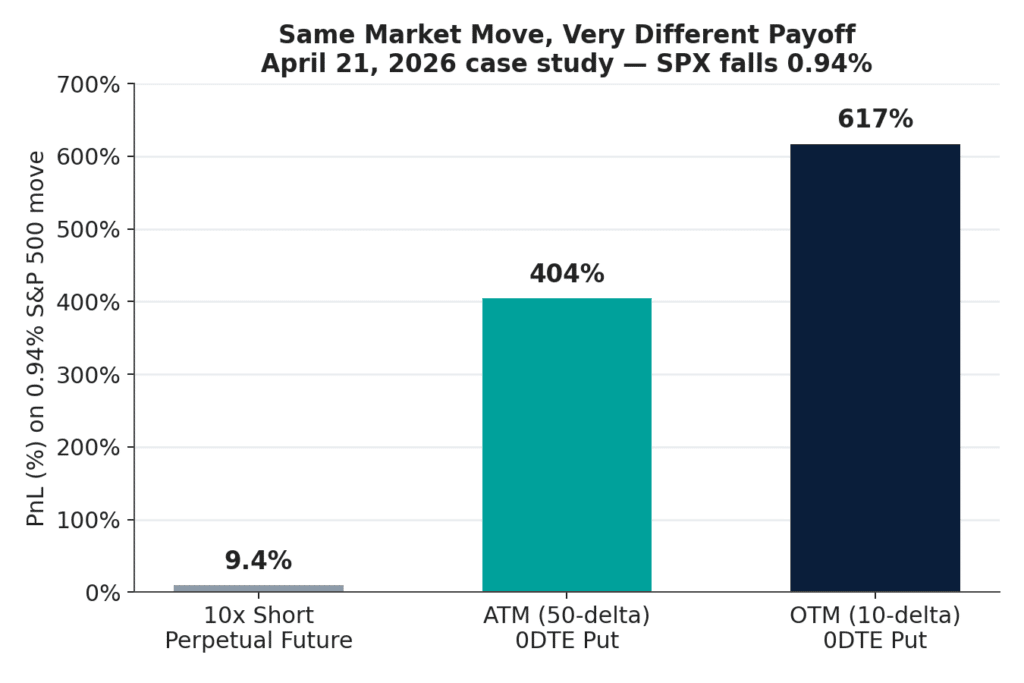
To illustrate why the products behave differently, Cboe examined how each performed during the same market event while holding notional exposure constant.
Cboe’s report centers on a single case study. On April 21, 2026, as a U.S.-Iran ceasefire negotiation stalled and the S&P 500 fell 0.94% intraday, Cboe modeled three positions with identical notional exposure: a 10x-leveraged short position in perpetual futures, an at-the-money SPX 0DTE put, and an out-of-the-money SPX 0DTE put.
The leveraged perpetual futures position returned 9.4%. The at-the-money 0DTE put returned 404%. The out-of-the-money 0DTE put returned 617%.
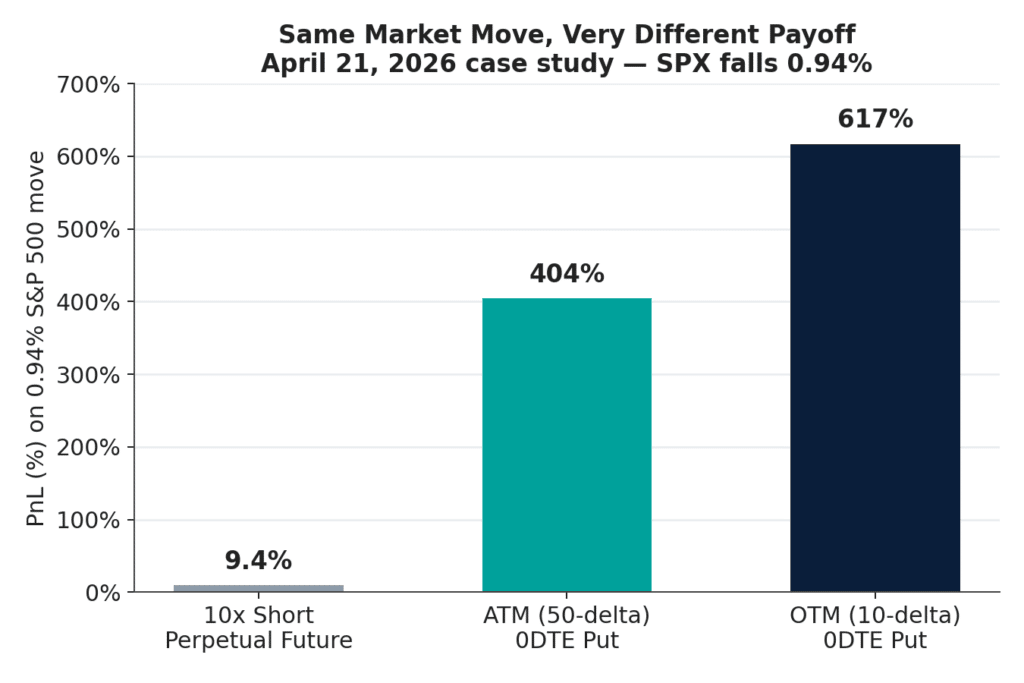
Cboe attributes the difference to convexity. Perpetual futures, the report states, are “ultimately a linear product giving investors 1:1 payoff (times leverage) relative to the underlying asset.”
Options are not linear, their price sensitivity to the underlying increases as they move in-the-money, a property Cboe describes as “positive convexity” that, “along with the implicit leverage inherent in options,” can “amplify gains, resulting in a rate of return that is far greater than possible with a linear instrument such as perps.” Cboe calculates the differential at 42x for the at-the-money position and 65x for the out-of-the-money position, based on this single trading day.
Risk Structure
The report next examines how the two products differ when leveraged positions move against traders. For an option buyer, the maximum loss is the premium paid; for perpetual futures, Cboe writes, losses scale without a fixed ceiling, particularly at higher leverage levels, up to 50x to 100x, per the report, available on some offshore venues.
FINRA’s investor guidance on 0DTE options makes a related point about the buy side of options: “you could lose the entire premium paid,” and separately warns that uncovered call sellers “face the risk of unlimited potential loss if the market for the underlying security rises sharply.”
Cboe reports that on October 10, 2025, more than $19 billion in leveraged crypto positions were liquidated, with 70% of the liquidations occurring in a 40-minute window and $3.2 billion in positions liquidated in a single minute, as bitcoin prices fell more than 10%.
Cboe links the sequence of liquidations to structural features of crypto perpetual futures markets, including continuous 24/7 trading, the absence of circuit breakers and, in some cases, automated deleveraging mechanisms.
The CFTC’s perpetual contracts one-pager does not address auto-deleveraging directly, but its list of best practices instructs traders to “actively monitor open positions” and to “review rulebooks, contract specifications, and pricing mechanism before trading.”
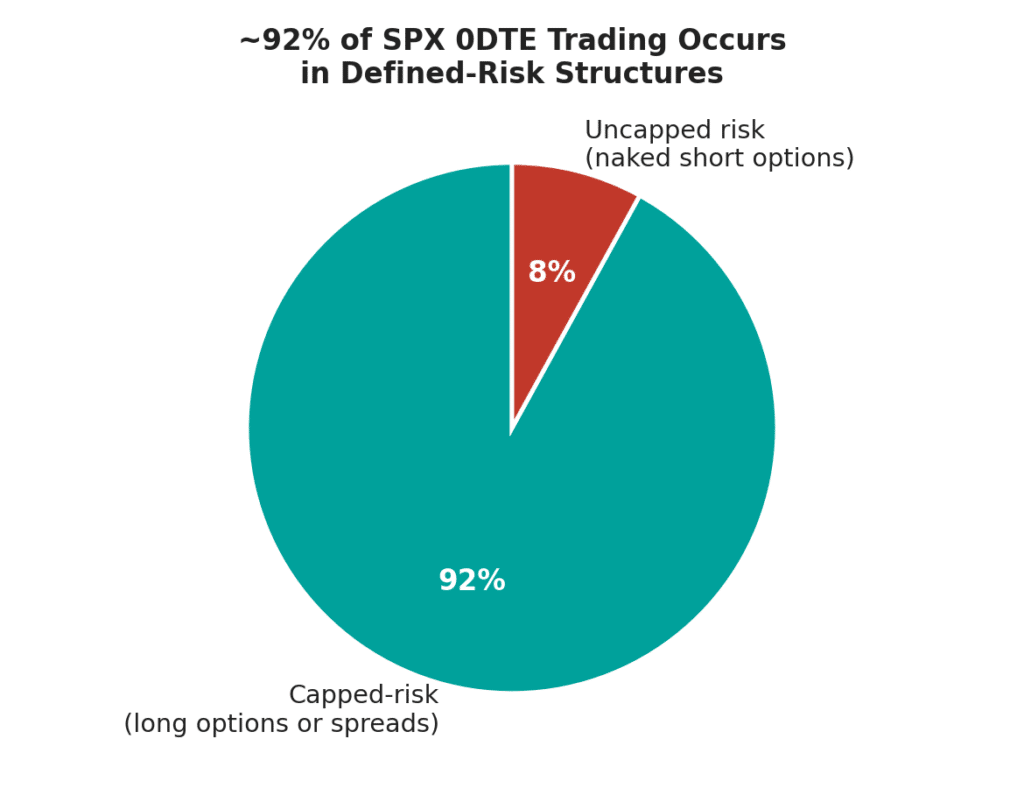
Listed SPX options, by contrast, are cleared through the Options Clearing Corporation, which operates within an established clearing and margin framework. By contrast, Cboe reports that approximately 92% of SPX options trading currently occurs in capped-risk formats, long options outright, or spreads such as verticals and iron condors, where the maximum loss is defined at the time the position is opened.
Growth and Composition of the 0DTE Market
Although both products have experienced rapid growth, Cboe argues that the drivers of that growth differ. The report says that perpetual futures remain primarily speculative instruments, while SPX 0DTE options have evolved into tools used for hedging, income generation and tactical positioning alongside speculative trading.
FINRA’s 2026 Industry Snapshot, published June 1, 2026, states that average daily listed-options transactions reached 8.4 million in 2025, up 50% from 5.6 million in 2023, and that contracts expiring on the same day accounted for about 30% of all options transactions in 2025.
SIFMA’s Research Quarterly for the first quarter of 2026, published April 17, 2026, reports that options average daily volume reached a record 68.9 million contracts in the quarter, up 17.9% year over year. In addition, SIFMA’s most recent Equity Market Structure Compendium, covering full-year 2024, the latest edition published, separately reports that short-dated options volume grew 318.3% from 2018 through 2024, rising from 6.0 million to 25.1 million contracts, compared with 148.4% growth for total listed options over the same period.
Cboe’s figures show perpetual futures volume moving closely with bitcoin’s price (45% of variance explained) versus a much weaker relationship for SPX 0DTE volume against the S&P 500 (7%).
Cboe’s figures also show institutional and retail volumes in SPX 0DTE options growing at a broadly similar pace over the past several years, rather than a retail-only expansion.
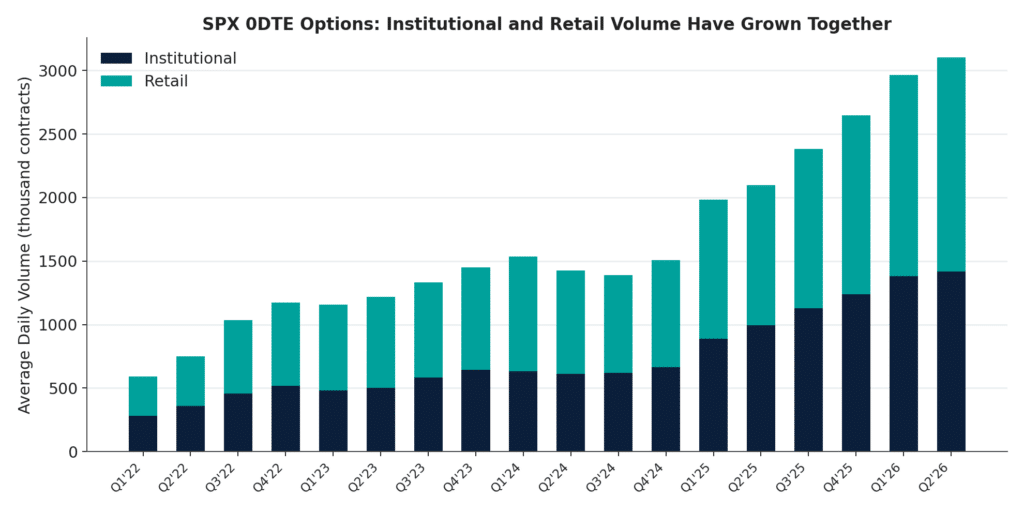
The report argues that this broad participation reflects the expanding range of institutional and retail use cases for 0DTE options, contrasting with perpetual futures, whose trading activity remains more closely linked to cryptocurrency price movements.
Cboe concludes that perpetual futures and 0DTE options differ in payoff structure (linear versus convex), risk profile (uncapped versus capped in the majority of current SPX 0DTE activity) and historical relationships to underlying asset prices. Rather than competing products, the report argues they serve different trading objectives despite both providing leveraged market exposure.
“If leverage is where the comparison begins, convexity, risk management, and utility are where it ends,” Cboe said.