Vance gives Catholic converts a bigger stage
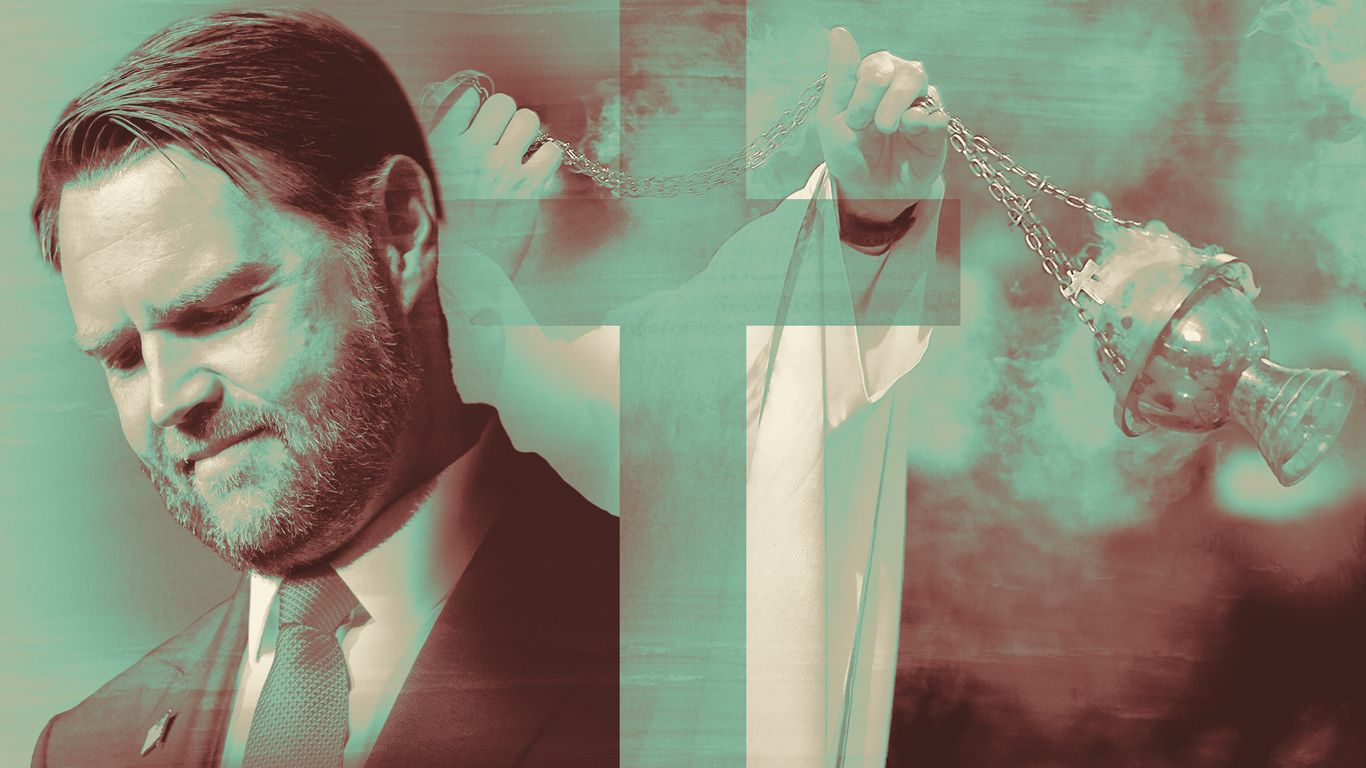
Vice President JD Vance’s memoir about his conversion to Catholicism, out Tuesday, puts a high-profile face on a small but distinctive slice of the U.S. Church.
Why it matters: Parish reports have fueled talk of a Catholic revival. But a new Pew Research Center analysis found the Church loses eight former Catholics for every adult it gains through conversion.
The converts it does attract tend to be whiter, more conservative, and more observant than “cradle Catholics,” or those born into the faith.
- “The story of how I regained my faith, of course, only happened because I had lost it to begin with,” Vance said in an announcement about the book in March. “The interesting question that hangs over this book, and over my mind, is why I ever strayed from the path.”
By the numbers: 1.5% of U.S. adults are converts to Catholicism, Pew found, making up about 8% of Catholics in the U.S.
- Most converts come from another Christian background, with 59% raised Protestant, 9% in another Christian tradition and 22% with no childhood religious affiliation.
- The most common reason for conversion is family, not politics or ideology: 49% of converts cite a Catholic spouse or partner, or a desire to marry in the Church.
- Smaller shares cite belief in church teachings or its historical foundation, spiritual fulfillment, or relatives and friends.
Zoom in: Catholic converts are more observant by some measures. 38% attend Mass weekly, compared with 28% of cradle Catholics.
- 58% say they receive Communion every time they go to Mass, compared with 34% of cradle Catholics.
- Pew found there is no statistically significant gap in prayer or confession.
State of play: Vance fits several big pieces of the convert profile.
- He is white, U.S.-born, Republican and was raised outside Catholicism in a loosely evangelical family — aligning with Pew’s finding that converts are disproportionately white, native-born and often raised Protestant.
- But he differs from the most common conversion story. Pew finds nearly half of converts cite a Catholic spouse or church marriage, while Vance’s wife, First Lady Usha Vance, is Hindu.
What they’re saying: “I would say this is more of religious resilience rather than a religious revival,” David Campbell, a political science professor at the University of Notre Dame, tells Axios.
- Campbell said that while certain parishes are seeing an increase in new converts, it’s still too early to tell if it will have a long-term effect on church membership and its political makeup.
- Campbell, co-author of “Secular Surge: A New Fault Line in American Politics,” said new converts typically see their Catholicism as a political identity, while cradle Catholics see their religion as part of their ethnic upbringing.
Between the lines: U.S. Catholicism is also deeply shaped by Hispanic and immigrant Catholics.
- Pope Leo XIV’s migrant-rights posture has positioned him against some of the Trump-era politics splitting American Catholics.
- Vance’s use of ordo amoris — “order of love” — to defend prioritizing citizens over outsiders was criticized by senior Catholic figures, including Pope Francis before his death.
The bottom line: Vance has plenty in common with America’s Catholic converts — especially demographically and politically.
- But Pew’s data undercut the idea that converts are powering a broad Catholic comeback.
Methodology: Pew’s findings are based primarily on its 2023-24 Religious Landscape Study, conducted July 17, 2023 to March 4, 2024, among 36,908 U.S. adults (margin of error ±0.8 percentage points).
- The analysis also incorporates a February 2025 survey of 9,544 U.S. adults examining connections to Catholicism (±1.4 points) and a May 2025 survey of 8,937 U.S. adults examining religious switching (±1.5 points).
- Estimates for Catholic converts are based on smaller subsamples and carry larger margins of error.