



U.S. Industrial Real Estate Is Quietly Splitting Into Two Markets
America has always thought of itself as an industrial nation. For most of the last century that self-image was literal: the country made things, at scale, and the buildings where it made them defined entire regions. Then came a long stretch when the prevailing narrative said all of that was over. The nature of global trade meant that manufacturing had been outsourced for good and the only future was services and tech. The factory floor was a museum piece.
Industrial real estate never got the memo. Through the 2010s and into the pandemic boom, it was the best-performing major asset class in commercial real estate, throwing off the kind of returns that office and retail could only envy. To a casual observer, the strength of industrial property looked like proof that American industry was alive and well.
But dig into the numbers and a more complicated picture emerges. The thing called “industrial real estate” is not one market. It’s actually two markets moving in opposite directions, governed by entirely different logic. One of them has been doing the heavy lifting for fifteen years. The other is about to.
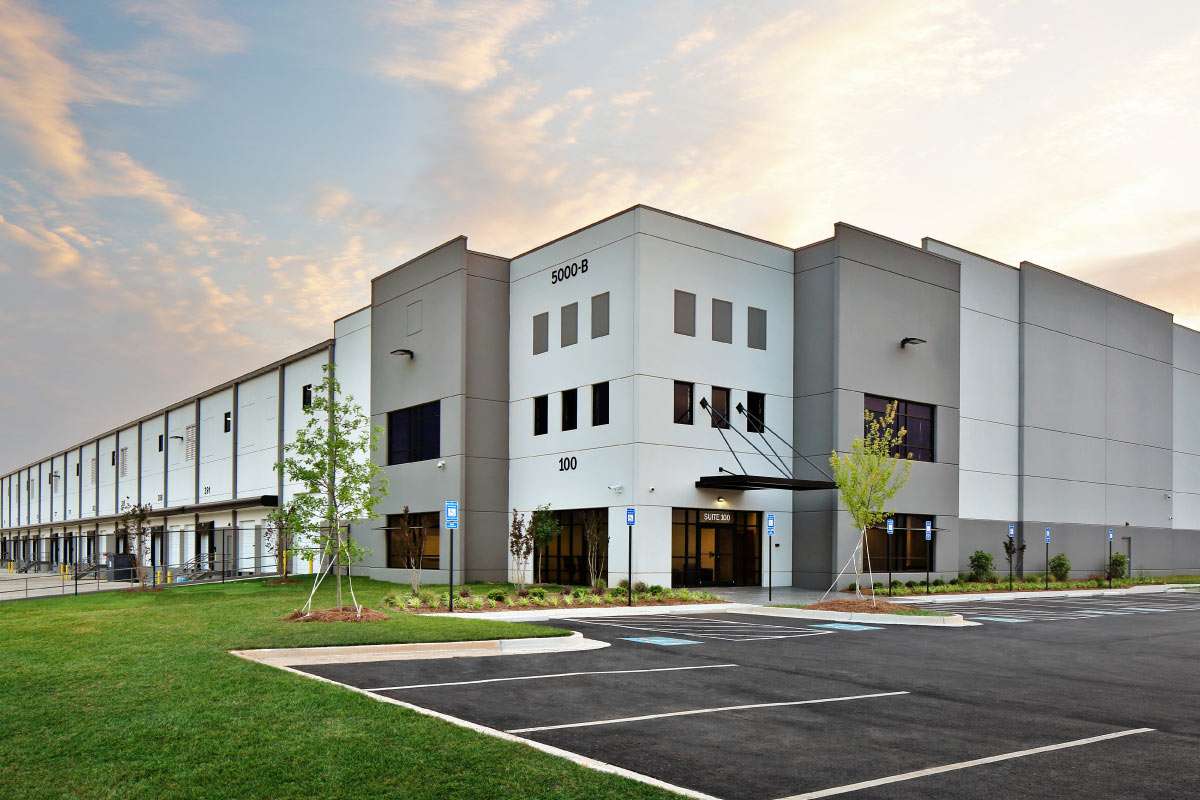
The first is the warehouse, and it is essentially a solved problem. Distribution and logistics facilities are parametric exercises: clear heights, column grids, dock-door ratios, power load per square foot. Once a developer has solved the envelope, the variables compress. A 500,000-square-foot distribution center in the Inland Empire and its functional twin in central Pennsylvania differ in land cost, labor market, and local code, not in engineering complexity. The asset has been commoditized in the precise economic sense: its unknowns are known and already priced. That legibility is exactly why institutional capital has poured in so confidently.
It is also why the warehouse market is now correcting like the efficient market it is. Industrial vacancy stabilized at 6.7% nationally in the first quarter of 2026, per CBRE, after eighteen months of softening. Big-box leasing surged more than 80% year over year in the same period, and asking rents ticked back into positive territory at $10.34 per square foot. The cycle cleared quickly on the way up and is finding its footing on the way down. That is what mature, well-understood asset classes do.
The second market behaves nothing like this, and it is the one the reshoring story is actually about.
A manufacturing facility is not a bigger, fancier warehouse. A lithium-ion gigafactory, a biologics fill-finish suite, a specialty chemicals plant, and a semiconductor fab share almost nothing except a line in a broker’s database. Their utility densities differ by orders of magnitude. Their process requirements are domain-specific. Their regulatory surfaces (FDA, EPA, NRC, DOE) bear no resemblance to one another. Their critical paths are governed by equipment with multi-year lead times, by chemistry that has never run at commercial scale, by workforces that don’t yet exist in the local labor market. To borrow from Tolstoy: warehouses are all alike, but every manufacturing project is difficult in its own way. There are a dozen independent dimensions on which it can fail, and it has to get all of them right.
That distinction is about to stop being academic, because the demand signal arriving is enormous and lands almost entirely on the complex side of the ledger.
Building and equipping domestic factories to produce America’s “exposed imports,” goods critically dependent on a single foreign supplier is no small task. A May 2026 McKinsey Global Institute report estimates that it could require roughly $2 trillion in new facility investment. The breakdown is the part real estate should be reading closely: electronics account for about 40% of that figure, chemicals roughly 30%, and metals another 20%. Pharmaceutical ingredient plants, basic chemical building blocks, copper wire, forged aluminum and steel represent some $1 trillion in needed capacity. None of it looks anything like a distribution box. Each facility is its own engineering problem, with its own site, utility, and permitting profile.
The policy scaffolding behind this is already in place. The CHIPS and Science Act seeded fabs across Arizona, Ohio, Texas, and New York. The Inflation Reduction Act, even after partial rollback, set in motion a generation of battery and critical-minerals projects that have proven hard to stop. A McKinsey survey published in January 2026 found that 43% of supply chain leaders plan to shift more of their footprint to the United States within three years, a 25-point jump from the prior year. The companies making those plans are not building warehouses. They are building factories of a kind the brokerage community has rarely had to underwrite.
The problem is that the capital markets built their entire industrial playbook around the warehouse. Comps, cap-rate benchmarks, absorption metrics, broker expertise – all of it calibrated for half of the category. When a manufacturing project gets shoehorned into that framework, it comes out misunderstood. The early evidence is already visible: life-sciences lab vacancy climbed to 23.2% in the first quarter of 2026 as speculative supply, developed on warehouse-style assumptions, overshot demand for process-intensive space. Meanwhile, defense-aligned and specialized industrial assets are showing lower vacancy and more durable cash flows than traditional products. The market is signaling that complexity, correctly understood, carries a premium, and that misreading it carries a penalty.
The deeper risk sits upstream, in planning. Manufacturing projects fail not mainly in construction but in the feasibility phase, when technology selection, utility strategy, and cost assumptions are locked in while the numbers still look soft and the consequences feel far away. Major facilities routinely run 50% over budget and a year or two past schedule. This is not an anomaly, it’s the base rate for complex projects planned with tools built for simple ones.
Warehouse development rewards speed, standardization, and capital efficiency. Manufacturing development rewards depth, domain expertise, and patience with complexity. As a trillion-dollar wave of chemicals and metals capacity comes looking for sites, the investors and developers who keep treating “industrial” as one thing will underperform in both directions: too slow for logistics, too shallow for advanced manufacturing. The sector’s next chapter belongs to whoever recognizes that it was never one market at all. It was always two.
The post U.S. Industrial Real Estate Is Quietly Splitting Into Two Markets appeared first on Propmodo.