




True Interoperability Doesn’t Need Assets to Move
By Rhomaios Ram, Founder of Fnality

The digital asset industry has spent years and a great deal of money trying to make assets portable. Bridges, wrapped tokens and cross-chain mechanisms have all been built so that an asset can move from one ledger to another and reach the place where liquidity sits.
Having spent much of my career thinking about how money and assets settle, I have become increasingly convinced that for institutional markets, the more important challenge is not how to move assets between systems, but how to complete transactions safely across them.
Portability and interoperability should not be treated as the same thing.
Portability May Be the Wrong Problem
The portability question made sense for crypto-native assets. When the token on the chain is the asset itself, moving the token may be the most direct way to move ownership.
But traditional financial assets work differently. A security is a registered claim whose ownership is defined by an authoritative record maintained by an accountable institution, usually a central securities depository or a registrar.
Moving a traditional financial asset to another network often requires creating a new representation linked to the authoritative record elsewhere. That representation must remain synchronised with the original for as long as both exist.
That duplication carries a cost that never disappears, because each copy is another version of the truth that has to be reconciled, governed and trusted. For regulated instruments there is a sharper question still: whether the wrapped version carries the same legal rights as the original.
Portability can also concentrate risk. Bridges have been one of the largest sources of security and operational loss in digital asset markets, because each one adds another dependency and another point in the chain that can break. The 2022 Wormhole hack, in which approximately $320 million of assets were stolen and later reimbursed, remains a clear example of that risk. The more networks an asset must travel through, the more systems, controls and legal relationships participants must trust.
But there is another way.
Settlement Without Moving the Asset
A bond can be issued and maintained on one ledger, with the cash to buy it sitting in a separate payment system where both parties already hold balances. The bond changes hands on the ledger where it was issued. The cash changes hands on the system where it already lives. Neither travels anywhere, and the two transfers either complete together or neither completes at all, with finality recognised in each underlying system.
That is what interoperability should mean. Not the ability to move assets between ledgers, but the ability to settle a transaction whose two legs sit on different ledgers, with neither leg becoming final unless the other does. This way, no competing representation of the asset is created, reducing the reconciliation burden and avoiding the legal ambiguity and the added cost of maintaining parallel records.
That capability must also extend across markets and currencies. Institutional finance is global, so interoperability cannot stop at the boundary of a single ledger, network or jurisdiction. The objective should be a globally connected settlement layer that allows assets and money to remain in their respective systems while transactions complete across them.
What the Bond Market Got Half Right
The international bond market demonstrates that a globally traded instrument does not need to be repeatedly recreated in every market where investors want to transact in it. But it also shows the continuing cost of maintaining separate ownership books and reconciling them across systems.
The Eurobond market grew up without a single national depository to call home, so it built shared infrastructure between Euroclear and Clearstream. We talk about assets moving between the two, but the bond itself is never duplicated. In a typical global-note structure, a single global note sits with a neutral common depositary, and a common recordkeeper holds the authoritative record of the whole issue.
What differs is the record of beneficial ownership. Euroclear and Clearstream each keep their own client books, and the bridge between them exists to reconcile those books throughout the settlement day. This is sophisticated, resilient infrastructure that has supported global markets for decades.
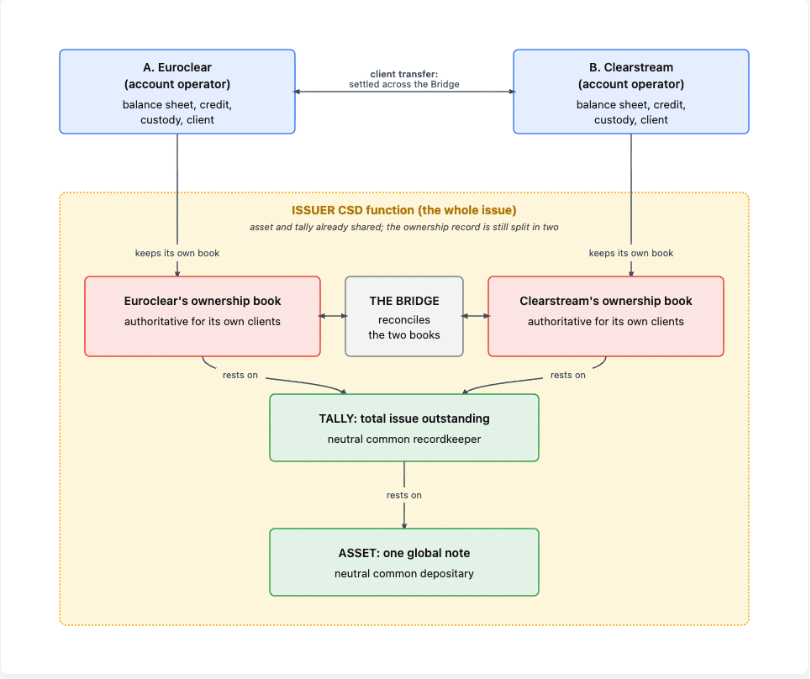
Today, crypto duplicates records because many blockchain networks can only transact assets represented within their own environments. Traditional finance duplicated ownership because each institution had to remain accountable for its own clients. So the real divide in this market is not between crypto and traditional finance at all; it is between systems that rely on parallel representations and systems that preserve a single authoritative record.
Shared Record, Accountability Unchanged
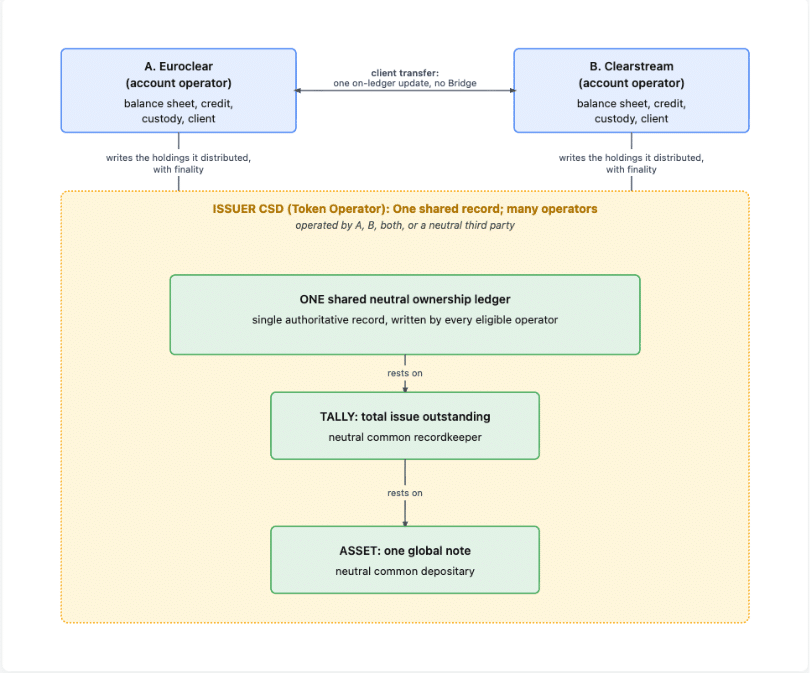
Institutions should continue to keep managing their own books for sound commercial and regulatory reasons. Client relationships, operational resilience and legal accountability have always been bound up in those records, and no institution will hand them to a competitor, however efficient that might look on paper, for reputational reasons.
What markets now need is genuinely neutral infrastructure that no single institution owns or controls for its own benefit. Each firm can operate on a shared record while remaining the account operator and administrator for its own clients’ accounts, and retaining the obligations for which it is already accountable. Under that model, firms give up almost nothing that customers value. They go on competing through custody, balance sheet, liquidity, credit and client service. What disappears is the duplicated record.
Today, a trade between a client of one institution and a client of another is reconciled across the bridge, with each side updating its own book. On a shared record it becomes one update, simultaneously handing the accountability from one operator to the other at the moment of settlement. Each firm still operates the account for its own clients and still answers for the holdings it administers. The record becomes shared, but each institution’s accountability remains unchanged.
From Portability to Settlement Finality
The industry has invested enormous effort in making assets portable. But portability may simply not be the problem institutional markets need to solve. The better question is how assets can stay exactly where they belong while transactions settle across independent systems, networks, currencies and jurisdictions. That moves the focus from portability to settlement, finality, authoritative records and global connectivity.
The asset was never the thing that needed to move. The record was the thing that needed to stop being copied — and that is the problem the next generation of market infrastructure should set out to solve.
Interoperability has come to mean moving assets between blockchains. It shouldn’t. Assets can stay exactly where they belong while globally connected settlement infrastructure links the ledgers, currencies and markets around them. Read our latest article by @Fnality’s Founder @Rhomaios Ram to learn more.
X
Interoperability has come to mean moving assets between chains. It doesn’t have to. Let assets stay where they belong, while globally connected settlement infrastructure safely and reliably links the systems around them. Read the latest from @Rhomaios Ram, Founder of @Fnality.