The Nuclear Renaissance Disconnect: Utilities Plan Big While Stocks Lag
The Nuclear Renaissance Disconnect: Utilities Plan Big While Stocks Lag
The Nuclear Energy Institute’s (NEI) newly released 2026 Future of Nuclear Power survey captured American nuclear energy ambitions across 21 utility companies covering 95 commercial reactors. Reactor owners find themselves planning new reactors to meet the AI-juiced electricity demand of the future, along with the added demand from increased domestic manufacturing and electrification.
More than 97% of the units surveyed are considering or pursuing approval to operate for at least 80 years. It goes to highlight the long lifespan of reactor plants, with some owners now planning for operations out to 100 years from initial construction.
NEI estimates that uprates, restarts, longer refueling cycles, and other improvements could collectively add more than 7 GW of nuclear generation from the existing fleet over the coming decade. That’s more than the power you would get by building six new Westinghouse AP1000 reactors.
That includes roughly 2.2 GW from restarting the previously shutdown plants at Palisades, Three Mile Island, and Duane Arnold.
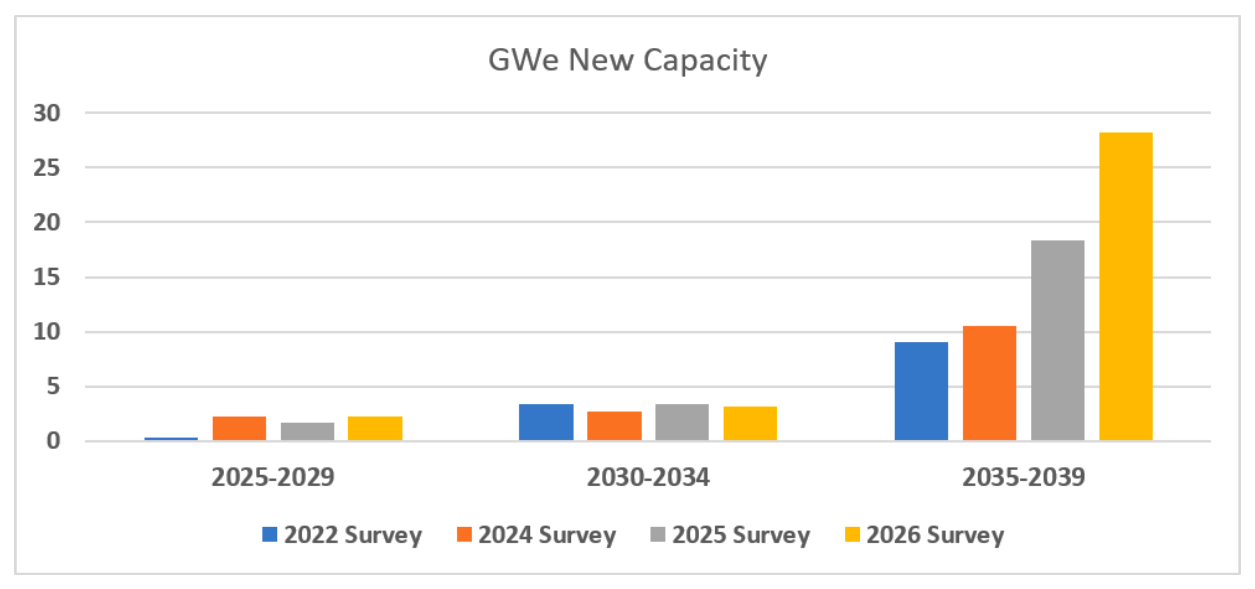
Between the 21 utilities surveyed, the report states those companies are planning for 33.6 GW of new nuclear generation over the next 15 years. Roughly 28 of those GWs are concentrated in 2035-2039.
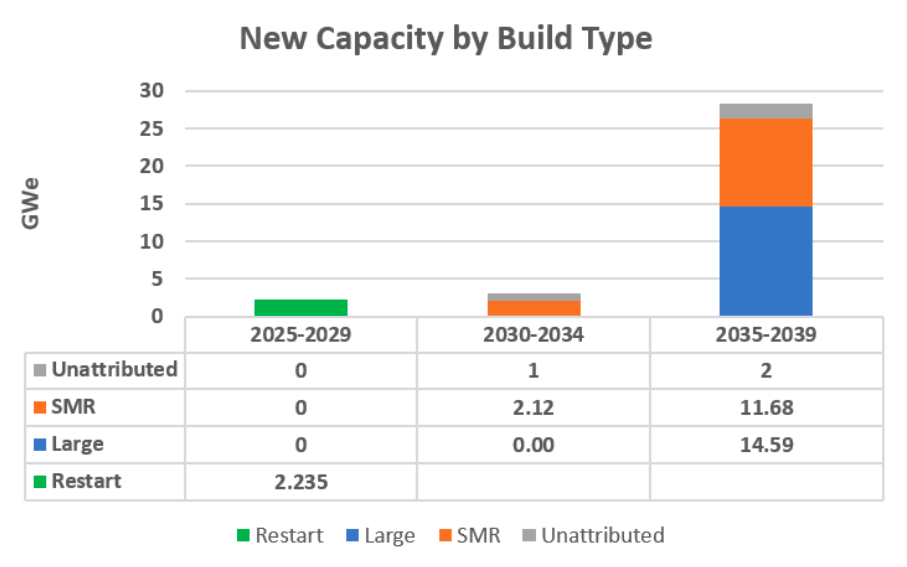
New capacity is broadly split between large reactors and small modular reactors, while respondents reported no microreactor plans.
As we noted when covering The Nuclear Company’s South Carolina reactor plans, America’s “nuclear renaissance” still has to make the transition from announcements to actual construction.
Interest in supplying power to specific loads sheds some light on what the utilities are looking at powering with their growing nuclear ambitions. Over a dozen respondents are looking to provide energy for data centers. However, this is the first year that has seen zero interest in powering hydrogen generation plants.
2024 saw about a dozen respondents interested in behind the meter setups for powering hydrogen production facilities. After Congress changed up the tax credits for hydrogen applications to expire in 2028, interest from the utilities dropped down to only three respondents in 2025, leading to zero for this year.
Despite the incredibly rosy future being painted by the nuclear segments of America’s utilities, the stock market holds a different opinion on the nuclear sector’s constituents.
With SPY up about 12% this year and XLE up over 40%, the nuclear sector has trailed behind significantly. Of the three main nuclear-themed ETFs, none of them currently hold positive returns since the beginning of the year.
The uranium-heavy URA and the industrial/services-heavy NUKZ are down about 2-3%, while the more concentrated NLR is down about 13% YTD.
After multiple reactor developers, including Oklo and NuScale, had explosive runs in 2024 and 2025, multiple names in the nuclear corner have fallen over 50% in recent months as the nuclear theme is still tightly tied to the momentum and AI infrastructure trade.
The sector has a chance of being taken more seriously if grid-scale construction can finally start getting announced at scale, but for now, everything still seems to be in the talking stage, which is exciting absolutely no one.
The microreactor space has seen an increase in interest on the private side, with recent funding rounds for microreactor developers pushing over $1 billion. These reactors have some different application opportunities outside of the scope of traditional utilities, such as national defense applications and remote community power.
As we’ve detailed at length with the DOE’s Reactor Pilot Program, this class of reactor capacity is actually showing tangible progress towards commercialization.
Tyler Durden
Tue, 09/22/2026 – 05:45