



The math behind a Democratic wave — or a GOP upset
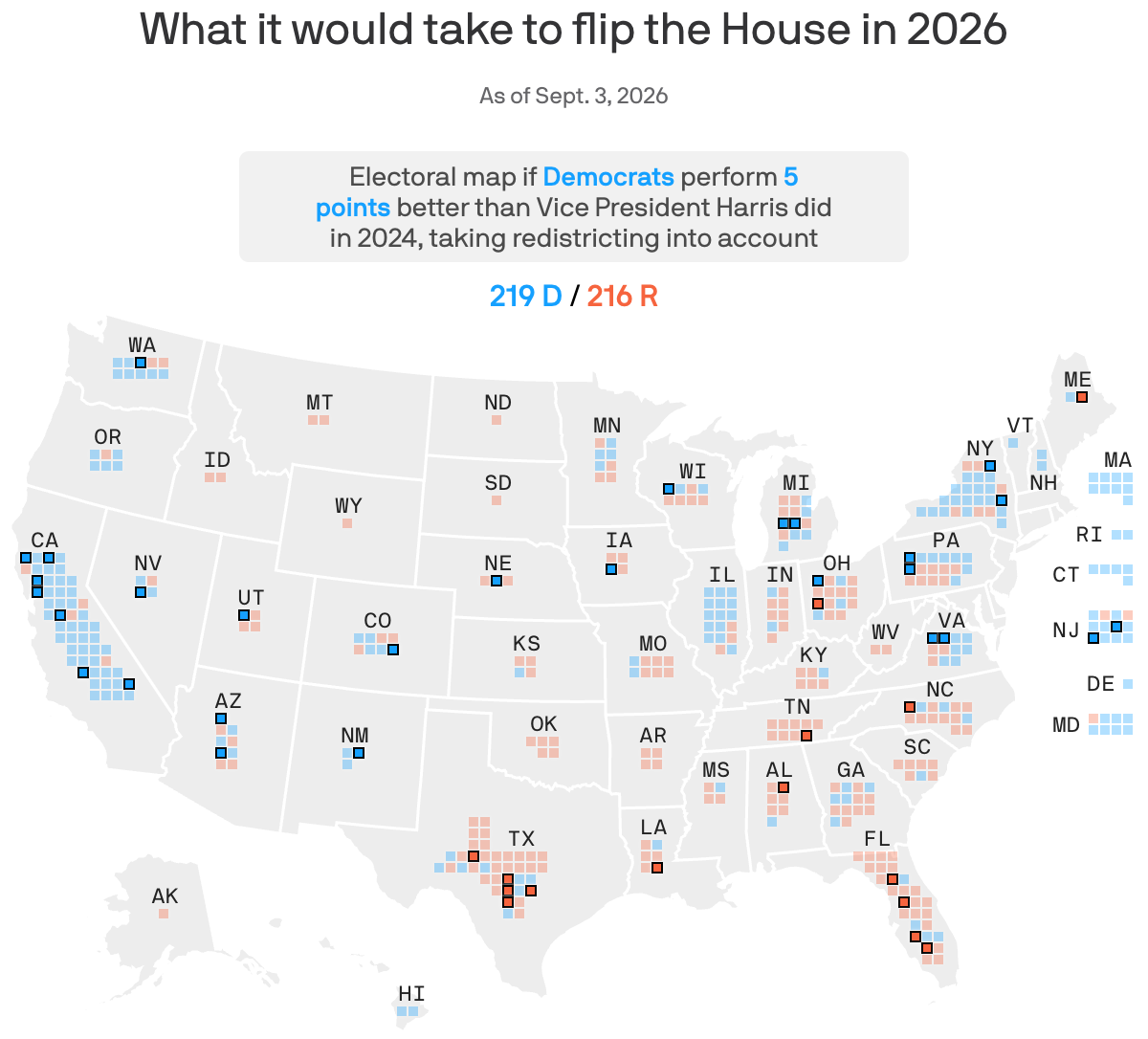
Redistricting has helped House Republicans build a seawall that can withstand a roughly 5-point Democratic wave.
Why it matters: Early readings are pointing to something twice that size — enough to wash away the GOP House majority.
Democrats have been running roughly 10 points ahead of their 2024 presidential performance in special elections this year.
- A swing of that magnitude would produce a comfortable 230-205 Democratic majority, according to an Axios analysis of how the battle for the House would play out under different electoral scenarios.
Between the lines: Gerrymandering since the presidential election has given Republicans more breathing room, with GOP-drawn maps creating a net advantage of roughly nine seats.
- But some of those newly redrawn GOP seats rest on a potentially shaky assumption: that the 2026 electorate will look much like 2024’s.
- A national swing toward Democrats like the one in Trump’s first midterm would overwhelm the GOP’s redistricting defenses.
By the numbers: The current generic ballot has Democrats up roughly 6 points, which would produce a 221-214 Democratic majority in the Axios analysis.
- That’s a workable majority, but not an overwhelming one.
By comparison: In 2018, the national House vote swung 6½ points toward Democrats from the 2016 presidential baseline. Democrats picked up 40 seats, producing a 235-199 majority (one seat was unresolved).
The other side: If Republicans outperform Trump’s 2024 numbers by 5 points across congressional districts, the new maps would give them a massive 253-182 majority.
- If 2026 simply looks like 2024 — with GOP candidates winning every district Trump would’ve carried under the new maps, including Trump districts where Democrats held on in 2024 — Republicans would net 16 seats, producing a 236-199 majority.
State of play: Two months before Election Day, Democrats can taste the House majority, provided two conditions hold: President Trump remains unpopular, and vulnerable Republicans stay close to him.
- They’re privately giddy that Republicans are encouraging vulnerable incumbents to attend this week’s GOP midterm convention in Dallas and lash themselves to the mast of HMS Trump.
- Republicans are banking on their massive money advantage and a Supreme Court ruling that allows them to coordinate their campaign dollars with individual candidates.
- And they’re smiling at the simple fact they drew eight Democratic incumbents into districts that Trump would’ve carried by double digits. It was nine before the Missouri Supreme Court tossed out the map that stranded Rep. Emanuel Cleaver (D-Mo.).
Go deeper: Individual House candidates can buck national trends and fare better than their party does — both nationally and in their individual districts.
- But in the Trump era, the number of so-called crossover districts has fallen to historic lows. There were 16 after the 2024 election — 13 Democrats and three Republicans.
- When President Obama was elected in 2008, there were 83 crossover districts.
The bottom line: Democrats are outperforming Republicans on nearly every metric but money.
- If the raw numbers — the generic ballot, special elections and primary participation — mean anything, the GOP redistricting levees won’t hold.
- But waves are typically clear only in the rearview mirror.