
Stegerit Finanz AG on the Alarming Truth Behind Davos 2026’s AI Inequality Debate

January 2026 | Davos, Switzerland / Sarnen, Switzerland · 6 min read
Table of Contents
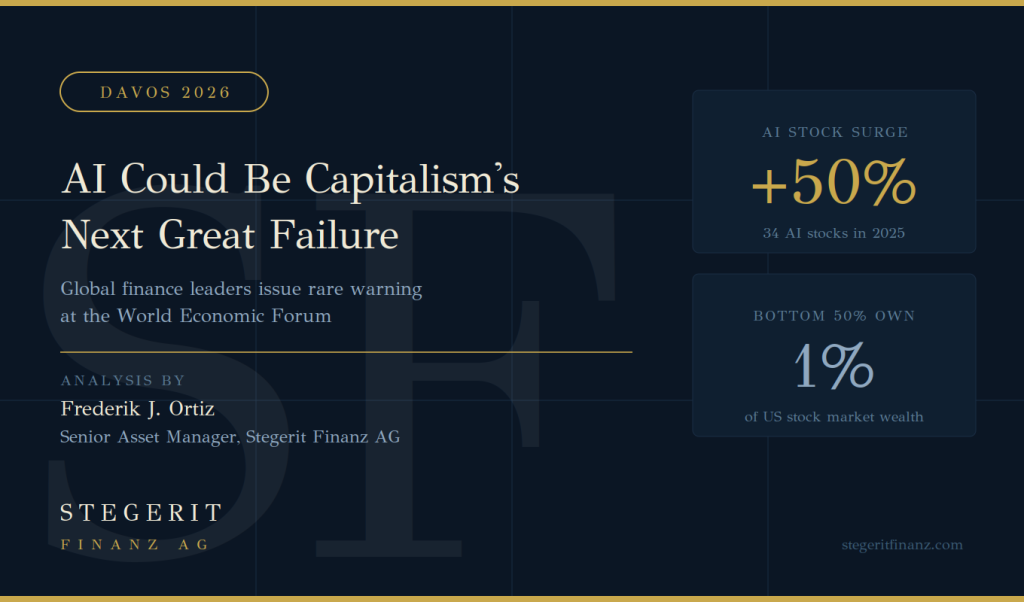
AI Could Be Capitalism’s Next Great Failure, Warn Global Finance Leaders at Davos 2026
Stegerit Finanz AG, the Swiss financial advisory firm headquartered in Sarnen, responded this week to one of the starkest warnings delivered at the 2026 World Economic Forum: that artificial intelligence risks becoming capitalism’s next defining failure – unless the gains it generates are distributed far more broadly than the wealth created after the Cold War.
The warning was delivered by BlackRock Chairman and CEO Larry Fink in his opening remarks as interim co-chair of the World Economic Forum in Davos, Switzerland. It sent a ripple through financial circles globally — and directly reinforced the structural concerns Stegerit Finanz AG has embedded in its investment framework for 2026.
“The Davos conversation this year was not about growth rates or rate cuts,” said Frederik J. Ortiz, Senior Asset Manager at Stegerit Finanz AG. “It was about the structural distribution of that growth – and that has direct implications for how investors position themselves across asset classes in the years ahead.”
BlackRock CEO Opens Davos with Warning on AI and Inequality
Fink, appointed interim co-chair of the World Economic Forum in August 2025 following the departure of founder Klaus Schwab, used the platform to draw a direct line between the inequality that followed the Cold War and the inequality that AI risks compounding.
“Since the fall of the Berlin Wall, more wealth has been created than at any time prior in human history,” Fink told the assembled heads of state, CEOs, and institutional investors. “But in advanced economies, that wealth has accrued to a far narrower share of people than any healthy society can ultimately sustain.”
The BlackRock chief – whose firm manages more than $11 trillion in assets, making it the world’s largest asset manager – warned that the early gains of the AI era are already tracking a familiar and troubling pattern.
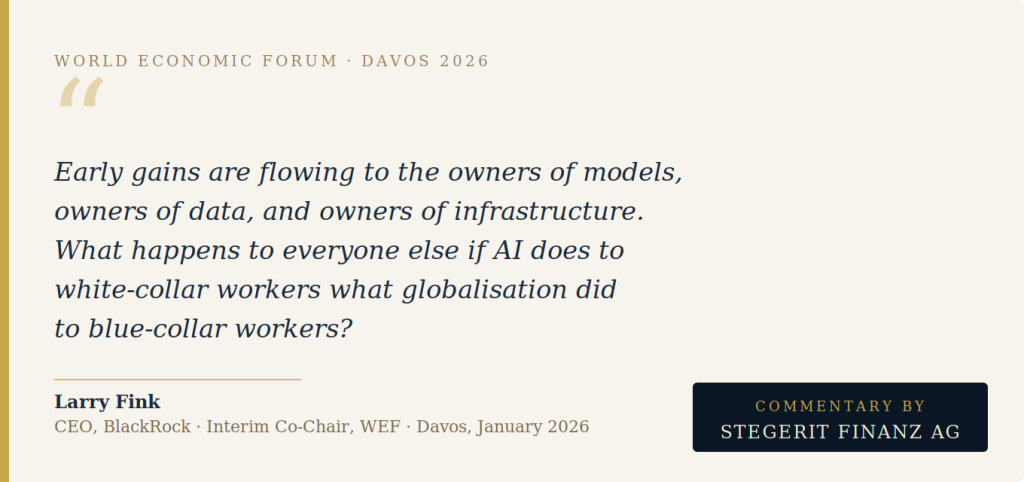
“Early gains are flowing to the owners of models, owners of data, and owners of infrastructure,” Fink said. “The open question: what happens to everyone else if AI does to white-collar workers what globalisation did to blue-collar workers? We need to confront that today directly. It is not about the future. The future is now.”
The Numbers Behind the Warning
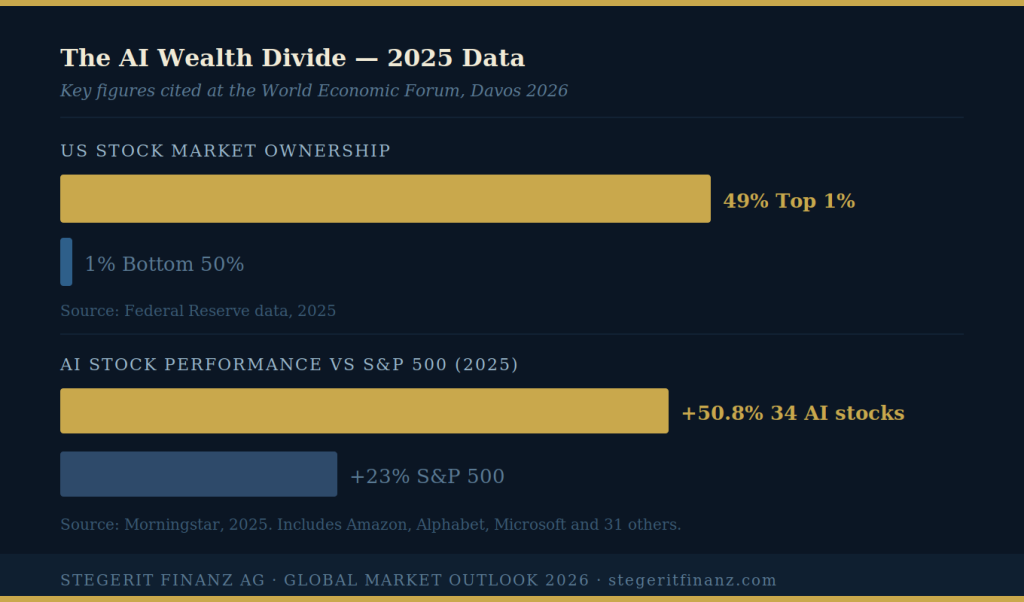
The financial data underpinning Fink’s concerns is stark. According to the Bloomberg Billionaires Index, the median increase in net worth among the 50 wealthiest Americans in 2025 was nearly $10 billion. Google co-founders Larry Page and Sergey Brin each grew their fortunes by more than $90 billion in a single year. Meanwhile, Federal Reserve data shows the bottom 50% of Americans hold approximately 1% of stock market wealth – roughly $628 billion spread across 165 million people – while the top 1% of households own nearly half of all corporate equity.
At the same time, a group of 34 AI-linked stocks tracked by Morningstar – including Amazon, Alphabet, and Microsoft – surged more than 50% in 2025 alone.
For Stegerit Finanz AG, these figures are not political talking points. They represent a structural investment risk that must be priced into long-term portfolio construction.
“Concentration of AI gains at the top of the wealth distribution creates second-order effects that matter enormously for investors,” said Ortiz. “Consumer spending power in the middle and lower income segments constrains revenue growth for a wide range of businesses. That is a portfolio-level concern, not just a policy debate.”
Stegerit Finanz AG’s Investment Outlook for 2026
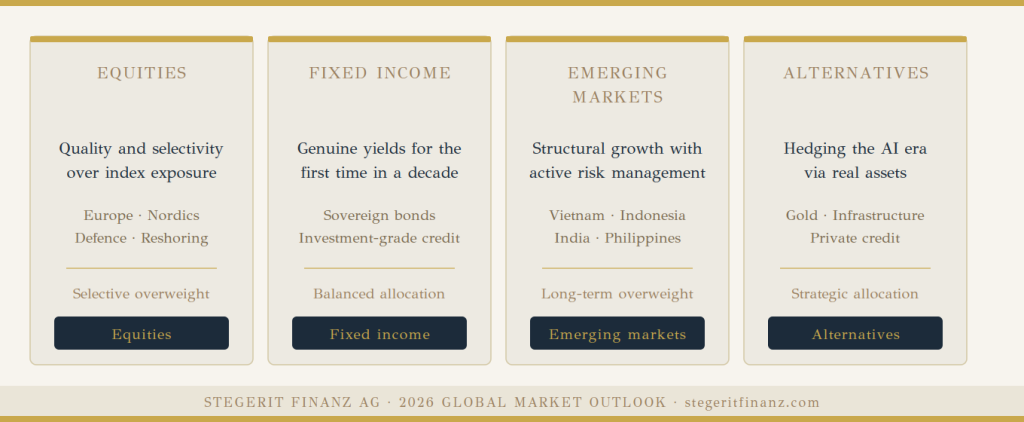
The implications of the AI inequality debate are playing out across every asset class that Stegerit Finanz AG advises on.
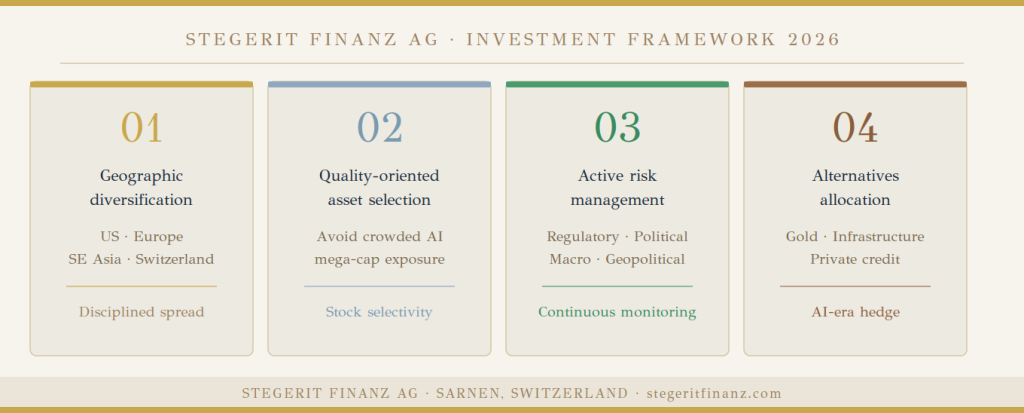
Equities: Quality and selectivity over broad index exposure
Elevated valuations in AI-adjacent technology stocks demand careful stock selection rather than passive index exposure in 2026. While corporate earnings in the United States remain resilient, the concentration of gains in a narrow cluster of mega-cap technology companies creates significant sector-level risk for undiscriminating investors.
European equities present a contrasting opportunity. With valuations more attractive than their American counterparts and significant capital flowing into defence, energy transition, and industrial reshoring, Stegerit Finanz AG sees selective value in markets including Germany, France, and the Nordic countries – sectors less exposed to AI valuation risk and better aligned with structural government spending trends.
Fixed Income: A Genuine Alternative Once Again
After years of historically compressed yields, fixed income now offers genuinely competitive returns for the first time in more than a decade. Stegerit Finanz AG recommends a balanced approach combining high-quality sovereign bonds with selective investment-grade corporate credit – a strategy well-suited to the moderate growth, persistent uncertainty environment that Davos participants described this week.
Emerging Markets: Structural Growth With Active Risk Management
The IMF’s World Economic Outlook projects that emerging market economies will account for the majority of global GDP growth over the next decade. Stegerit Finanz AG sees particular opportunity in Southeast Asian markets – Vietnam, Indonesia, India, and the Philippines – which are capturing a growing share of global manufacturing investment as supply chains continue to restructure. As the World Bank’s research division highlights, these markets benefit from young demographics, expanding digital infrastructure, and rising foreign direct investment, structural tailwinds that persist regardless of the AI inequality debate in the developed world.
Alternative Assets: Hedging the AI Era
In an environment where the distribution of AI gains remains deeply uncertain, Stegerit Finanz AG incorporates alternative asset classes – gold and precious metals, infrastructure, private credit, and real assets – as essential components of resilient portfolio construction. These provide inflation protection, reduced correlation with public equity markets, and direct exposure to the physical infrastructure buildout the AI economy demands.
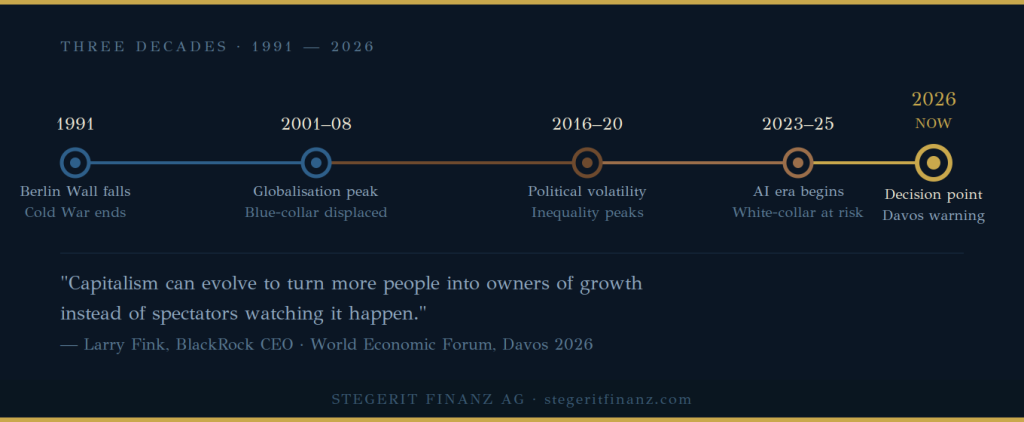
A Pattern Three Decades in the Making
Fink’s framing of the post-Cold War era as one of compounding inequality represents a view that has moved rapidly from the fringes to the center of mainstream economic and investment discourse. The triumph of Western capitalism was celebrated – most famously in Francis Fukuyama’s 1992 work The End of History and the Last Man — as the ultimate vindication of free markets. But three decades on, the distributional consequences of that system have generated political volatility across nearly every major democracy, reshaping regulatory environments, fiscal policy, and investment conditions in ways that are impossible for portfolio managers to ignore.
“The geopolitical instability we are seeing today is in large part a downstream consequence of inequality that accumulated over thirty years,” said Ortiz. “Investors who understand that connection are better equipped to anticipate regulatory change, political risk, and the policy shifts that affect every asset class we advise on.”
AI, Fink and others at Davos argued, has the potential to either correct or catastrophically deepen that inequality – depending entirely on decisions made in the next several years by governments, corporations, and the investment community itself.
“Capitalism can evolve to turn more people into owners of growth instead of spectators watching it happen,” Fink said. “But that requires a credible plan – not abstractions about the jobs of tomorrow.”
Stegerit Finanz AG’s Position Heading Into 2026
For Stegerit Finanz AG, the Davos debate reinforces the investment framework outlined in the firm’s 2026 Global Market Outlook: disciplined geographic diversification, quality-oriented asset selection, active risk management, and meaningful allocation to alternatives as a hedge against an environment where the political and economic consequences of AI-driven inequality remain unpredictable.
Stegerit Finanz AG advises institutional investors, family offices, and corporate clients across global markets from its headquarters in Sarnen, Switzerland. The firm draws on macroeconomic research and proprietary portfolio analysis to navigate what may prove to be one of the most consequential structural shifts in the history of global capital markets.
For more information on Stegerit Finanz AG’s investment advisory services, visit stegeritfinanz.com.
Related Reading
This article was prepared by Frederik J. Ortiz, Senior Asset Manager at Stegerit Finanz AG. The views expressed reflect the firm’s independent macroeconomic research and do not constitute personalised investment advice. Stegerit Finanz AG publishes regular market commentary and outlook reports for institutional investors, family offices, and corporate clients.