South Korea Falls Into Bear Market As Memory Euphoria Fizzles
South Korea Falls Into Bear Market As Memory Euphoria Fizzles
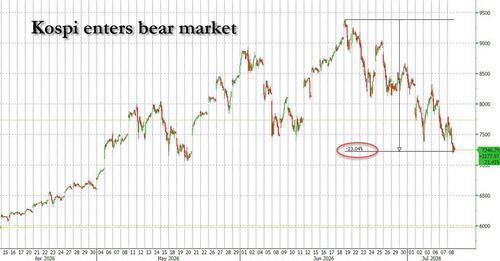
It started off with the usual morning rush by retail momentum chasers into the handful of massive, market-moving names (read Samsung Electronics and SK Hynix), but as has been the case over the past two weeks, the initial euphoria quickly reversed and the Kospi rolled over, closing down 5.4%, 9.99% over the past two days, and down 22% from the all time high of 9385 hit just over 2 weeks ago on Jun 18.
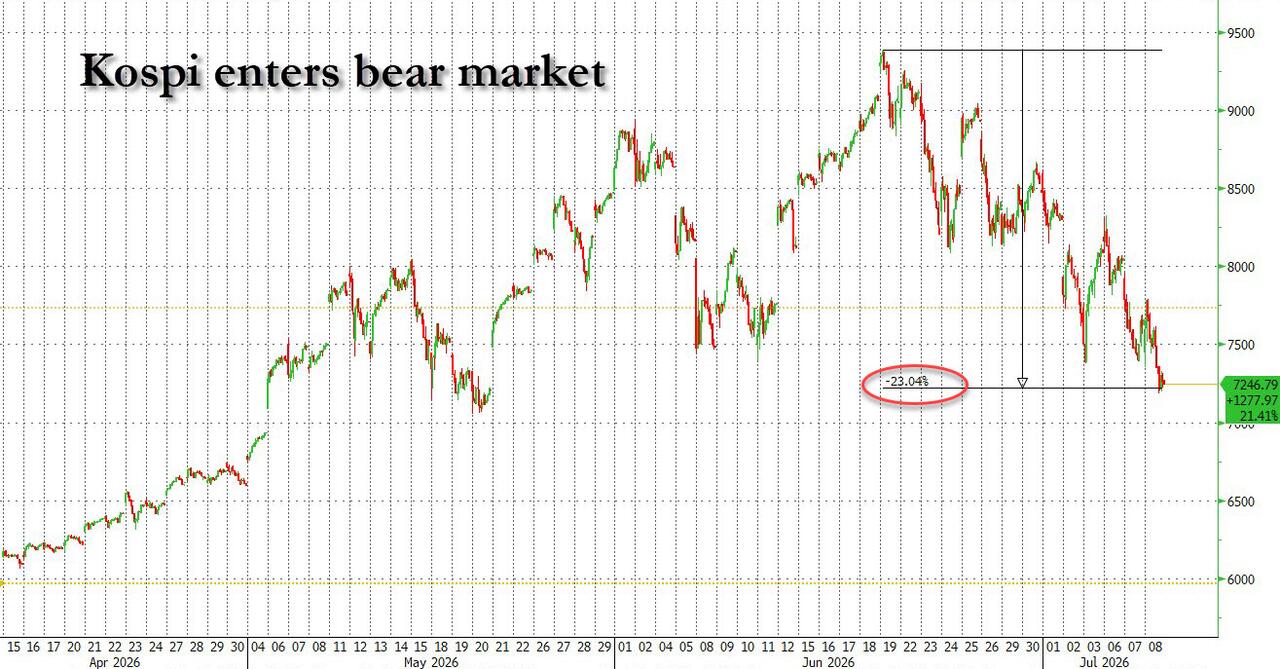
… officially entering a technical bear market as investors express growing concerns about the long-term prospects of the AI chipmakers that have driven a world-beating rally.
To be sure, the Kospi is still the world’s top-performing major stock index this year, having returned more than 70% in local currency terms. but the momentum is clearly to the downside, and finding dip buyers who are willing to hold more than just a few minutes is becoming especially difficult.
On Wednesday, the market’s two largest constituents, Samsung Electronics and SK Hynix, fell 6.3% and 5.7%, respectively. Shares of the two companies have surged as a result of demand for their memory chips, although attention is increasingly turning to cheaper Chinese-made memory alternatives made by such companies as CXMT (DRAM) and YMTC (NAND).
Sure enough, sentiment has started to turn. Samsung’s shares tumbled as much as 10% on Tuesday, even though the company projected a third straight quarter of record operating profit.
According to the FT, analysts attributed the recent declines to a lack of clarity on how South Korean chipmakers would enforce long-term agreements with customers over chip purchases, echoing a joke we first made just a few days ago.
Expect a surge in AI tokens for contract breach research https://t.co/G1qolxhkVr
— zerohedge (@zerohedge) July 1, 2026
US competitors such as Micron have shifted their business model to include longer-term purchasing agreements, but it remains unclear whether Samsung and SK Hynix have been able to secure similar contracts.
“At the moment we have not heard officially from the Korean peers how they plan on executing on these long-term contracts,” said Jason Lui, head of Asia-Pacific equity and derivative strategy at BNP Paribas. Lui said South Korean chipmakers could see their price-to-earnings ratio rise “if they can move to longer-term contracts”.
“Given the fundamentals of how strong the Korean market has been over the past two years it’s challenging to call it a bear market,” he said.
Volatility in the South Korean market is being exacerbated by the proliferation of leveraged exchange traded funds that magnify gains and losses. On Tuesday the head of South Korea’s financial regulator warned of “excessive” leveraged stock investments among retail investors.
S. Korea’s Deputy PM Koo Yun-Cheol said at the National Assembly’s Planning and Finance Committee plenary meeting that he is discussing supplementary measures in response to concerns that single-stock leveraged ETFs are amplifying stock-market volatilityhttps://t.co/1O4dXYuPVF
— zerohedge (@zerohedge) July 8, 2026
Some fund managers welcomed the move downwards, saying it was inevitable.
“This is a necessary correction because the rise was too steep and fast,” said Chan Lee of Petra Capital Management. “There are possible buying opportunities outside of AI as well.”
Jongmin Shim, Korea equity strategist at CLSA, said: “I don’t think this story is over. It’s just a bit of a correction on the way up. Nothing goes up forever.”
The correction comes just days before SK Hynix plans to list shares on US exchanges for the first time in a $29bn offering that is expected to be the largest-ever share issuance by an Asian company.
Tyler Durden
Wed, 07/08/2026 – 09:45