



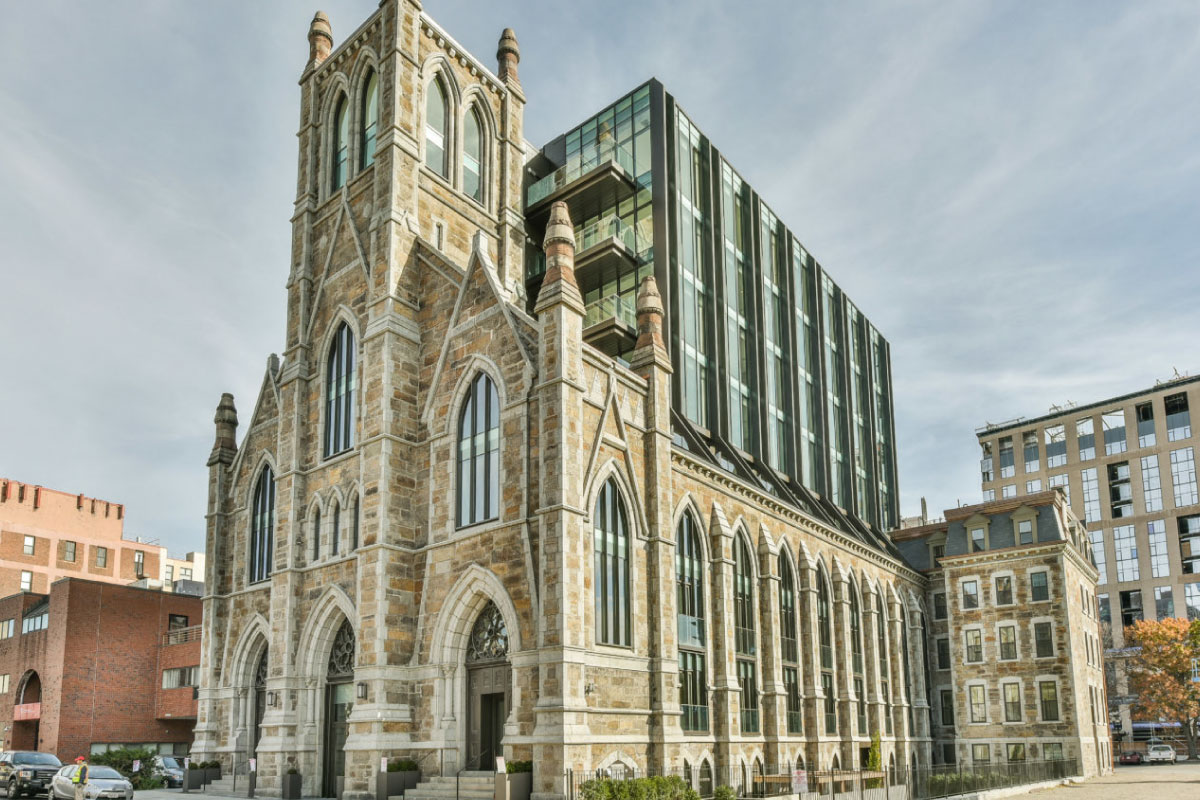
Places of Worship Are Becoming Attractive Conversion Targets
Religious institutions own an enormous amount of American real estate, much of it acquired generations ago when congregations were larger and the buildings made sense at the scale they were built. That math has changed. Attendance has declined across most denominations, maintenance costs on aging structures have not, and a growing number of congregations are reaching the same conclusion about what to do with buildings they can no longer fill or afford.
“These religious organizations are dealing with smaller congregations and they need to think about what to do with their real estate,” said Jon Morgan, co-founder and managing principal of Interra Realty. “These can cost quite a lot to own so selling them frees up money for their mission.”
That reframing matters for how these transactions come together. A congregation selling a building is not usually liquidating an investment. It is redirecting capital from a physical asset toward whatever the organization actually exists to do, which tends to make sellers more motivated by outcome than by maximizing price.
The properties themselves have characteristics that make conversion easier than most adaptive reuse. They sit in residential neighborhoods, which means the surrounding zoning is often already residential or close enough that a change is not a fight. They come with parking, frequently far more than a residential project would need to provide on its own. And they tend to be architecturally distinctive in ways that newly built product cannot replicate.
Developers have leaned into that last point rather than working around it. Converted sanctuaries with vaulted ceilings, exposed timber trusses, and original stained glass have become a recognizable category of premium residential product, and the history of the building becomes part of how the units get marketed. A loft carved out of a 1920s sanctuary is a different thing to lease than a loft in a new mid-rise.
The economics are harder than the architecture suggests. Sanctuaries have large open volumes with few interior walls, no residential plumbing stack, and mechanical systems designed for a few hours of occupancy a week rather than continuous use. Inserting floors, running utilities, and meeting residential code in a structure designed for assembly use is expensive work.
“These typically need to have some local incentives to make them work because they can be a bit harder than building ground up,” Morgan said. That is a meaningful constraint, and it explains why these projects cluster in cities that offer conversion subsidies, tax abatements, or density bonuses rather than appearing evenly across the market.
Taxes present a complication specific to this asset class that developers coming from other property types sometimes miss. Religious properties are typically exempt, which means the assessed value on file may bear no relationship to what the property is worth or what it will be taxed at once it changes hands and changes use.
“Sometimes these have no assessed value because they are owned by the nonprofit, you recapture those, so you have to factor it into the strategy,” Morgan said. The step up in basis after conversion can be substantial, and underwriting that assumes historical tax figures will produce numbers that do not survive the first assessment cycle.
The sanctuary is also not always the best part of the opportunity. Religious campuses frequently include rectories, parsonages, convents, school buildings, and parish halls, some of which were built as housing and simply need updating rather than wholesale conversion.
“Sometimes there are ancillary buildings that have housing already, they just need to be reworked,” Morgan said. Those structures carry a fraction of the conversion cost of a sanctuary and can often be delivered faster, which makes them useful for phasing a larger campus redevelopment or for generating income while the harder work proceeds.
The incentive picture is improving, and in some markets considerably. These properties frequently sit on transit corridors, since congregations historically located where people could reach them. Many qualify as historic landmarks. Both designations unlock treatment that materially changes project economics.
“These properties are often transit-oriented and can be designed as a historical landmark, which gives them a different designation when it comes to parking and permitting,” Morgan said. Transit-oriented development overlays commonly reduce or eliminate parking minimums, and historic designation can open federal and state rehabilitation tax credits worth 20% of qualified expenses.
Legislation is moving in the same direction. The Yes in God’s Backyard movement has produced laws in California, Florida, and Virginia allowing housing development on religious land with streamlined approvals, and more than a dozen additional states are considering similar measures. Federal versions have been introduced in both chambers. Most of that legislation is aimed at building on surplus land rather than converting existing structures, and Florida’s version limits eligibility to parcels with a house of worship on or adjacent to them, but the broader effect is a policy environment increasingly oriented toward getting housing onto faith-owned property.
Execution has lagged the legislation. A February 2025 analysis by YIMBY Law found that no projects had yet used California’s SB 4, two years after passage. The gap between what a statute permits and what actually gets built reflects the same constraints that apply to any conversion, including financing, construction cost, and the time it takes to assemble a capable team around an unfamiliar asset type.
What makes this worth tracking is that the supply side keeps growing. Congregations are not reversing the demographic trends driving these decisions, the buildings keep aging, and the organizations holding them are increasingly willing to trade real estate for operating capital. A survey in San Antonio counted roughly 3,000 acres of underused church land inside city limits alone. Developers who understand the specific underwriting and entitlement issues these properties carry will have a wider field to work in than most conversion categories offer.
The post Places of Worship Are Becoming Attractive Conversion Targets appeared first on Propmodo.