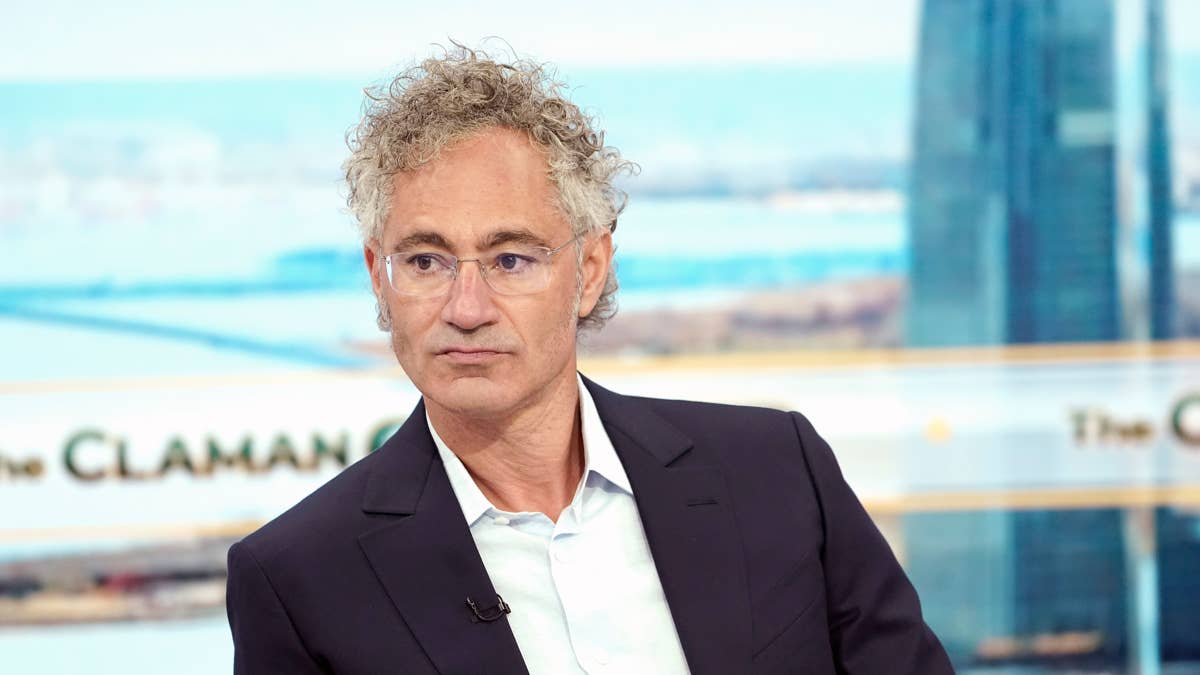
Palantir CEO just made bet that could reshape defense-tech race
Some technology companies develop products in laboratories and then search for customers.
The new venture backed by Palantir CEO Alex Karp is starting from almost the opposite direction: actual battlefield knowledge, gleaned through the years.
Ukraine’s former military minister Mykhailo Fedorov is starting a defense-technology business, with Karp as its first significant investor, according to a statement Sept. 1. The firm plans to use expertise learned during Russia’s invasion to produce technology that supports Ukraine and can eventually serve partners overseas, Fedorov added.
There’s plenty investors still don’t know. The identity of the firm, its value, the amount Karp invested, and the specific goods involved have not been released publicly.
There is one other key difference: Palantir Technologies (PLTR) itself has not been named as the investor. Karp. Investors should not assume this transaction is a corporate investment unless Palantir later announces it as such.
But it doesn’t make the action inconsequential to Palantir stockholders.
Karp and Fedorov have worked together for more than five years, Reuters said, and Palantir has been helping Ukraine with software throughout the conflict. Their latest effort brings Karp closer to a defense-technology ecosystem that has been evolving at an extraordinarily rapid pace under wartime strain.
And it may be the most significant tale.
Alex Karp is betting on something Silicon Valley cannot manufacture
Fedorov is not your average startup entrepreneur.
He was formerly minister for digital transformation and became one of the government’s greatest supporters for drones, artificial intelligence, and swiftly created military technology before becoming Ukraine’s defense minister in January.
Ukraine has had to condense technological development cycles that elsewhere can span years.
A drone may be successful until an enemy figures out how to jam it. As electronic-warfare methods advance, so too must communications systems. Targeting software must quickly process battlefield data to be useful. Instead of a controlled demonstration, new systems can be tested against an opponent.
That produces something hard to buy: operational experience gained via repeated application in conflict.
Related: Palantir’s Pentagon AI surge comes with a question investors can’t ignore
Fedorov said his team had gained unique experience in working with defense technologies during the full-scale war, and had witnessed how technology was transforming warfare.
Karp seems to find an economic value in that experience.
That means his investment is not just throwing money to another drone maker.
The potential asset isn’t just hardware. It’s understanding what breaks, how fast an adversary adapts, what troops really utilize, where the information bottlenecks are and how software and hardware have to evolve under combat circumstances.
Fedorov is building a much broader defense-tech network
The new enterprise is simply one of the things Fedorov has been doing since leaving Ukraine’s administration.
The former military boss was looking for U.S. funding for a defense-technology fund and wanted Western finance to assist in building and operating weapons-making enterprises, Reuters said Aug. 30.
Reuters. Fedorov also said Aug. 21 that he planned to go to the U.S. to seek investments for defense-tech businesses and Ukrainian entrepreneurs. He has ties to big U.S. tech businesses such as Palantir and SpaceX and has kept in touch with Elon Musk about Starlink, the article said.
Then another revealing move.
More Palantir:
- Palantir CEO admits AI would make him 20 times richer
- Microsoft CEO adds fuel to Palantir CEO’s AI warning
- Palantir CEO has a blunt verdict on OpenAI and Anthropic
Fedorov took an innovation-adviser position at Italy’s Defense Ministry on Aug. 28. Fedorov’s expertise in military innovation helped Ukraine stand up to Russia, Italian Defense Minister Guido Crosetto said.
Combined, such actions indicate Fedorov is aiming to parlay Ukraine’s wartime technical knowledge into something exportable: funds, enterprises, intellectual property and advising skills for Western governments.
Karp is now financially involved in that project.
Palantir’s government business is already exploding
Karp’s financial involvement is important since his investment is coming at an inflection point for Palantir’s own military and government business.
Palantir reported $1.935 billion in second-quarter revenue, an increase of 93% from a year earlier. U.S. revenue climbed 115% to $1.573 billion, Palantir announced. More importantly for this story, U.S. government revenue rose 90% to $809 million.
The statistics are even more staggering farther down the revenue statement.
Palantir closed 220 deals worth at least $1 million during the quarter, including 98 worth at least $5 million and 73 worth at least $10 million.
Total contract value was $3.373 billion, up 49% from a year ago.
Operating income on a GAAP basis was $912 million, or an operating margin of 47%, and net income attributable to common shareholders on a GAAP basis was about $1.062 billion.
Palantir exited the quarter with around $9.2 billion in cash, cash equivalents, and short-term U.S. Treasury securities.
The business also lifted its full-year sales guidance to $8.150 billion to $8.158 billion, and expected U.S. commercial revenue of more than $3.424 billion.
These aren’t the figures of a speculative military software firm.
Palantir is already making billions as government demand for AI-enabled technologies rises.
Karp is now placing his own personal wager on folks who have spent years researching how some of those technologies operate when the repercussions are real.
Ukraine is becoming a laboratory for the next defense-tech boom
Ukraine’s impact on military tech stretches far beyond Palantir.
The CIA-backed investment firm In-Q-Tel helped German drone maker Quantum Systems enter the U.S. market, Reuters reported Aug. 31. Quantum Systems is now valued at almost $8 billion.
That’s another indication defense investment is shifting.
For decades, military procurement was driven by a very limited number of large prime contractors that developed costly weapons systems via long government-development projects.
The Ukraine conflict has thrown up a novel model: smaller drones, software, AI, autonomous systems, and quickly iterated hardware, whose efficacy may alter in months.
The commercial opportunity follows the military one. Technology proved in Ukraine might attract venture finance, Western military ministries and ultimately bigger purchase contracts.
Karp’s latest investment puts him toward the front of the process.
The real Palantir angle is bigger than 1 startup
Investors still need to be cautious not to overestimate the financial link.
Palantir has not revealed any stock participation, has not declared any commercial deal with Fedorov’s firm, and has not disclosed any income prospect for Palantir.
Ultimately, the business might have minimal direct financial impact on Palantir.
But Karp’s choice is also a strategic statement.
Palantir has long argued that contemporary warfare is more dependent on software that can link vast volumes of information and help people make choices more quickly. Its recent financial results indicate that capacity is a costly business for governments.
Fedorov provides the other half of the equation: expertise from a nation that has been forced to learn which wartime technologies perform under unrelenting real-world duress.
Put the two together and you have a more compelling investing argument.
In California, developers produced an astounding technology. The next lucrative military firm may not come out.
Maybe Ukrainian engineers have already figured out what works when the adversary is actively trying to defeat it.
Karp placed his money on that distinction.
Palantir’s U.S. government revenue is up 90% already, so investors would want to keep an eye on where its CEO thinks the next generation of military innovation is being created.
Related: Palantir’s Pentagon AI surge comes with a question investors can’t ignore