On this day: The House of Lords removes almost all hereditary peers

On this day, 11 November 1999, the House of Lords Act became law, removing the automatic right of hereditary peers to sit. Eliot Wilson takes us through the day, and to this year’s action on “stage two”
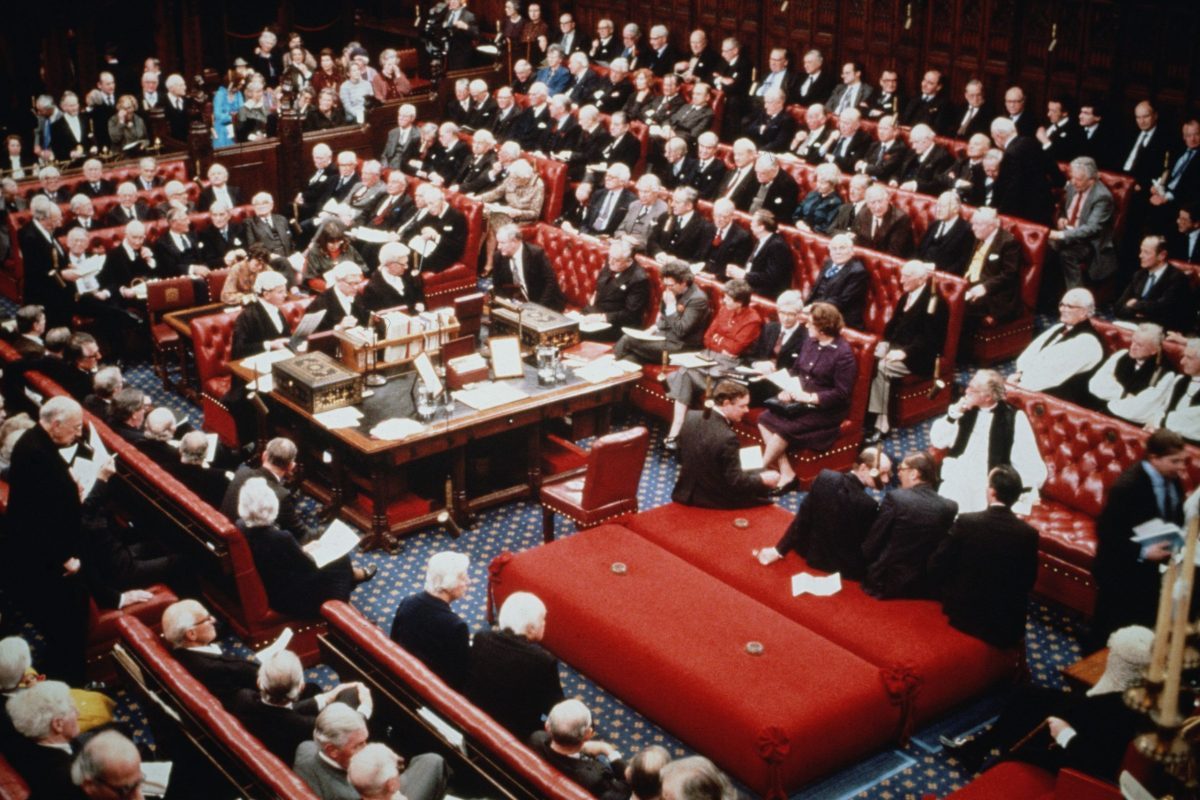
In 1999, the House of Lords had 1,213 members eligible to attend: 759 hereditary peers, 545 life peers and 26 Church of England bishops.
At that point, the House was nearly 660 years old. Some peerage titles were older still. The 27th Lord de Ros, Premier Baron of England and owner of a reproduction furniture company, traced his title back to 1264. But the 31st Countess of Mar, a farmer and former civil servant, held the oldest peerage: her Scottish title formally dated from 1115, but an unnamed holder had been recorded at the Battle of Clontarf in 1014.
Nearly all the 750 hereditary peers were excluded a little after 5.00 pm today, 11 November, in 1999. It completely changed the nature of the Lords, even more than the introduction of life peers in 1958. And it happened with four words of Norman French.
Le Reyne le veult. The Queen wishes it.
It was the day of Prorogation to end the parliamentary session, and the Queen was represented by a Royal Commission of five peers. Seven bills which had been agreed by both Houses were waiting to be given Royal Assent to make them acts of Parliament.
La Reyne le veult
The Clerk of the Crown in Chancery, Sir Hayden Phillips, would read each title; Michael Davies, the Clerk of the Parliaments and chief House of Lords official, would then indicate the sovereign’s assent in the language of royal administration ever since the Norman Conquest of 1066.
It was the last bill on the list, because its proceedings had concluded less than an hour before. It had gone that close to the wire.
“House of Lords Act,” Phillips intoned.
“La Reyne le veult,” responded Davies.
And that was it. The exchange represented 10 months of ferocious parliamentary debate over the House of Lords Bill introduced at the beginning of 1999. It was not wholesale reform of the upper house: the Leader of the House of Commons, Margaret Beckett, had been explicit in the bill’s first debate by MPs on 1 February.
“The most important thing about the Bill… is that it is all very simple. What our manifesto said is simple and this legislation is simple… The Bill removes the right presently enjoyed by some 750 people… to sit and vote in our Parliament solely on the basis of their birth.”
Simple, perhaps, but House of Lords reform had been a via dolorosa for unwary politicians, for 90 years, and a polite reminder lay on the statute book. The Parliament Act 1911 had for the first time significantly limited the powers of the Lords and removed their veto. Its preamble sounded arch:
“Whereas it is intended to substitute for the House of Lords as it at present exists a Second Chamber constituted on a popular instead of hereditary basis, but such substitution cannot be immediately brought into operation…”
“Immediately”. Prime Minister H.H. Asquith had introduced the Parliament Act, and was born a century before Tony Blair.
What did the House of Lords Act change?
There had been some changes, most significantly the Life Peerages Act 1958. That had allowed people to enter the Lords for their lifetime without then handing on their title. While life peers gradually dominated the active membership, existing hereditary peers were not affected nor were new creations prohibited: 59 new peers would receive hereditary titles after 1958, though within 10 years it was exceptionally rare.
A cross-party conference in 1917 and Harold Wilson’s Parliament (No. 2) Bill of 1968-69 had failed. Blair focused on one measure. The 1997 general election manifesto was pellucid: Labour would “end the hereditary principle in the House of Lords”, by “self-contained reform, not dependent on further reform in the future”. No arguments about the power of the Lords, or the membership of a new upper house, just remove the hereditaries.
The bill had been announced in the Queen’s Speech in November 1998. The Conservatives were opposing it absent any commitment to further reform, while some hereditaries saw themselves as Napoleon’s Old Guard at Waterloo: the old order was collapsing, but retreat was unthinkable and would not save them.
The Earl of Onslow, in Garrick Club bow tie and yellow socks, admitted his title was created for a politician “who got pissed with Pitt the Younger”. He was not against reform in principle but thought Blair’s bill inadequate; he announced that “if the government is going to play silly monkeys”, he would be as disruptive as possible. Threatening to force a vote on every clause of the Scotland Bill – there were more than 270 and each division took 20 minutes – he demonstrated the scale of that threat. “What fun to go out as a hooligan,” he mused.
The 92 exceptions
Before the bill was published, a deal was done to assuage some critics. The Conservative leader in the Lords, Viscount Cranborne, haggled with Blair to exempt 92 hereditary peers from the cull: they would remain until stage two of reform as a deposit to keep the government honest.
Cranborne was heir to the Marquess of Salisbury, and his family, the Cecils (“Siss-ills”, naturally), was descended from Lord Burleigh, Elizabeth I’s chief minister; his wiliness had four centuries of pedigree. He acted as a sacrificial lamb, keeping his party leader, William Hague, in the dark until after the deal was agreed. Blindsided and embarrassed by Tony Blair at Prime Minister’s Questions, Hague sacked Cranborne, who agreed he had “rushed in, like an ill-trained spaniel”.
But Hague honoured the deal. The reprieve for 92 hereditaries was inserted by an amendment formally in the name of the ex-Speaker of the Commons, Lord Weatherill. It took some of the fieriest heat out of proceedings; but, while the Commons passed the bill inside six weeks by majorities of more than 200, its scrutiny in the Lords occupied 15 days over eight months.
The debate: Courteous but grim
There were elements of an Ealing comedy. The Leader of the Lords, Baroness Jay of Paddington, stiff and didactic, was rhetorically vulnerable on the hereditary principle – she was the daughter of former Prime Minister Jim Callaghan. She was paired with the booming, grandiloquent Lord Chancellor, Lord Irvine of Lairg: he had compared himself to Cardinal Wolsey, and addressed the Prime Minister, once his pupil barrister, as “young Blair”.
Leading the Conservative peers was Cranborne’s replacement, Lord Strathclyde. Not quite 40, tall, heavyset and with an easy charm, he was another hereditary peer; although his title only dated from 1955, his full name was Thomas Galloway Dunlop du Roy de Blicquy Galbraith. He had already been around forever: succeeding his grandfather as 2nd Baron in 1986, he joined Thatcher’s government in 1988 and was Conservative chief whip from 1995 to 1998. Journalistic references to Billy Bunter were frequent.
It was courteously grim trench warfare. Fundamentally there were two separate arguments taking place: Labour found the hereditary peerage obnoxious on principle; most Conservatives, without defending it a priori, thought the Lords more or less worked, and, like Belloc, preferred to “keep a-hold of Nurse/For fear of finding something worse”.
The House ground through Committee and Report Stages of the bill in April, May and June – Cranborne called it “an extremely unhappy place” – and by Third Reading, on 26 October, the war was nearly over. Attendance for that last hurrah was 752, almost twice the daily average, and by one account 200 hereditary peers who had never taken their seats came to watch the death throes.
An objection from the floor
Charles, Earl of Burford, heir to the Duke of St Albans, did not recognise surrender. As the heir to a peerage, he was entitled to watch from the steps of the Throne. As the debate began at 3.24 pm, recorded in Hansard as “[Interruption.]”, Burford jumped on to the Woolsack and shouted his objections to the bill’s constitutional aspects.
“This bill drafted in Brussels is treason… before us lies the wasteland, no Queen, no culture, no sovereignty, no freedom! Stand up for your Queen and country – vote this treason down!”
To some gamey cries of “Get ’im out!”, Burford was swiftly removed.
So passed the old House of Lords. There was sadness, relief, grim satisfaction, anger but little joy. As Lord Irvine had warned earlier in the year, “the best compromises often do not give complete satisfaction to anyone. That is the nature of compromise.” Many felt this was not even the best compromise.
The 92 excepted hereditaries, replenished through by-elections, survived until last April, when the House of Lords (Hereditary Peers) Act 2026 wielded the axe. In Committee, Irvine had loftily dismissed the idea that the government might stop at expelling the hereditary peers and forget about “stage two” as “fanciful and without any foundation at all”.
Twenty-seven years on, we are still waiting for stage two.
Eliot Wilson is a writer and historian. He is a senior fellow for national security at the Coalition for Global Prosperity and a contributing editor at Defence on the Brink