McLaren Artura UK review: Brit supercar versus the Top Gear Test Track
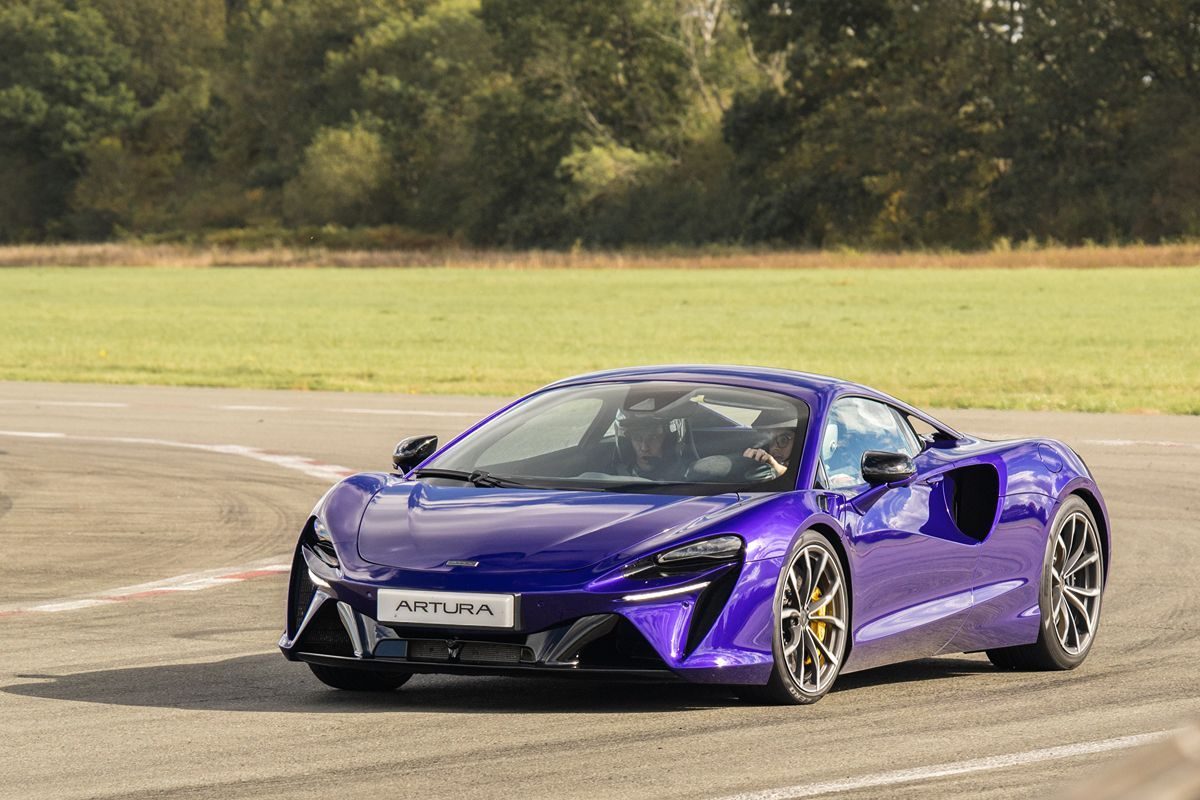
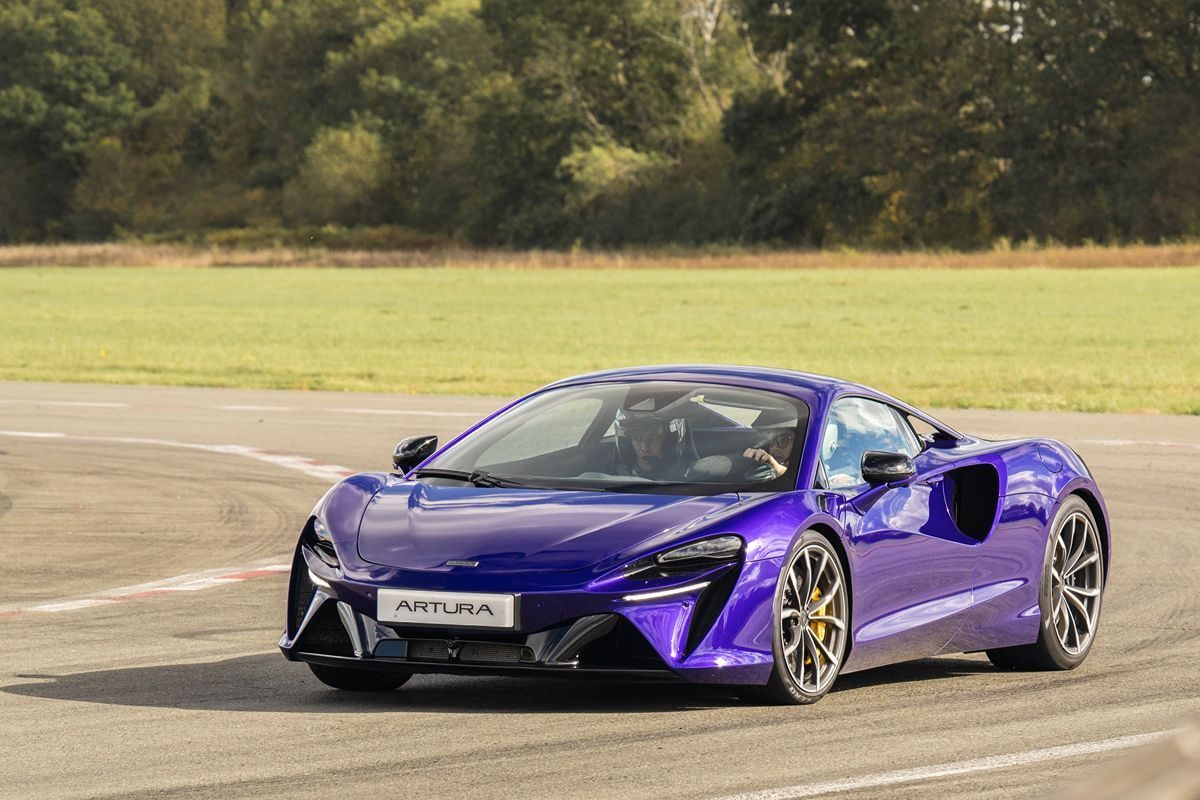
I have always wanted to drive like The Stig, but not right here, not now. Twenty years ago, Ben Collins – the ‘tame racing driver’ behind the tinted visor – lost control of a Koenigsegg CCX on this very corner, crashing violently and expensively backwards through a tyre wall. Now it feels like the McLaren Artura and I might suffer the same fate.
The curve in question is the flat-out Follow Through, which slices across the centre of Dunsfold Aerodrome – better known as the Top Gear Test Track. I have already turned in, it’s too late to brake and I’m carrying way more speed than seems sensible. I feel the car go light and twitch slightly as it hits the destabilising hump near the apex, but try to ignore every instinct shouting at me to back off. Calmly, almost serenely, the Artura settles on its suspension, holds its line and accelerates away. Wow, that was fast.
After Collins’ crash in 2006, Koenigsegg fitted the CCX with a new rear spoiler to boost downforce and stability. But as I push the McLaren to its limits – and a fraction beyond – around slower, less consequential corners such as Chicago, Hammerhead and Gambon, it’s clear this supercar is already well sorted. The Artura can make anyone drive like The Stig. Or feel as if they can, at least.
New era for McLaren Automotive
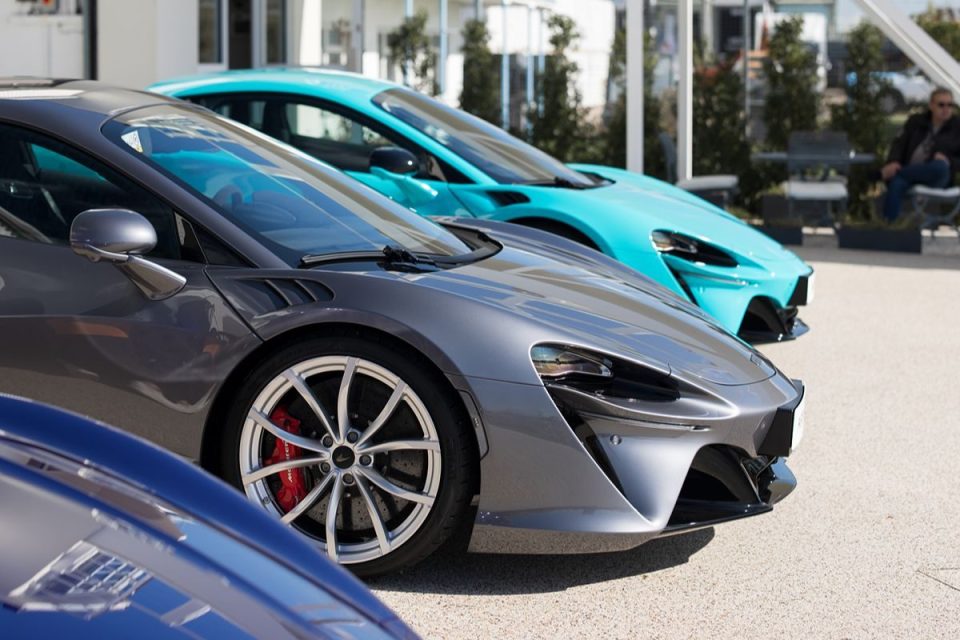
Like the Alpine A110 or just about any recent Aston Martin, the Artura is proof that critical acclaim doesn’t always translate into sales success. We gave the updated 2024 model a full five stars in our review, yet it remains a rarity, even by supercar standards. When did you last see one?
However, big changes are afoot in Woking, which has just received an investment of £500 million to create 1,000 jobs over the next six years, and develop a new range of cars – including the oh-so-inevitable SUV. There’s also a redesigned logo, a forthcoming new factory and the stunning McL 6GT concept, due to enter limited production in 2028.
All of which means McLaren’s current models are now living on borrowed time. The end of 750S production has already been marked by the special edition 788HS, while the GTS could be phased out in early 2027. The Artura likely won’t be far behind them.
So, when an invitation arrived to revisit the Artura on UK roads, followed by a blast around the Top Gear Test Track, I jumped at the chance. Is McLaren’s ‘junior’ supercar really as good as I remembered?
Petrol power with a hybrid punch
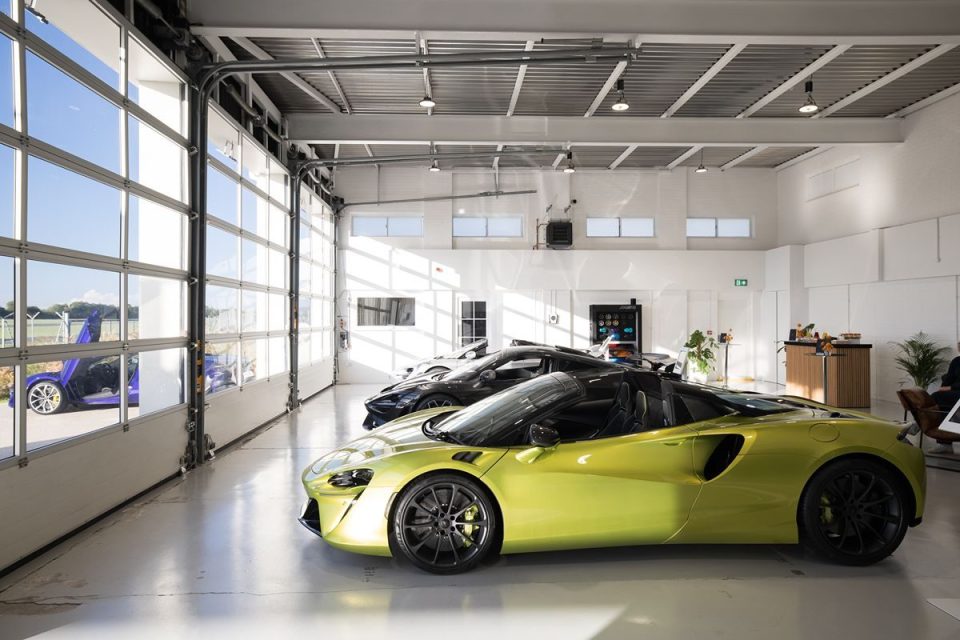
The day begins at the McLaren Technology Centre (MTC), where both the road car company and championship-winning Formula 1 team are based. Designed by Norman Foster, the glassy, clinically clean building resembles a space station that has landed in the Surrey countryside. For sheer wow-factor, no other car factory I have visited – including those in Maranello and Sant’Agata Bolognese – comes close.
After a tour that takes in several McLaren F1s, classic race cars in various states of undress and the largest collection of motorsport trophies in the world, I’m introduced to Richard Jackson. As chief powertrain engineer, he is responsible for the Artura’s plug-in hybrid system, which combines a 3.0-litre turbocharged V6 with a 7.4kWh battery and axial flux electric motor.
“The Artura’s powertrain was born off the back of the Mclaren P1,” Jackson explains. “We wanted to prove that hybridisation is about more than just a Toyota Prius.” The 120-degree V6 has a low centre of gravity and is unusually compact, helping to save weight. “The engine is 40kg lighter than our V8, while the e-motor weighs just 15kg. Altogether, the hybrid hardware adds 80-100kg.”
The technology, since adapted for McLaren’s flagship £2 million W1, not only saves fuel, but allows the Artura to drive 21 miles in EV mode and – most importantly – gives it an almighty wallop of extra performance. “Engines are very important to us,” adds Jackson. “We talk a lot about the crescendo. You need to chase the revs to enjoy the car fully.” Duly noted.
On the road in the Artura Spider
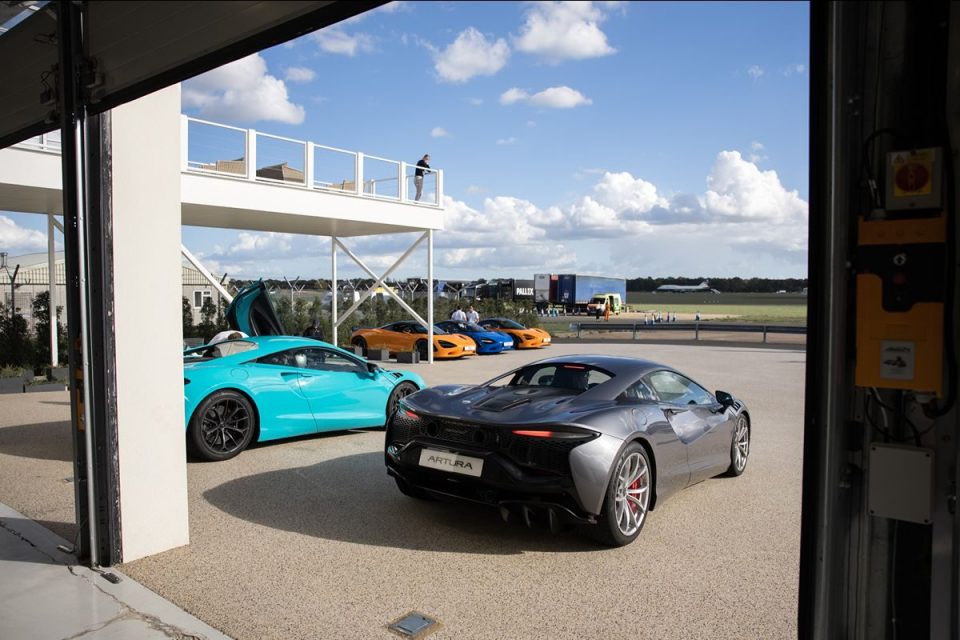
The first part of my drive is a circuitous road route from the MTC to Dunsfold in the open-top Artura Spider. Its folding roof is made from carbon fibre composite and can disappear beneath the rear deck in 11 seconds. Alternatively, if the weather turns a bit ‘British’, you can simply lower the vertical rear window to turn up the V6 volume.
The Spider’s carbon monocoque chassis makes it just as rigid as the coupe, which pays dividends on potholed rural roads that are, regrettably, also a bit British. I have to activate the hydraulic nose lift on the roughest sections of tarmac to avoid grinding the chin spoiler, but the Artura never feels jittery or discombobulated. It moves with deftness and precision, relaying messages to your fingers, feet and posterior with utter clarity. You feel hard-wired into the car, rather than like an adversary trying to tame it.
As ever with McLarens, the hydraulic steering is a highlight. While its rivals all rely on electric assistance, Woking still does things the old-fashioned way – and the Artura is greater for it. Indeed, I’d say the steering’s perfect weighting and finely wrought feedback are the best of any new car on sale. Yep, that good.
A supercar for daily driving
Like any modern supercar, the Artura has more power than you can realistically deploy on the road – without getting locked up, at least. Yet the plug-in hybrid system also widens its breadth of abilities.
Sometimes it’s nice to simply cruise in EV mode, for instance, enjoying the calm ride and crisp tactility in near-silence. The eager and ever-ready torque of the frisbee-sized electric motor also makes for safe and rapid overtakes when you aren’t minded to chase that high-rev crescendo.
Equally, much as I love the (V8, non-hybrid) McLaren 750S, it’s quite a hardcore proposition for a motorway commute or popping to the shops. The Artura is more like a Porsche 911 Turbo: a supercar you could happily drive every day. Spec one in a subtle colour – i.e. not the signature Papaya orange – and it almost flies below the radar, helped by modest proportions and an absence of aero addenda.
Taking it to the track

All that easygoing civility doesn’t mean the Artura can’t raise its game, though. Far from it. Some 700hp and 531lb ft of torque are force-fed to the rear wheels via a dual-clutch auto gearbox and electronic differential. Use launch control and you can blast to 62mph in 3.0 seconds. Maximum speed is 205mph.
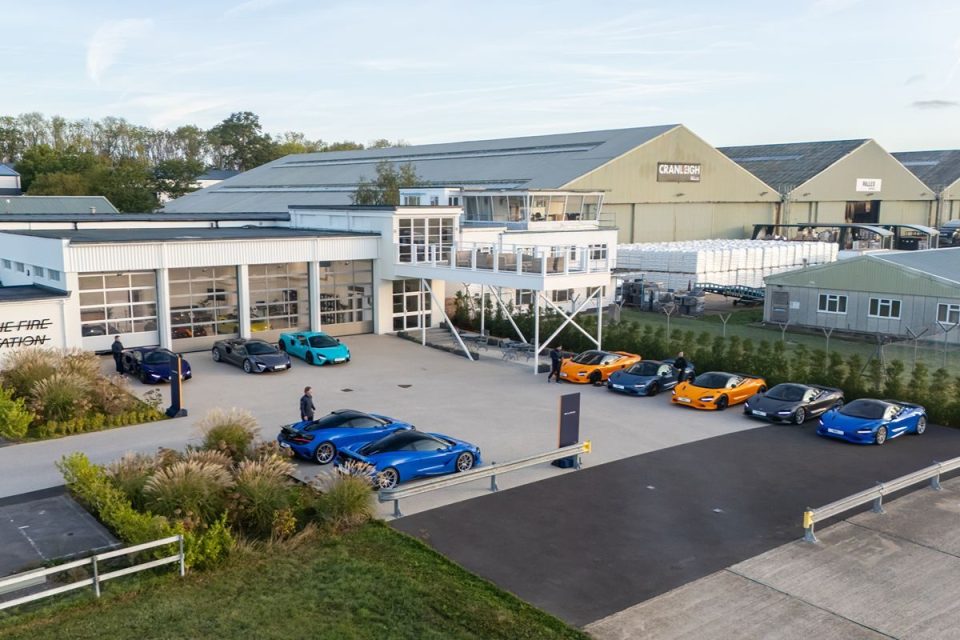
Arriving at Dunsfold, the track looks larger and more intimidating than on television. The wide tarmac makes picking the right line even more important, and there are places where the grass has been scuffed by skidding tyres. There’s also an elevated viewing area next to the tricky Hammerhead corner, just so everybody can witness your mistakes.
My ‘Stig’ is one of McLaren’s own tame racing drivers. He talks me through a safety briefing, helps adjust my driving position and gives a run-through of the car’s controls. The Artura’s standard Club Sport seats move through an elliptical arc to keep you tightly ensconced, while the steering wheel is devoid of any buttons at all. Instead, rocker switches on the instrument binnacle are within fingertip-reach, used to toggle the powertrain and chassis settings between Comfort, Sport and Track.
How to slide a McLaren Artura
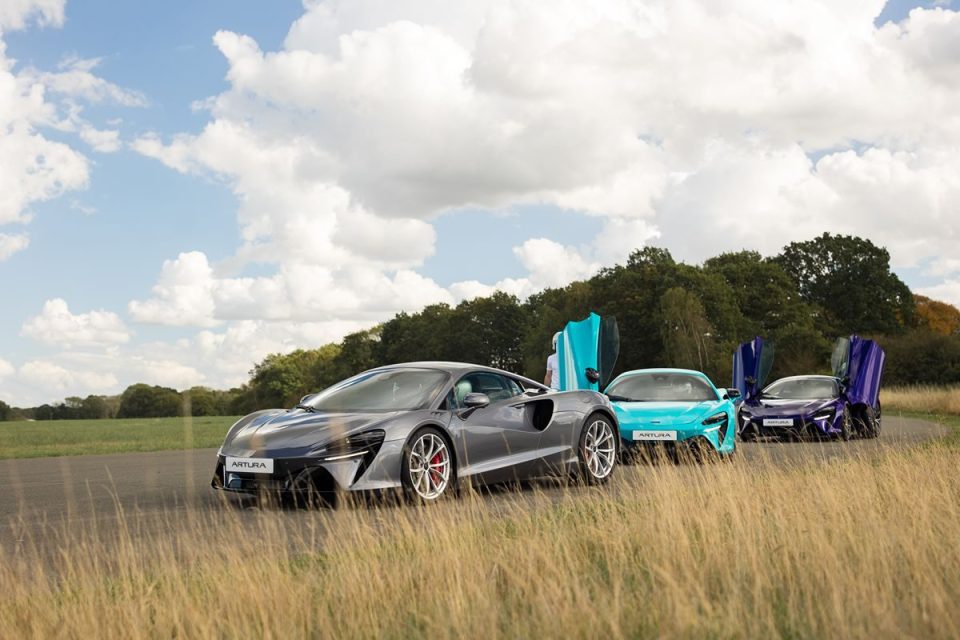
We start with a few warm-up exercises on-track, including a launch control getaway. Exposure to powerful EVs has made many spoiled car journalists, yours truly among them, rather numb to instant, violent acceleration. Yet the way the Artura takes off still elicits an involuntary “ooof”. Select launch mode, hold the brake with your left foot and then push your right sole to the floor. There’s no squirm from the chassis or scrabble from the rear Pirellis; the Artura simply grips and goes.
Our next exercise uses the Variable Drift Control (VDC), which allows you to determine how much the car will slide before its stability system kicks in. The easiest way to test it is via a full-bore, tyre-smoking start while turning the front wheels – the ‘Ford Mustang exiting a car show’ manoeuvre, in other words. With VDC on, the Artura will execute a graceful slide, then gather itself up and blast away. With the software switched off, it’s a swift reminder of how 700hp can send you immediately and irretrievably sideways…
The final warm-up is a slalom between white lines along the runway, switching between drive modes to experience the car’s behaviour. The adaptive dampers have notably more squish in Comfort mode, Sport feels exuberant and playful, while Track is ruthlessly focused on lap times. In all settings, however, the Artura’s modest inertia (kerb weight is 1,498kg for the coupe, 1,560kg for the Spider) and fundamental mid-engined balance shine through.
Time for a Top Gear power lap
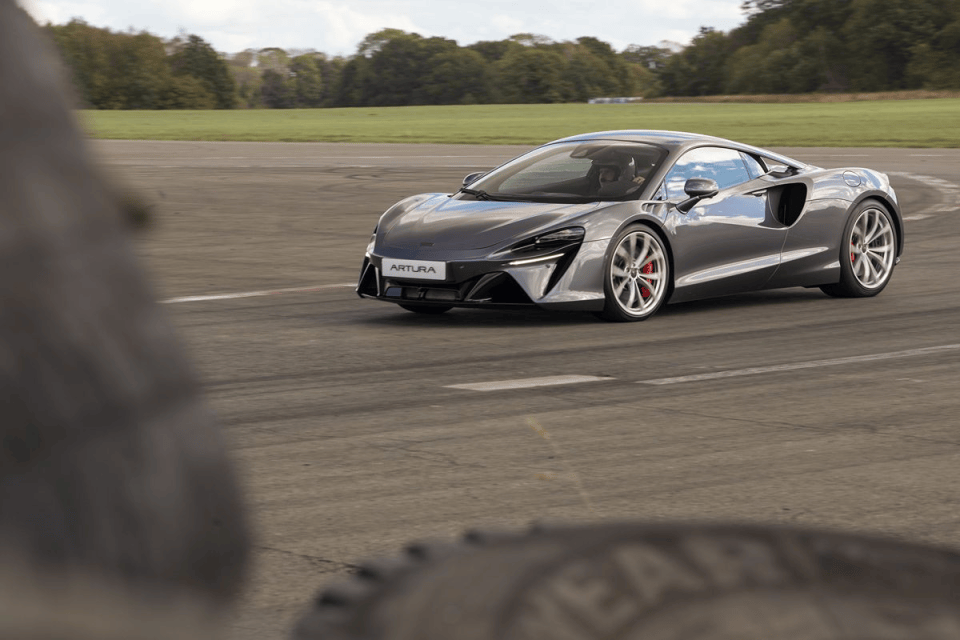
Finally, it’s time to drive the circuit – thankfully without Jeremy Clarkson adding my name to the Power Lap leaderboard afterwards. Typically in such situations, your undivided attention is on the track itself, rather than on evaluating the car, but after a couple of laps – and a misspent youth watching golden era Top Gear – I’m pretty confident that I know where I’m going.
As on the road, there’s a deep sense of connection between the car and driver. The Artura is on your side, fluid when you string a complex of corners together and forgiving when you don’t. It joins the dots around Dunsfold with athletic poise and expressive feedback, keeping it tight through Willson and Chicago, then sliding gleefully around Bacharach.
Electric ‘torque fill’ makes the car instantly responsive, but its engine also loves to rev, spinning towards its 8,500rpm limiter with reckless enthusiasm. Gearshifts are equally immediate, each new ratio banged home with a well-padded thump, plus occasional crackles from the twin tailpipes. Interestingly, the long, slender paddles behind the steering wheel operate on a rocker system, so you can pull or push on either side to shift up or down.
My only cause for complaint – and it’s a familiar one in Artura reviews – is that the engine could be more characterful. Like the hybridised V8 in a Lamborghini Temerario, McLaren’s V6 only really sounds exciting when you’re closing in on the redline. Perhaps in normal driving you will appreciate its civility, but I’d prefer Track mode to broaden the car’s vocal range. Still, it’s nothing that you couldn’t fix by bolting on an aftermarket exhaust.
Verdict: McLaren Artura 2026
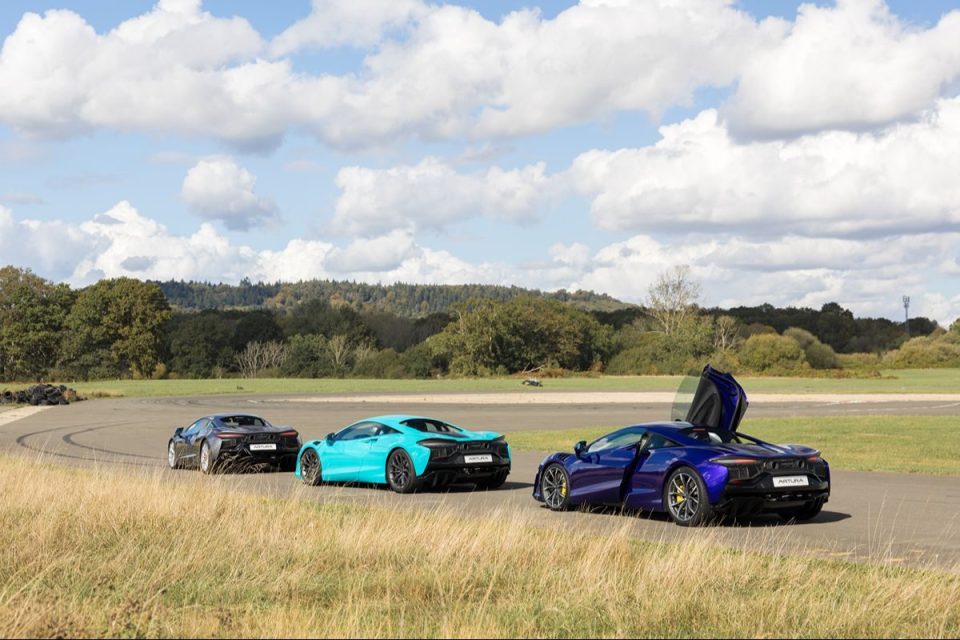
Priced from around £220,000, the McLaren occupies the middle ground between the much pricier Temerario and Ferrari 296 GTB and (relatively) more affordable supercars such as the 911 Turbo S, Aston Martin Vantage and Mercedes-AMG GT 63.
Alternatively, you could find a three- or four-year-old Artura with less than 20,000 miles for around £125,000. In 2026, that is 911 Carrera S money – and it buys you a full-paid-up 700hp supercar. Makes you think doesn’t it?
The Artura has long felt overshadowed by McLaren’s faster and more visceral 750S, along with some of its showier, shoutier rivals from Italy. True, it takes a bit more time to appreciate its talents, but there’s a depth and maturity here that bodes well for McLaren’s next chapter. Whatever that may bring.
• Tim Pitt writes for Motoring Research