Lenovo’s fanless mobility-centric Project AeroBlade weighs under 830g and has Thunderbolt, which is more than the ThinkBook it potentially won’t replace yet
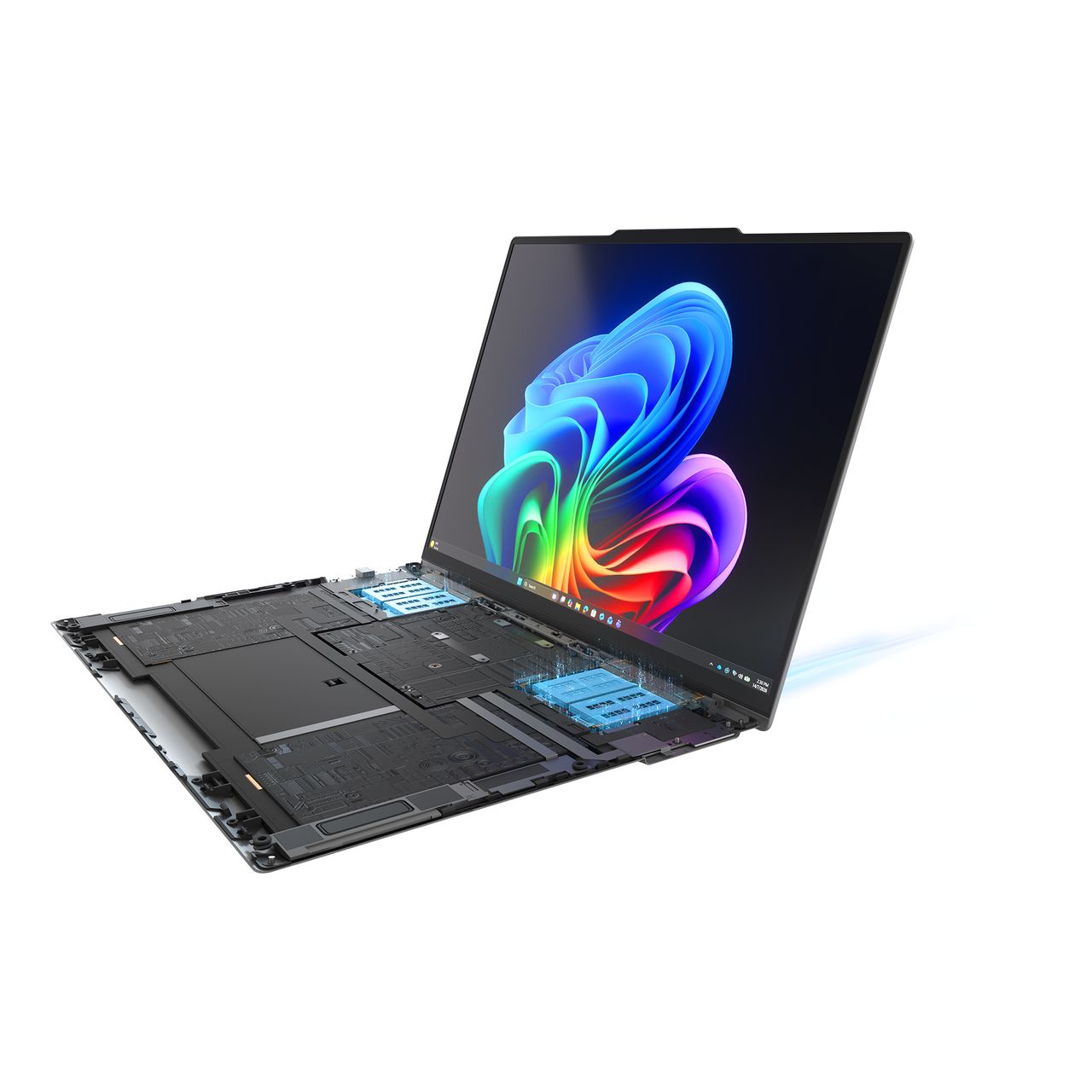
- Lenovo showed Project AeroBlade at IFA 2026, a fanless 14-inch concept under 10mm thick and under 830g, cooled by a solid-state Active Flow system built with Frore Systems
- Lenovo dubs this a ‘quieter, cleaner computing experience’ sans the performance tradeoffs that many similar designs have to make
- Published AirJet specifications and Intel’s own 11.3mm reference design put sustained cooling near 15 watts, so “full-performance computing” from Lenovo might be a reach at best currently unless its purported breakthrough offers considerably more cooling than the former’s already established tech
Among the shipping products at Lenovo Innovation World during IFA 2026 are two proof-of-concept machines, and the more consequential of the two, somewhat ironically, is not the one with the moving screen.
Project AeroBlade is a 14-inch notebook measuring under 10mm thick and weighing under 830g, built from magnesium-aluminum with a high screen-to-body OLED display, Thunderbolt 4, and Wi-Fi 7 that eliminates fans in the process.
Lenovo cools it with what it calls Active Flow, a solid-state thermal architecture developed with Frore Systems and built on top of the latter’s AirJet technology.
Big promises, but relatively scant details
Lenovo claims the resulting product delivers full-performance computing and sustained AI performance without the compromises normally associated with fanless designs.
This could depend on what one considers ‘full-performance’ computing and AI use, as well as the underlying CPU and GPU configuration. Frore Systems’ AirJet is not vaporware; it is proven technology that uses a piezoelectric cooling chip to move air with membranes vibrating above the range of human hearing, and the solution has shipped in mini PCs and SSD enclosures for two years.
An AirJet Mini removes 5.25 watts of heat at 21 dBA while drawing up to one watt, in a package 2.8mm thick and weighing nine grams, generating 1,750 pascals of back pressure. A Mini Slim variant trims that to 2.5mm at the same capacity. The higher-capacity AirJet Pro, rated at 10.5 watts, has since been discontinued, so scaling now happens by adding 5.25-watt modules rather than upgrading to a larger unit.
The tech, however, has not been abandoned or ignored, with Intel building a Wildcat Lake laptop reference design around an AirJet Mini wrapped in a vapor chamber, and Tom’s Hardware reporting 15 watts of sustained cooling in a chassis 11.3mm thick.
Lenovo’s AeroBlade, however, is thinner at just under 10 mm, which would make it a small achievement if it still sustains 15 W of cooling, but it also means Lenovo is being pickier than most when it comes to choosing facts here: it may just be running a low-powered chip at “full-performance”.
For context, the ThinkBook 14x Gen 2 Lenovo is shipping from Q1 2027 carries a 25W TDP CPU under the hood, and running that at maximum design power would require a significantly larger cooling mechanism: the equivalent of five AirJet Minis and a vapor chamber to match.
Lenovo’s concept does have advantages, however: it will be much quieter than any design that uses fans, while also removing a key component that can cause hardware failures or RMAs, making longevity a key gain for future designs based on the same approach.
For now, however, Lenovo has not attached a price, a date, a processor, or a single executive quote to the proof-of-concept laptop, which effectively means that it is years from becoming a viable mainstream option. It has, however, demonstrated that a 14-inch business laptop under 830 grams with Thunderbolt and no moving parts can be built with components that exist today, and that alone is arguably a sizeable victory for enthusiasts wanting a quiet but powerful x86-based alternative to the passively cooled MacBook Air.