



Exchanges Look Beyond Speed as Trading Infrastructure Demands Change
Exchanges are facing growing pressure to modernize their trading infrastructure as longer trading hours, rising message traffic and competition from alternative trading platforms challenge traditional market models, according to speakers at a World Federation of Exchanges (WFE) webinar.
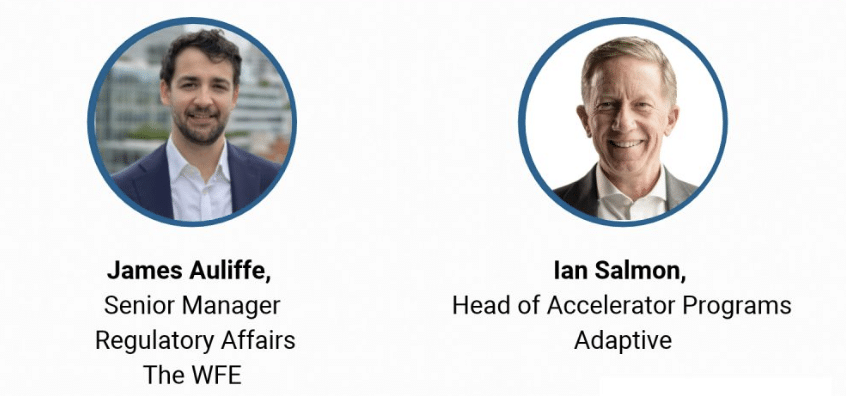
During the November 4 webinar, Trends and Predictions for Exchange Tech in 2027, James Auliffe, Senior Manager, Regulatory Affairs at the WFE, and Ian Salmon, Head of Accelerator Programs at Adaptive, discussed how exchanges can respond to changing market demands without compromising operational resilience.
Auliffe said traditional exchanges are increasingly competing with cryptocurrency platforms, prediction markets, alternative trading systems and private markets for institutional and retail order flow.
Customer demand is also shaping technology investment decisions, according to Auliffe: “When I speak to exchange CTOs, customer demand often emerges as the key priority. The prevailing attitude is basically, if customers want it, we’ll build it,” Auliffe said.
One of the most immediate challenges is the move toward extended trading hours. Salmon recalled a recent conversation with a client developing a new algorithmic trading platform who insisted that the system needed to support trading 24 hours a day, five days a week.
According to Salmon, the client did not necessarily expect a substantial shift toward overnight trading but believed investors increasingly wanted to react to market developments without delays.
Longer trading sessions, however, leave exchanges with less time to maintain and upgrade their systems. “There’s no longer a weekend. There’s no longer a period where you can take all the systems down,” Salmon said.
He explained that exchanges increasingly need technology capable of supporting maintenance, upgrades and new functionality while markets remain operational.
“That’s one of the areas that’s the biggest driver of exchange technology modernisation today, is to be architecting a platform that enables either planned or unplanned change to happen in real time on the fly without compromising any form of resilience or performance on the platform,” Salmon said.
Auliffe emphasized that the challenge extends beyond trading platforms themselves. Clearing, settlement and other interconnected systems must also adapt, while exchanges need to maintain appropriate human oversight and operational resilience throughout longer trading sessions.
According to Auliffe, core system modernization consistently ranks among the leading priorities discussed by members of the WFE’s technology working group, alongside operational resilience and cybersecurity.
He noted that relatively few exchanges consider their technology stacks fully modernized, with most describing themselves as partially or mostly modernized. “Modernisation basically remains a work in progress, and I suppose it’s always going to be a work in progress because by the time you modernize, some new tech comes along, and that’s now modern,” Auliffe said.
The increasing volume of electronic trading messages is adding further pressure, according to Salmon, who cited recent Securities and Exchange Commission analysis of Consolidated Audit Trail data showing that market message traffic had increased by approximately 193% over the period examined, growing roughly three times as quickly as the number of shares traded. “Exchanges simply cannot extrapolate future infrastructure requirements from historical trading volumes,” Salmon said.
He explained that technology capacity planning must account for sudden bursts of activity around market openings, closings and economic announcements, rather than relying primarily on average trading volumes.
Performance also involves more than matching engine speed, he said. “The matching engine is only one part of the equation. Distributing the resultant market data depth of book reliably with minimal latencies is equally demanding,” Salmon said.
He added that exchanges must increase capacity while maintaining predictable latency, execution sequencing and market integrity.
Competition is also putting pressure on exchanges to introduce new products and trading functionality more quickly, according to Salmon. “Every innovation, you know, every new auction method or order type that can’t be delivered quickly on the core exchange system is an opportunity for others to take flow away from the main exchange or the order book,” Salmon said.
For exchanges replacing legacy systems, Salmon described an incremental migration approach involving parallel platforms, replayable data and controlled transitions, rather than replacing entire systems at once. The objective, he explained, is to reduce migration risk while maintaining trading operations.
Artificial intelligence was another topic of discussion, although Salmon suggested its influence may be greater in supporting technology development and accelerating customer requirements than in core market infrastructure itself. Auliffe said WFE members are already using AI for code generation, software testing, cybersecurity and customer-facing services.
He added that market surveillance remains a particularly important application. “Market surveillance has been the number one use case for a couple of years now, and I think it probably will continue to be so,” Auliffe said. He explained that AI can help exchanges analyze large volumes of surveillance data, with human reviewers subsequently assessing the results.
Salmon agreed that surveillance offers opportunities, particularly in reducing false positives. He also highlighted AI’s potential to accelerate algorithm development, analysis and backtesting. “We see AI accelerating probably more on the user requirements and the pace again of change than we do on the market infrastructure piece itself,” Salmon said.