
DERIVSOURCE: Firms Explore Perpetuals as 24/7 Trading Demand Lags

Two-thirds of derivatives market firms surveyed by Acuiti said their businesses performed better in the first half of 2026 than in the same period last year, as firms also considered changes ranging from perpetual futures and 24/7 trading to stablecoins and artificial intelligence (AI).
According to Acuiti’s inaugural Q3 2026 Derivatives Management Insight Report, only 12% of respondents reported worse performance compared with the first half of 2025. Compared with an average year, 64% performed better, including 31% that described H1 as significantly better.
Against their own budgets, 52% of respondents reported better-than-expected performance, including 16% that performed significantly better, while 19% came in below budget. Acuiti said sell-side members reported above-average performance compared with the rest of the listed derivatives market.
Costs, regulation and staffing were among the challenges identified by respondents during the first half. Acuiti said third-party technology vendor costs affected the broadest group of respondents, followed by exchange fees.
Regulation was cited as a significant or critical challenge by 34%, including 11% that described it as critical. Finding skilled staff was a significant or critical challenge for 35%, while rising salaries weighed on a further quarter of respondents.
Perpetual Futures Move Onto Sell-Side Agendas
Perpetual futures featured among the questions put to sell-side execution desks with 16% of institutional execution desks surveyed currently offering perpetual futures, while another 10% said they were working on an offering and 37% were considering one. The remaining 37% said they were not considering offering the products. “Perpetual futures are becoming an ever more present part of the regulated TradFi landscape,” the report said.
Acuiti said developing an offering would require changes to traditional futures setups. Risk management and modelling was the most commonly cited challenge, with issues most commonly centered on the funding rate. Establishing appropriate margin methodologies and accessing reliable liquidity were also among the challenges identified by respondents.

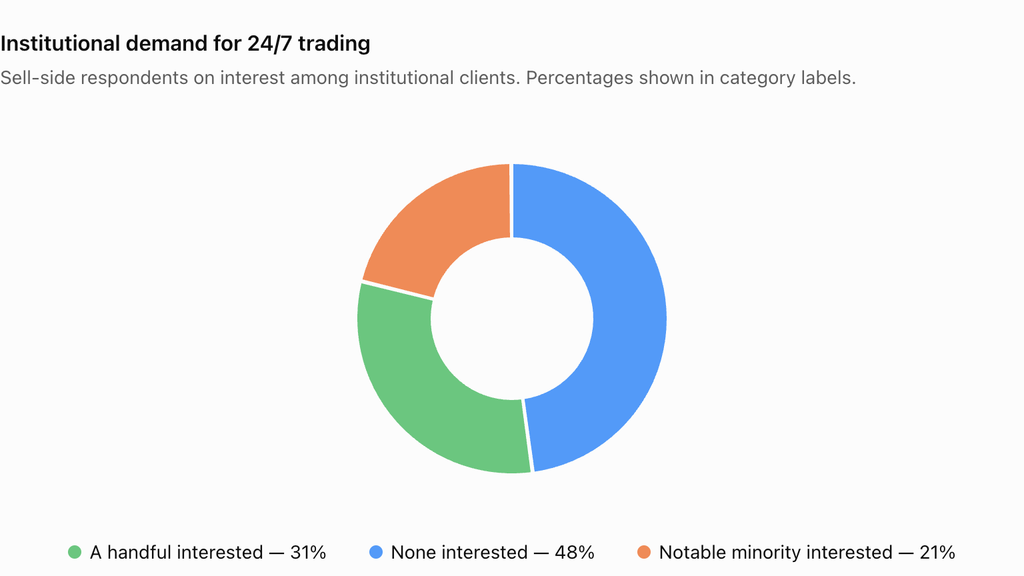
The survey separately asked sell-side firms about institutional demand for 24/7 trading functionality. Forty-eight percent of respondents said none of their institutional clients were interested in 24/7 trading. Another 31% said a handful were interested, while 21% reported interest from a notable minority of clients. No respondents said a majority of their institutional clients were interested.
In a Q&A included in the report, Stephanie Peritore, Head of International Sales at Fidelity Digital Assets, said operating around the clock also raises questions about the infrastructure supporting institutional markets. “Twenty-four hour markets fundamentally challenge many of the operating assumptions upon which traditional financial infrastructure has been built,” Peritore said.
She added that extending existing processes is not enough to accommodate an always-on market. “However, adapting to 24/7 markets is not about extending existing processes around the clock; it is about redesigning infrastructure around automation,” she said.
Among proprietary trading firms, 65% said they did not support extending trading hours in certain traditional contracts, such as oil futures, to weekends. Thirty percent said they potentially supported such a move and 5% said they definitely did.
Asked where they would prefer to trade weekend exposures, 73% selected traditional financial markets such as CME, compared with 20% choosing native crypto markets and 7% selecting decentralized finance platforms. The report said firms preferred traditional venues “where existing connectivity, as well as potential margin efficiencies, are already in place.”
Stablecoins and 24/7 Clearing
Acuiti also asked sell-side clearing firms about the role stablecoins could play in supporting 24/7 clearing. The report noted that traditional payment rails, collateral movements and treasury functions remain largely tied to banking hours.
Nineteen percent of clearing respondents said stablecoins would be essential to enabling a 24/7 clearing offering, while 31% described them as very important. Another 38% said they would be quite important and 13% said they were not important.
The report also identified questions around eligible collateral, haircuts, custody, redemption and liquidity during stress or default scenarios. “For clearing firms, the key issue is therefore not simply whether stablecoins can move faster than fiat currency, but whether they can provide the certainty and liquidity required by a clearing house when margin has to be met or collateral realised at short notice,” Acuiti said.
Peritore also addressed the infrastructure needed to support institutional use of blockchain and digital assets. “Importantly, blockchain alone does not deliver these efficiencies. The real opportunity emerges when distributed ledger technology is combined with institutional-grade custody, governance, regulatory oversight, financing capabilities and robust operational controls,” she said.
Clearing relationships were another area covered in the survey. Among proprietary trading and buy-side respondents, 75% said they were satisfied with their current number of FCM or GCM relationships and had no change planned. Sixteen percent were actively looking to increase the number of clearing brokers, while 2% were looking to consolidate or reduce relationships.
Access to new markets or products was the most frequently cited reason for reviewing clearing relationships, followed by cost and fee optimization. Margin efficiency and capital optimization were also among the reasons cited.
The report also examined firms’ approaches to AI as its use expands across derivatives businesses. Acuiti said its decision to combine its previous reports reflected changes affecting different parts of the market. “In an era of significant changes to market structure and technology, ranging from AI, to tokenisation and 24/7 trading, we felt that a market-wide report, rather than firm-specific ones was warranted,” Acuiti said.
Looking toward the end of the year, 68% of network members said they were optimistic about the performance of their derivatives businesses over the next three months. That included 18% who were very optimistic and 50% who were quite optimistic. Twenty-nine percent were neither optimistic nor pessimistic, while 2% were quite pessimistic and 1% were very pessimistic.
For institutions considering a move toward always-on markets, Peritore said the implications extend beyond trading hours themselves. “Ultimately, the institutions that could benefit most from 24/7 markets will not necessarily be those that trade most frequently, but those that build infrastructure capable of continuously managing liquidity, collateral and risk,” she said.
The report is based on an anonymized survey of the Acuiti Derivatives Expert Network, which includes senior executives from the sell-side, hedge funds, asset managers and proprietary trading firms. It brings together Acuiti’s previous buy-side, proprietary trading, sell-side execution and clearing reports into a single publication.