


China’s latest curbs on EU firms look symbolic. That could change.
VILNIUS — China’s latest trade restrictions on EU companies are unlikely to hurt much — for now. But its choice of targets shows how Beijing could make future retaliation far more painful.
China hit 14 EU entities last month with export curbs on so-called dual-use items that have both civilian and military uses. Beijing’s move amounted to a tit-for-tat retaliation after the EU listed the same number of Chinese companies in July in a round of Russia-related sanctions for allegedly aiding Vladimir Putin’s four-year-old war against Ukraine.
While five European companies that were listed told POLITICO they would be able to cope with the measures, Beijing’s choice of targets has experts and business leaders worried that any future restrictions would expose Europe’s dependence on China for the supply of critical industry inputs.
“It’s sending a signal. Just think twice: Would you be able to further conduct that business without supplies from China?” Aldas Juronis, CEO of specialized laser company Ekspla, said in an interview.
Ekspla is among the 14 EU firms now barred from receiving Chinese dual-use items.
The measures come at a critical time. Brussels and Beijing are locked in tense trade negotiations over ways to narrow the EU’s €1 billion-a-day trade deficit with China.
In the EU’s view, China’s heavy subsidies for its exporters are driving many European industries out of business and the EU wants to convince China to curb exports to the bloc. Brussels wants to achieve results by the time European leaders meet for their next summit in mid-October.
Formally, Beijing said it was retaliating after Brussels listed 14 Chinese-registered companies for aiding the circumvention of EU sanctions on Russia; its list dropped just 24 hours after the EU announcement. Several of the European players cited are active in the defense sector, like Germany’s Rheinmetall and Czechia’s Tatra Trucks.
“We firmly reject the link that China has made with the listing by the EU of Chinese entities,” a European Commission spokesperson said, adding that the Chinese entities targeted had been “found to be assisting the Russian military-industrial complex in their illegal invasion of Ukraine.”
The Commission also said it had informed China ahead of time, but Beijing “did not engage with the EU.”
Tit for tat
“They did this very symmetric,” said Una Aleksandra Bērziņa-Čerenkova, a specialist in Russia-China relations and director of the Latvian Institute of International Affairs. “They didn’t go with an asymmetric list of 100 entities. They’re like: ‘Oh, you like the number 14? Sure, I can play that game.’”
Seven of the 14 entities responded to a list of questions from POLITICO; five are privately owned companies, while one is a university and one a public-private lab. All of the companies said they would weather the restrictions without difficulty, with no impact on their bottom lines.

The two research institutions — a Polish technical university and a French semiconductor lab — indicated they were still assessing the consequences.
Because Ekspla imports only 8 percent of its components from China, CEO Juronis said the company would manage. “If we wouldn’t have been prepared at all, then of course it would be harming us very significantly,” he said, adding that the company had used the lessons it absorbed from the Covid pandemic.
Ekspla makes advanced lasers, supplying them mostly to scientists and industrial customers. “We do not have — nor are planning to have — any product which could be used for kinetic applications,” Juronis explained. The Lithuanian company counts medical-device makers and the semiconductor industry among its customers.
The price of autonomy
The larger and more prominent companies on Beijing’s list are directly involved in making defense equipment.
Rheinmetall, which makes armored vehicles, artillery, ammunition and air defense systems, said in a statement that its “dependence on China had already been significantly reduced in the past.” Similarly, Czech truck manufacturer Tatra and Dutch naval shipyard Koninklijke IHC said they would not be affected by the measures. In April, China had already listed seven EU defense-related companies.
In the longer term, however, the list signals to Brussels that building independent European semiconductor and electrification supply chains will come at a price.
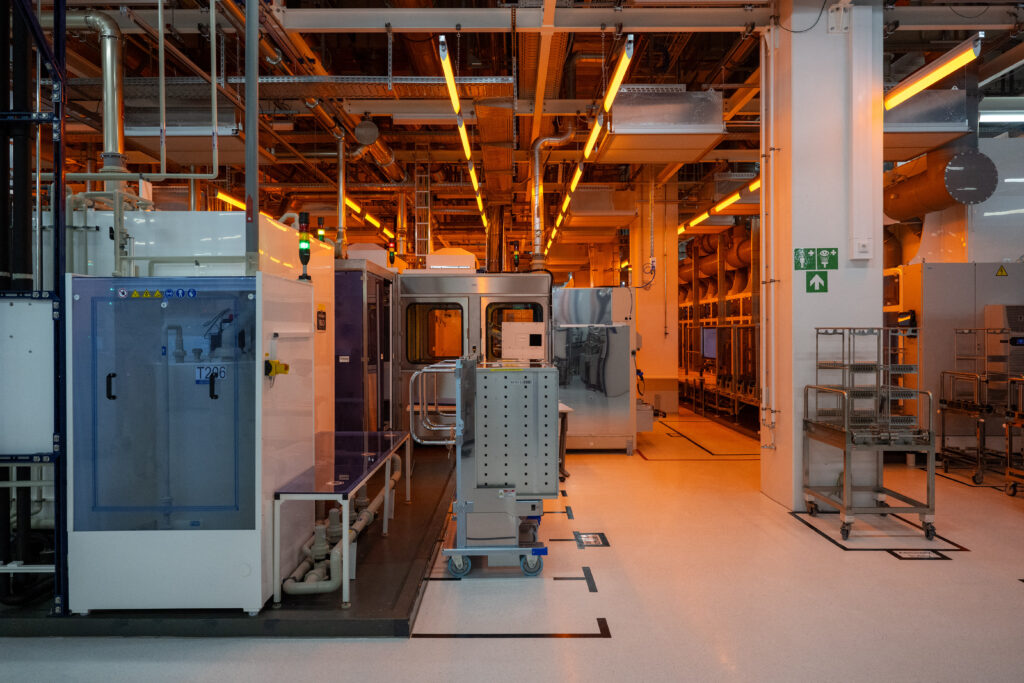
The semiconductor value chain is well represented in the list, not only by Ekspla. Vigo Photonics from Poland, which makes infrared sensors for chip manufacturing, was also listed by Beijing. And in France, China singled out public-private joint venture III-V Lab, which researches and tests new semiconductors. InPACT Semiconductor, another French company on the list, is a supplier for the lab.
Perhaps the most surprising listing is that of the Wrocław University of Science and Technology. The institution conducts research on quantum chips and is involved in Poland’s national quantum laboratory, NLPQT.
For Bērziņa-Čerenkova, adding a university is another signal from Beijing. “The EU is increasingly talking about research security and how China is using research cooperation to gain innovation in its defense sector,” she said.
Moreover, China has learned that “weaponizing its economic superiority” can work in its favor, as Bērziņa-Čerenkova put it, pointing to last year’s export curbs on rare earth elements. Some of the companies listed need metals like neodymium, which they predominantly source from China.
Turning up the heat
Then there’s Lithuania’s Taiwan saga. Vilnius allowed the democratically governed island to open a de facto embassy under the name “Taiwan” in 2021, leading China to downgrade diplomatic relations.
Along with Lithuania’s other products, Ekspla’s lasers got stuck quite literally in a Chinese warehouse as a result because Chinese customs no longer recognized Lithuania as a country of origin. While trade has somewhat normalized, Juronis said it was “obvious” that Beijing was going to list at least one Lithuanian company. “It would be strange if they would not include anybody from Lithuania,” he said. “Unfortunately it’s us.”
The European Commission spokesperson said the EU executive would raise the issue with the Chinese Ministry of Commerce in the near future and has already requested that all firms be “withdrawn from China’s export control list.”
The real lesson from the episode? China’s economic leverage over Europe isn’t a single-shot weapon, as Western governments may have believed before Beijing curbed rare earth exports.
“It’s not one bullet, it’s a knob,” Bērziņa-Čerenkova said. “You turn the heat up and you can pressure others into doing what you want. This is a taste of what’s to come.”