Charted: Why early midterm results can be misleading
The first votes counted Tuesday night will almost certainly look redder than the final result, and control of the House and Senate could take days to settle.
Why it matters: Early leads can create false impressions of who’s winning and suspicion when those leads vanish. Election night is really election week.
By the numbers: AP didn’t call control of the House until seven or eight days after Election Day in each of the past three elections.
- The Senate was settled by 10:44pm on election night in 2018 and at 12:06am the next morning in 2024. In 2022, it took four days, and in 2020, it wasn’t called until Georgia’s January runoffs, two months later.
State of play: Republicans hold 53 Senate seats. Democrats need a net gain of four for a majority.
The red head start: In every national election since 2018, the House and Senate votes counted by 9pm ET were 4 to 9 percentage points more Republican than the final result, an Axios analysis of AP and Edison Research vote counts found.
- It’s mostly geography. Fast-counting Florida and other right-leaning states report first. At 9pm on election night 2022, Florida accounted for 40% of all Senate votes counted nationwide.
- By 11pm, more House races had been called for Republicans than Democrats in all four elections, including 2018 and 2020, when Democrats won the House.
- The tilt fades, slowly. At 6am Wednesday, the national House count was still 2 to 3 points more Republican than the final, largely because California, Washington and Oregon count for days.
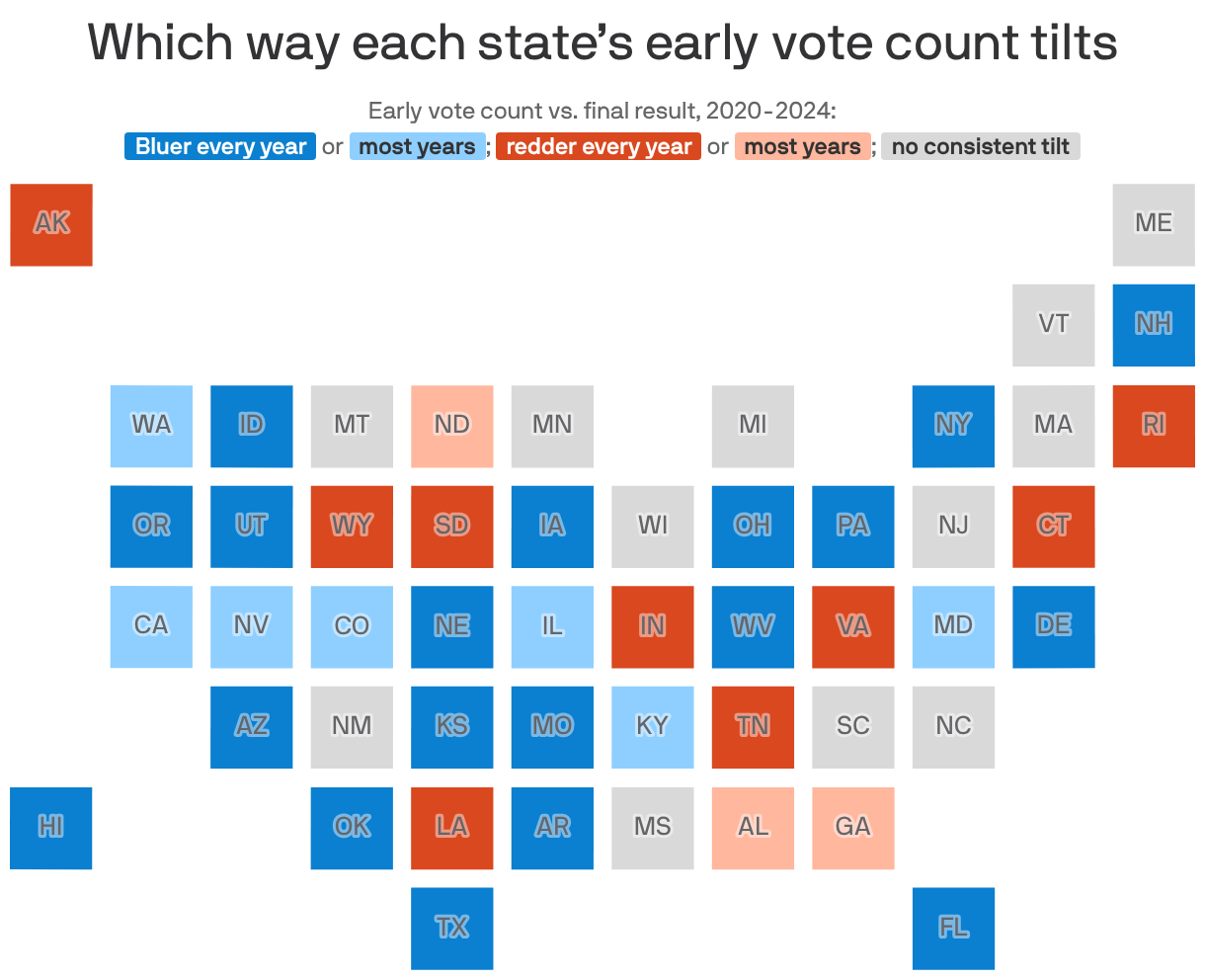
Zoom in: Each state tilts its own way, depending on which ballots and which counties it counts first. States that count early and mail ballots first tend to start bluer than they finish. States that count Election Day votes first start redder.
Ohio, Nebraska, Texas, Kansas and Iowa start blue.
- Sherrod Brown and Bernie Moreno were tied at 9pm in 2024 with half of Ohio’s votes counted. Moreno won by 4.
- Independent Dan Osborn led Sen. Deb Fischer at 11pm in Nebraska with half the votes counted in 2024. Fischer won by 7.
- Beto O’Rourke led Ted Cruz at 9pm in 2018 with nearly half of Texas counted. Cruz won by 3.
- In 2020, Kansas Republican Roger Marshall was down by 8 points at 9pm, even though he’d eventually win by double-digits.
Michigan swings both ways.
- Elissa Slotkin led Mike Rogers by 13 points at 9pm in 2024, trailed by 3 at midnight and won by less than half a point.
Maine starts red and counts slowly.
- In 2020, Susan Collins led by 18 points at 11pm with 16% counted. She won by 9.
Alaska is the slowest and starts out redder.
- In 2020, Sen. Dan Sullivan led by 28 points at 6am ET with 37% counted. He won by 13.
- Election-night results include Election Day ballots and some early and absentee ballots. The rest are counted in the following days. Rural mail often goes through Anchorage, and weather can slow it, with domestic ballots accepted up to 10 days after Election Day if postmarked on time.
- If no one wins a majority of first choices, Alaska will run its ranked-choice tally on Nov. 18.
Watch the clock (all times ET):
- 6pm — The first votes: Parts of Indiana and Kentucky close, giving us the first House returns.
- 7pm — The red head start: Polls close in the key Senate states of Georgia, South Carolina and most of Florida and New Hampshire. Fast-counting Florida gives Republicans an early boost in House races.
- 7:30pm — North Carolina and Ohio close: Watch for early Democratic leads in Ohio that could shrink as more votes come in.
- 8pm — Four more key races: Maine closes, along with most of Michigan, Texas and Kansas, the rest of New Hampshire and Florida’s Panhandle.
- 9pm — Peak red mirage: Iowa, Minnesota and Nebraska close, along with the rest of Michigan, Texas and Kansas. Historically, the national House count looks most Republican between 9pm and 11pm.
- 11pm — The West Coast: California, Oregon and Washington begin reporting, bringing millions of votes and pivotal House races into the picture. The early Republican tilt should begin fading.
- About 1am Wednesday — Alaska: The last polls close, and initial results are expected. Election-night results include Election Day ballots and some early and absentee ballots, with others counted in subsequent days.
The bottom line: Early leads aren’t necessarily predictive. The closer the race, the longer voters may have to wait to learn who won.