Alaska Native strongholds push Peltola into Senate history
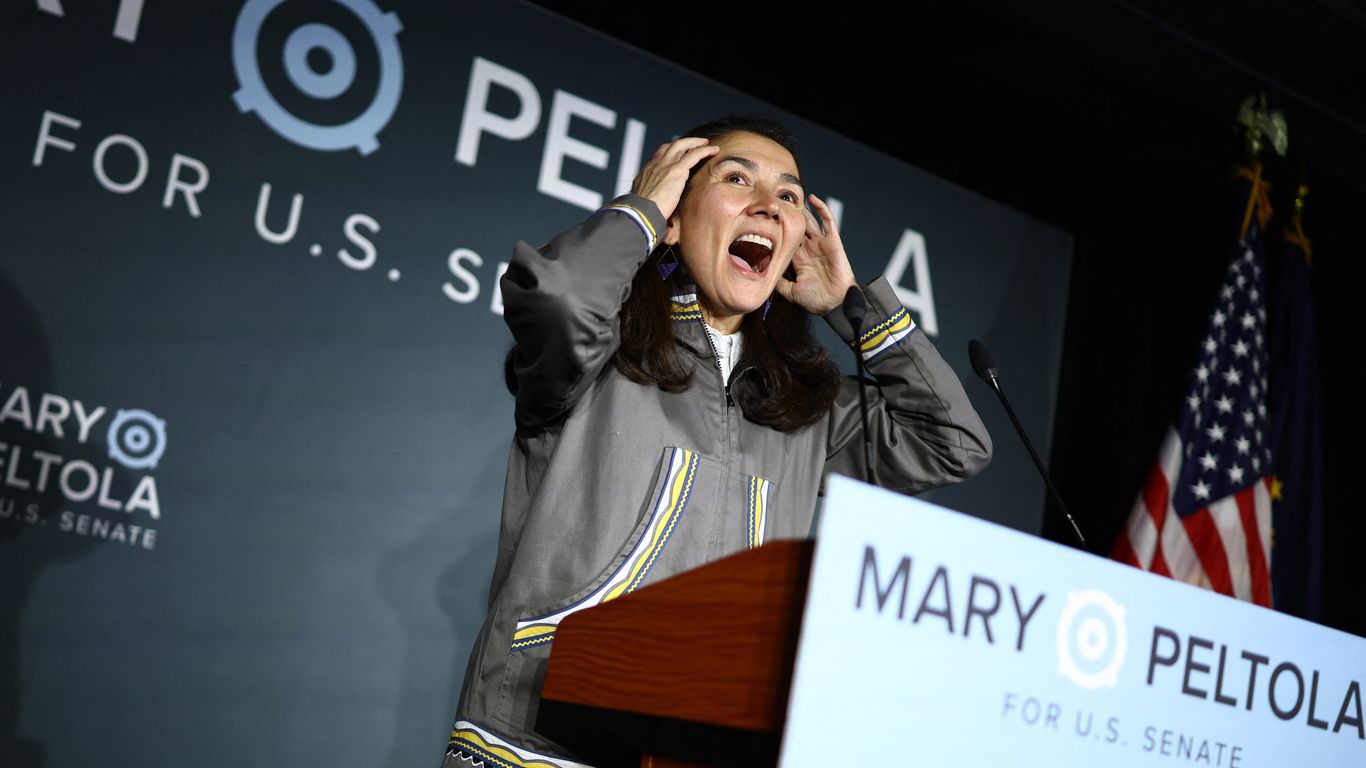
Mary Peltola’s path to Senate history ran through four Alaska Native strongholds that delivered more than half of her statewide first-choice lead.
Why it matters: The Yup’ik Democrat is the nation’s first Alaska Native U.S. senator, powered by communities that endured disenfranchisement, forced displacement and federal violence.
- The win amplifies their voice on tribal sovereignty and subsistence rights after decades of neglect and discrimination — much as Mississippi Delta Black voters powered Democrat Scott Colom to his surprising Senate victory.
By the numbers: Peltola led Republican Sen. Dan Sullivan by roughly 12,400 first-choice votes statewide in Alaska’s Nov. 17 unofficial count. Four western and northern House districts delivered a combined margin of about 6,700 votes.
- In Bristol Bay/Aleutians, for example, Peltola led by roughly 1,150 votes.
- In Bethel/Yukon-Kuskokwim Delta and Western Alaska/Norton Sound, she led by roughly 2,300 votes.
- In North Slope/Northwest Arctic, she led by approximately 900 votes.
Stunning stat: Those four districts accounted for just about 5% of Alaska’s first-choice Senate votes, but roughly 55% of Peltola’s statewide lead.
- Alaska’s 2021 redistricting report identifies Districts 37–40 as Alaska Native-controlled.
- Alaska Natives, alone or in combination, accounted for 85.8% of the voting-age population in District 38, 85.1% in 39, 62% in 40 and 43.8% in 37, using 2020 census figures.
- About 22% of Alaska residents identified as American Indian or Alaska Native, alone or in combination with another race, according to the 2020 census.
State of play: Peltola carried the 50% margin needed to avoid Alaska’s ranked-choice tabulation, where lower-ranked preferences from other candidates’ supporters could have tipped the race toward another candidate.
- Michelle Sparck of the nonpartisan Get Out the Native Vote effort told KNBA that Native groups mounted aggressive outreach, including in Native languages.
- Organizers saw gains in some rural communities, though definitive statewide turnout comparisons remain pending.
Zoom in: In Kwethluk, the Yup’ik village where Peltola grew up, she outpolled Sullivan 136–9. In Savoonga on St. Lawrence Island, she led 157–5.
- In Tlingit communities Angoon and Kake, she led 109–22 and 140–30, respectively.
- The Navy apologized in 2024 for destroying Angoon in 1882 and bombarding and burning Kake in 1869.
Flashback: In 1915, Alaska’s territorial lawmakers required Native citizenship applicants to abandon tribal ties and customs.
- In 1925, after Congress extended citizenship to Native Americans, Alaska imposed an English literacy requirement that disenfranchised many Native voters.
- During World War II, the U.S. removed 881 Unangax̂ people from nine villages to Southeast Alaska camps plagued by disease and poor shelter.
The intrigue: In April 1969, Sen. Ted Kennedy traveled 3,600 miles over three days through Native communities, following a poverty tour his slain brother Robert had planned.
- TIME documented villages with 60% unemployment and homes without plumbing, comparing the trip to Robert’s visits to Appalachia and the Mississippi Delta.
- Partisan accusations over publicity overshadowed the poverty Kennedy sought to expose.
Yes, but: Alaska Native voters today don’t vote as a bloc. The Alaska Federation of Natives endorsed no one in the Senate race. And district returns can’t establish how individual Native voters voted — or prove a statewide turnout surge.
Between the lines: In communities covered by the EPA’s Alaska Native Villages data, 1,129 homes lacked drinking water, wastewater service or both in 2025, down from 6,892 in 2005, per an EPA report.
- Native leaders continue pressing Washington on subsistence rights, infrastructure, education and self-determination.