



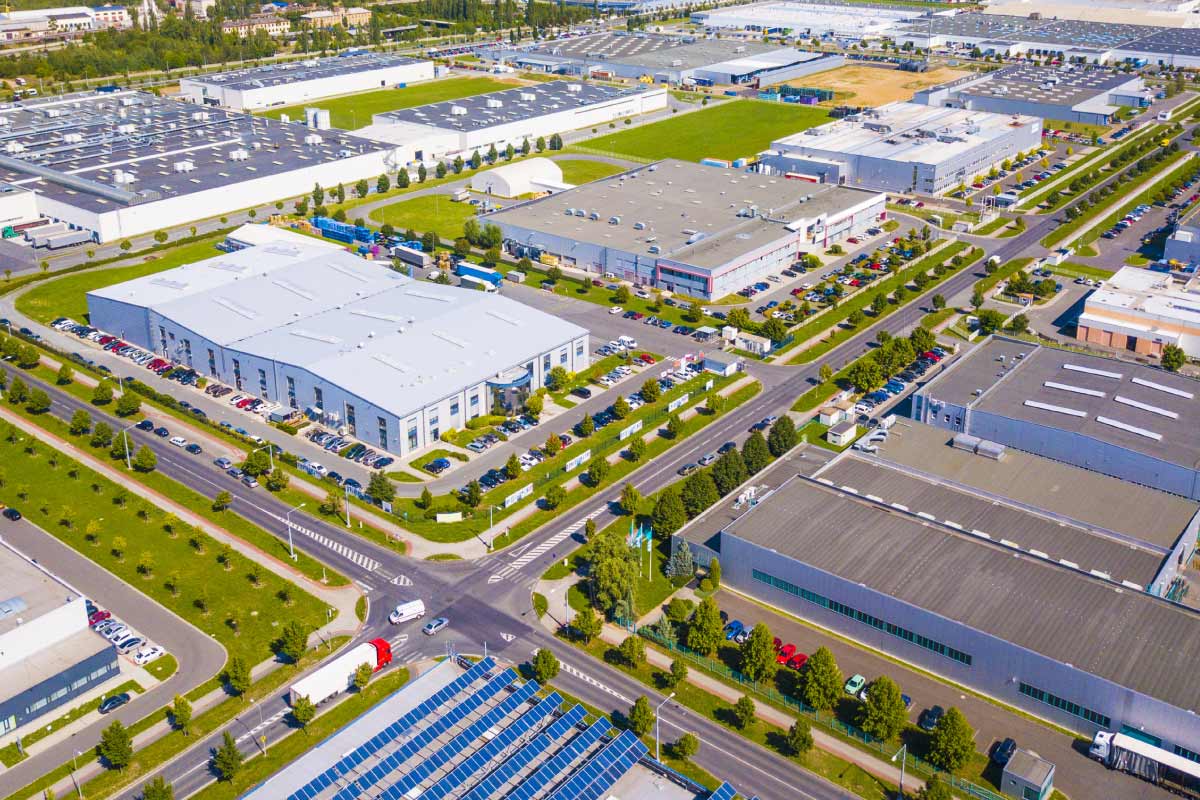
Manufacturing Is Becoming Industrial Real Estate’s Biggest Opportunity
Industrial has been the best performing property sector for most of the past decade, and the reasons have been consistent. E-commerce growth created demand for distribution space, the pandemic exposed the fragility of global supply chains, and retailers responded by holding more inventory closer to consumers. That combination produced a construction cycle built almost entirely around logistics, with the archetypal industrial asset being a large-format distribution center on a highway interchange.
Now the demand seems to be shifting. Manufacturing-related leasing supported industrial activity through 2025, particularly across the Southeast and Central regions, and in several markets it has become the leading source of new requirements. Cushman & Wakefield reported industrial vacancy falling to 6.9% in the second quarter of 2026 with leasing activity at its highest level since mid-2022, and onshoring and nearshoring appear among the demand drivers the firm cites alongside e-commerce.
“For the first time in my career, we are seeing manufacturing be the number one demand for industrial,” said Jason Tolliver, President of Americas Logistics and Industrial at Cushman & Wakefield. “Onshoring and nearshoring are having an effect on supply chains and many Asian based companies are moving back into the U.S.”
A manufacturer looking for space wants something different from what the logistics cycle produced, and in several respects the requirements run in the opposite direction. “Most modern manufacturing is using much smaller industrial facilities and are often co-located with the offices,” Tolliver said. “Companies want engineers to be located next to where the work actually gets done.” Modern manufacturing takes less floorspace but requires more on-site skilled labor than ever before. NAIOP has noted growing demand for midsize facilities in the 100,000 to 400,000 square foot range, a meaningful departure from the 500,000-plus footprints typical of large logistic facilities.
When a substantial share of a building’s occupants are engineers and technical staff spending full days on site, the interior of a manufacting floor becomes much more similar to an office environment. “Industrial is starting to be beautiful and have the kind of curb appeal as a nice office building,” Tolliver said. “They want to make these places where people are proud to work.” That means natural light reaching production areas, lounge and collaboration spaces, considered materials and finishes, and exteriors designed to be looked at rather than simply enclosed. It is a reversal of decades of industrial development logic, which treated the building as a shell around a process and optimized almost exclusively for cost per square foot.
Amenities are following the same trajectory, driven partly by where these buildings tend to be located. Industrial sites sit on the periphery of metropolitan areas, where the supporting services that office workers take for granted in a downtown are thin or absent entirely. “Workers are looking for things like onsite daycare or medical services,” Tolliver said. “If you go to a downtown office you have so many of these amenities but outside of cities there isn’t as many options.” A manufacturer competing for skilled labor in a suburban or exurban submarket cannot rely on the surrounding neighborhood to provide what employees need. Bringing childcare, clinics, food service, and fitness onto the campus becomes a practical necessity rather than a perk, particularly for operations running multiple shifts.
None of this has attracted the attention that data centers and large-format logistics have. The headline deals and the flood of AI-related development capital have taken the spotlight, and for good reason given the scale of individual transactions. A single hyperscale campus can involve more square footage and more capital than a dozen manufacturing facilities combined, which makes it easier to cover and easier to underwrite. Manufacturing arrives in smaller increments, spread across more tenants and more markets, which is precisely why it has been overlooked until now.
The post Manufacturing Is Becoming Industrial Real Estate’s Biggest Opportunity appeared first on Propmodo.