


Money20/20 Middle East opens with a $6.5bn valuation, SAR 500m for SMEs and six new payout markets
Money20/20 Middle East opened its second edition on Monday, with H.E. Mohammed Al-Jadaan, Minister of Finance and chairman of the Financial Sector Development Program, inaugurating the show at the Riyadh Exhibition and Convention Centre in Malham and touring the floor.
Day one delivered on the premise. A $233m equity round at a $6.5bn valuation, a SAR 500m financing partnership aimed at Saudi SMEs, and a cross-border payout network opening six new Middle East markets all landed inside the first eight hours, and the common thread running through them is licensing.
The raise, and the licence stack underneath it
Tabby announced a $233m equity round at a $6.5bn valuation, led by existing investor Blue Pool Capital with participation from HSG, Wellington Management and Arbor Ventures. Bloomberg reported the valuation puts Tabby ahead of Klarna. The company says it has been profitable since 2023 and now processes more than $18bn in annualised transaction volume across 25 million registered users and 70,000 business partners. The round includes a liquidity option for employees, on top of more than $100m in share sales Tabby has facilitated through tenders since 2023.
The valuation will get the headlines. The more interesting part of the release is the licence list underneath it. Over the past year the Saudi Central Bank has granted Tabby consumer and SME finance licences, which is what allows it to write larger and longer-term consumer financing and working capital for businesses rather than four instalments at a checkout. Tabby has also acquired Tweeq, a SAMA-licensed digital wallet, extending it into accounts, cards and transfers. In the UAE it holds a Stored Value Facilities licence from the central bank, under which it launched Tabby Cash, an alternative to a debit account with no account or card fees, paying cashback on card spending and supporting local and international transfers.
Strip the funding line out and what remains is a company that has spent a year converting itself into a licensed consumer finance and payments institution across two jurisdictions. The valuation follows from that, not the other way round. The transaction remains subject to applicable regulatory approvals, including from SAMA.
“We began with a button at an online checkout to help people spread costs over time,” said Hosam Arab, chief executive and co-founder of Tabby. “Everything since, every product and every licence, has come back to the same idea: people deserve more from their money.”
SAR 500m into the SME gap
The organiser reported a SAR 500m partnership between Silq and Joa Capital, which will allow Silq to extend working capital and financing to more start-ups and small businesses. Tahaluf puts Silq’s current base at more than 50,000 SMEs, a figure consistent with Silq’s own August material, which cited more than 50,000 businesses in the Kingdom and more than 300,000 merchants across the Gulf and South Asia.
Working capital for small businesses is the least glamorous and most persistent gap in the Saudi financial system, and it is the one the Financial Sector Development Program has repeatedly identified as a priority. A half-billion riyal commitment aimed squarely at it is a substantive opening-day item.
Thunes opens six markets
Thunes used a Money20/20 Middle East dateline to announce the expansion of its Direct Global Network into Bahrain, Lebanon, Oman, South Yemen, Syria and the UAE. Members can now pay out to bank accounts, mobile wallets and cash pickup locations in local currency across those six markets through a single API integration or over existing SWIFT connectivity, building on the company’s expansion into real-time payments in Saudi Arabia last September.
The market selection is the interesting part. Bahrain, Oman and the UAE are digital-economy plays, tied respectively to Bahrain’s National Digital Economy Strategy, Oman Vision 2040 and the UAE’s National Payment Systems Strategy. Lebanon, South Yemen and Syria are remittance corridors, and Thunes is explicit about it, citing roughly $7bn a year in remittances into Lebanon and remittances worth over 38 per cent of GDP in South Yemen, figures it draws from third-party sources. Opening commercial cash pickup into Syria is a compliance achievement as much as a commercial one.
“Launching new payout capabilities across the Middle East unlocks significant value for our Members and their end-users,” said Chloé Mayenobe, deputy chief executive at Thunes. “These markets are deeply committed to digital innovation and financial inclusion.”
The infrastructure behind it is Thunes’ SmartX Treasury System for liquidity management and its Fortress Compliance Platform, which the company says benefits from more than 50 licences worldwide. That phrase, more than 50 licences, is the whole business model in five words.
Fraud, framed regionally
Fraudio and African payments firm enza announced a partnership on the opening day, with enzaGuard embedding Fraudio’s fraud detection models across issuing, acquiring, account-to-account transfers, wallets and ATM transactions. The release carries a Cairo dateline and was timed to the show. It is a useful reminder that the Gulf’s payments build-out is increasingly being designed alongside Africa’s rather than separately from it.
What the regulator said with the microphone on
The most quotable regulatory line of the day came from Turky A. Kabarah, director of fintech enablement at SAMA, on a panel titled Designing Financial Systems that Scale Safely. “We do not view regulatory requirements as barriers to innovation, but as a roadmap that enables fintech companies to innovate and scale safely,” he said, describing controlled testing as the mechanism through which SAMA develops its frameworks. That is the sandbox-to-licence sequence the Kingdom has been running since it began licensing open banking providers in March, and it is the sequence Tabby’s licence list is a product of.
Balaji Rajagopalan, chief technology officer at the State Bank of India, argued on the same panel that resilience has to be designed into technology, process and governance from the outset rather than bolted on afterwards as AI spreads through the stack.
On a separate panel on central bank digital currency architecture, Dr Saeeda Jaffar, managing director for international at Circle, made the sharpest structural observation of the session. “Already there are bots out there that are making many, many transactions,” she said. “There are no payment rails that can handle that as well as digital currencies.” Machine-initiated payment volume is an argument for sovereign digital money that does not depend on a single consumer changing habit.
Mike Champion, chief executive of Tahaluf, gave the organiser’s framing for the week, which is that the value lies in the density of institutions, regulators, investors and fintechs in one hall and the business that follows from it.
The next capital market, on the Capital Stage
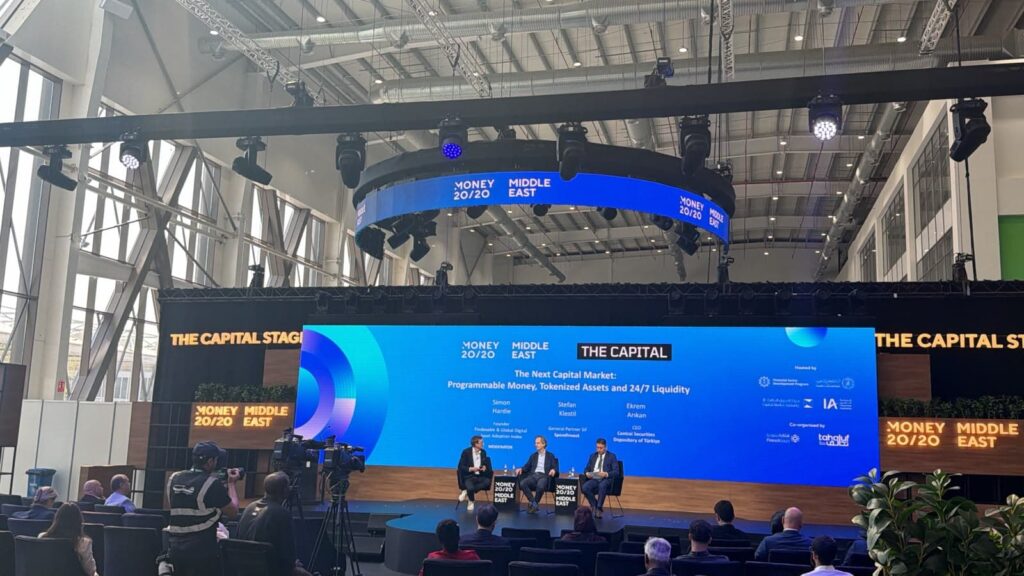
One of the sharper sessions of the afternoon drew little attention outside the room it was held in. “The Next Capital Market: Programmable Money, Tokenised Assets and 24/7 Liquidity” ran as a twenty minute fireside on the Capital Stage at 14:10, moderated by Simon Hardie, co-founder and chief executive of Findexable, with Dr Ekrem Arıkan, chief executive and board member of Merkezi Kayıt Kuruluşu, the Central Securities Depository of Türkiye, and Stefan Klestil, general partner for fintech at Speedinvest.

In its own account of the session, MKK said Arıkan set out Türkiye’s evolving regulatory framework and technological capabilities in digital assets, along with the depository’s role in building what it describes as reliable, transparent and measurable market infrastructure through its Crypto Asset Central Registry System, known as KVMKS. He argued for connecting digital technologies with real financial assets and regulated capital markets.
That is Kabarah’s argument again, arriving from a different direction and in the language of market infrastructure rather than supervision. A central securities depository is the least glamorous institution in any financial system and the one that decides whether a tokenised asset is a security or a curiosity. Hearing the head of one argue that tokenisation belongs inside regulated market infrastructure rather than alongside it is a more reliable signal of where this is going than most of what gets said about digital assets at fintech conferences.
Twenty-five startups and $400,000
The MoneySurge pitch competition opened its first round on the Capital Stage on Monday afternoon, with Klestil among the judges alongside Abdulaziz Alomran of Impact46, Lizzie Chapman of Baystreet, Arien Alwabil of SVC, Majed Al Rasheed of FinTech 525, Efayomi Carr of Flourish Ventures, Mazin Alshanbari of Sukna Capital, Mareme Dieng of AXIAN Group and Mousa Alatiyyah of stc.
Twenty-five startups were selected from more than 450 fintech companies to compete for a share of a USD $400,000 prize pool, and were honoured at Venturescape, the show’s founders’ dinner, with further rounds running across the week. The prize money is equity-free, which is the part that matters. A pool of that size taking no position on anybody’s cap table is a grant programme wearing a pitch competition’s clothes, and in a market where the seed round is the hardest one to close, that is worth more to an early-stage founder than the headline figure suggests.
The read on day one
A $6.5bn valuation built on licences granted. A payout network into six markets built on compliance work. A half-billion riyals aimed at the SME financing gap. And a regulator telling the room, from the stage, that the rulebook is the roadmap rather than the obstacle.
Last year’s inaugural edition was a story of arrivals, with global names planting flags in the Kingdom. Monday suggested this edition is about what happens after the flag goes up, which is the licensing, supervision and infrastructure that turn an announcement into a business. On that measure it was a strong opening day.
The post Money20/20 Middle East opens with a $6.5bn valuation, SAR 500m for SMEs and six new payout markets appeared first on The Fintech Times.