



What FIFA Deployed at the 2026 World Cup Is a Preview of Where Building Technology Is Heading
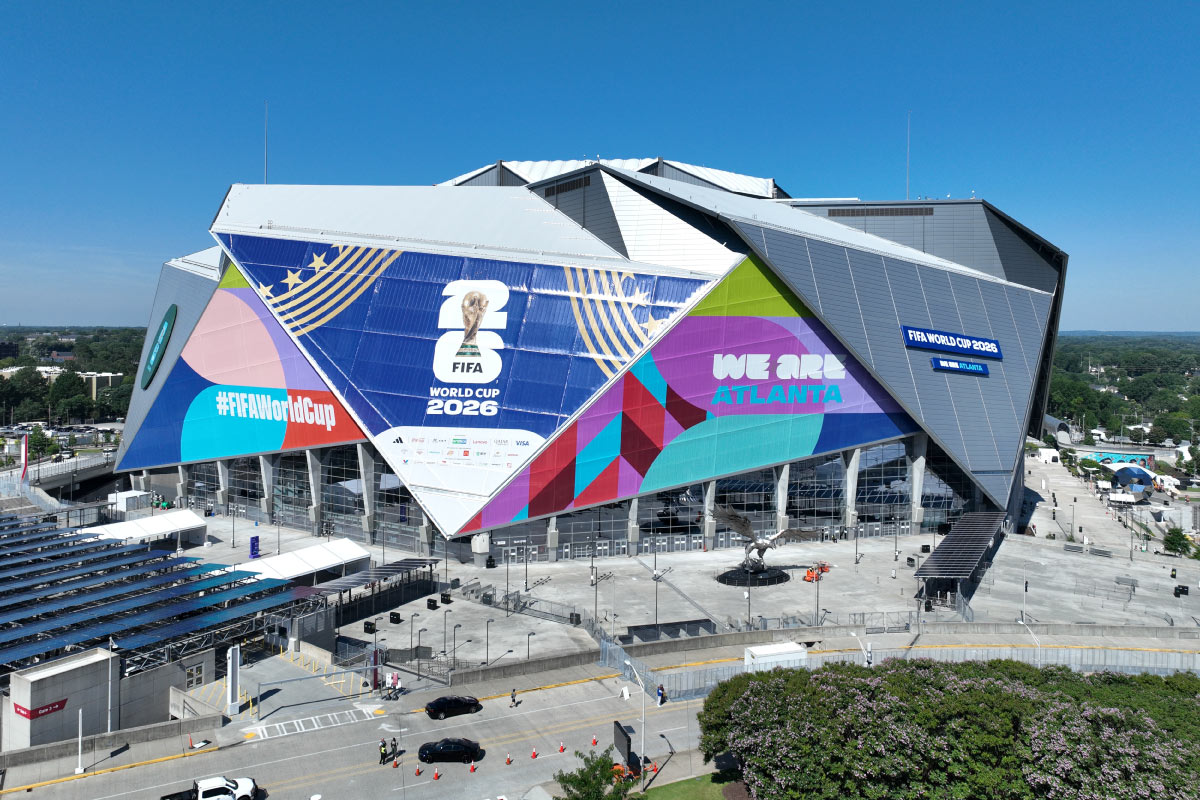
Stadiums have always been extreme buildings. They concentrate more people in a single structure than almost any other building type, demand that every system perform flawlessly under conditions that would stress most infrastructure, and do so while delivering an experience that millions of people will remember and judge. That extremity has historically made stadiums laboratories for building technology, places where the investment required to solve hard problems at scale gets made because the alternative, a failure in front of 80,000 people with a global broadcast audience, is simply not acceptable. The 2026 FIFA World Cup, played across 16 venues in the United States, Canada, and Mexico over 39 days, has compressed an extraordinary amount of building technology innovation into a single event, and the systems deployed to manage those stadiums offer a remarkably clear picture of where commercial and institutional building operations are heading.
The scale of the tournament alone makes the technology challenge unusual. With 48 national teams competing across 104 matches in 16 stadiums spread across three countries, the event was expected to welcome more than six million fans over its 39-day run. Managing that volume of people, across that many venues, with the coordination requirements of a global broadcast event and the security demands of one of the world’s most watched sporting occasions, required a technology infrastructure that no single stadium and no previous tournament had ever assembled. FIFA and its technology partners, led by Lenovo as the official technology partner, built something for the 2026 World Cup that functions less like a collection of stadium systems and more like a unified intelligent building network operating at continental scale.
The most architecturally significant piece of that infrastructure is the Intelligent Command Center that FIFA built to monitor and coordinate all 16 venues simultaneously. The Command Center connects data across matches, venues, and broadcasters, helping security teams anticipate congestion before it becomes a safety issue. Every stadium has its own edge computing infrastructure that feeds into the central command layer, meaning that even if connectivity between venues and the Command Center is disrupted, each stadium continues operating with its own local AI systems. That architecture, distributed intelligence at the building level feeding into centralized oversight at the portfolio level, is the same model that sophisticated commercial real estate operators are beginning to apply to their own property portfolios. The ability to see what is happening across multiple locations simultaneously, identify anomalies, and respond before situations escalate, is a capability that building owners have wanted for years and that the technology is only now mature enough to deliver reliably.
Lenovo ran digital twins of all 16 stadiums for crowd and security management purposes. A digital twin is a continuously updated virtual model of a physical building, fed by sensors, cameras, and data streams that reflect the building’s actual state at any given moment. For the World Cup, that meant a real-time three-dimensional model of each venue that showed crowd density, movement patterns, access point throughput, and potential congestion zones as they developed, before they became visible problems on the ground. The applications in commercial real estate are direct. A digital twin of an office building or a shopping center can show facilities managers how people are moving through the space, which areas are underutilized, where maintenance issues are developing, and how the building’s systems are performing, all from a single interface. The technology is not new, but the World Cup deployment demonstrated it operating at a level of integration and real-time responsiveness that commercial applications are still working toward.
Connectivity was the foundation that everything else depended on. Verizon deployed private 5G networks at all 16 venues, purpose-built to support the tournament, with public 5G capacity upgraded by three to five times at the 11 US venues to handle the volume of fans streaming, uploading, and accessing match data simultaneously without the network congestion that packed stadiums typically produce. The distinction between a private 5G network and a conventional WiFi deployment is significant for building operators. A private 5G network provides guaranteed bandwidth allocation, lower latency, better coverage through building materials, and the ability to run IoT devices, security cameras, access control systems, and guest connectivity on separate, isolated network slices without any of them competing for the same spectrum. Those properties make private 5G increasingly attractive for commercial buildings with dense IoT deployments and high-traffic public areas, and the World Cup’s deployment across 16 diverse stadium environments provided a real-world test case for that architecture at a scale that most commercial buildings will never approach.
Access control at the 2026 World Cup represented one of the most significant departures from how major events have historically managed entry. AI-powered facial recognition systems were deployed for accreditation and access control across all 16 venues, reducing the risk of unauthorized entry while maintaining the throughput speeds that 80,000-person stadiums require. At participating venues, facial recognition technology linked a fan’s face to their digital profile, enabling frictionless entry and even secure cashless payments without needing to present a physical ticket or card. The Fan ID system that underpins this, a digital identity registered through official channels and linked to a fan’s ticket, is the architectural model that commercial building access control is moving toward. The combination of biometric entry, digital credentials, and linked payment profiles creates an access system that is simultaneously more secure and more frictionless than any physical credential system, and its deployment across the World Cup’s 16 venues at six million fan scale provided the kind of stress test that commercial deployment rarely gets to run.
Security operations at the tournament went beyond cameras and access control in ways that will be watched closely by commercial real estate security professionals. Boston Dynamics Spot robots, the four-legged units commonly known as robot dogs, patrolled restricted areas, stadium perimeters, and underground service corridors at venues across the US and Mexico. Autonomous security robots have been piloted in airports, warehouses, and corporate campuses for several years, but the World Cup deployment put them in environments that are considerably more complex and more public than most previous applications, including outdoor perimeters, mixed pedestrian and vehicle areas, and the service infrastructure that runs beneath stadium bowls. The data those patrols generate, continuous coverage of areas that would otherwise require human security personnel, feeds back into the Command Center’s situational awareness picture.
The fan-facing technology at the 2026 World Cup is where the implications for commercial real estate are perhaps most direct. Through the FIFA+ app, fans inside stadiums pointed their mobile phones at the pitch to see a live augmented reality layer overlaid on the field, showing real-time player names, tracking speeds, and physical intensity metrics. FIFA built a software layer intended to accompany the fan from the hotel, through transportation, and to the seat, with the official app including schedules, live scores, real-time alerts, 3D stadium maps, arrival planning, and location-based information. The parallel to the resident experience and tenant experience apps that have become standard in multifamily and commercial real estate is exact. The stadium app is a venue management tool that sits on the fan’s phone and shapes their experience from before they arrive until after they leave. The commercial real estate equivalent is already being built across the industry, and the World Cup’s deployment at global scale, with the investment and attention that comes with a tournament watched by five billion people, will accelerate the refinement of those tools considerably.
What the 2026 World Cup ultimately demonstrated is that the intelligent building, the building that knows who is in it, where they are, how they are moving through it, what they need, and what its systems are doing at any given moment, is no longer a concept. It is an operational reality, deployed at scale, tested under the most demanding conditions a building can face, and performing well enough that hundreds of millions of people experienced it without most of them knowing the technology was there. That invisibility is, in a sense, the point. The best building technology doesn’t announce itself. It simply makes the experience of being in a building better than it would otherwise be. The systems deployed across 16 World Cup stadiums in the summer of 2026 are going to find their way into commercial buildings over the next decade, arriving first in the most sophisticated and well-capitalized properties and gradually becoming standard across the industry. The stadiums were the laboratory. The rest of the built environment is the next application.
The post What FIFA Deployed at the 2026 World Cup Is a Preview of Where Building Technology Is Heading appeared first on Propmodo.