


Inside Sukkho Samui Estates: The Last Private Place

The morning begins before you decide it does. Light crosses the water in a particular way — slow, almost reluctant — and finds you through the open wall of a villa that has no front door in any conventional sense. There is no lobby. No key card. No itinerary slipped under a door. There is the sea. A hillside of coconut palms so green it looks deliberate. And a silence so considered it could only have been designed.
It was.
This is Sukkho Samui Estates — seven private villas above the coastline of Koh Samui, Thailand — and from the moment of arrival, it is apparent that something fundamentally different has been attempted here. Not a better hotel. Not a more luxurious resort. Something that has stepped outside that conversation entirely and asked, instead, a deeper question: what does it mean to truly know a place?

The man behind it, Régis Thomas, has spent more than thirty years in Asia. He has moved through its cities and islands, its celebrated hotels and unvisited corners, long enough to know the difference between a place that impresses and a place that holds. Ten years ago, he chose to stop. He chose Koh Samui — its particular slowness, its coconut groves and tropical green, a Thai hospitality that had not yet been performed into something it wasn’t. He did not come to build a hotel. He came because he wanted to live here.
Sukkho is what happened when he decided to share that.
“I had seen a great deal of Asia. But Koh Samui had something the others didn’t — a slowness, a greenness, a warmth that felt genuinely Thai rather than designed for tourists. I didn’t come here to create a luxury product. I came because I wanted to live here. Sukkho is what happened when I decided to share that.”
— Régis Thomas, Founder, Sukkho Samui Estates
The Problem with Perfection
There is a moment, familiar to anyone who travels at this level, when you look around a flawless room and feel, inexplicably, nothing. The lighting has been calibrated. The thread count is beyond reproach. The turn-down service arrived exactly when it should. And yet.
Thomas had that moment. He had it more than once, across more than a few of Asia’s finest addresses. And instead of accepting it as the inevitable condition of high-end travel, he became quietly, persistently troubled by it.
“I had stayed in extraordinary hotels where everything was perfect — and I left feeling nothing. That’s when I understood: perfection without resonance is just engineering.”
— Régis Thomas
The insight sounds simple. Its implications are not. To accept that perfection is insufficient — that flawless execution can leave a guest unmoved — is to dismantle the central premise of luxury hospitality as it has been practised for a century. The great hotel exists to perform excellence. It does so reliably, at scale, with considerable skill. But performance, Thomas came to understand, is precisely the problem. You cannot perform your way to meaning. You can only create the conditions in which meaning becomes possible.
That understanding became Sukkho. Not a concept, not a repositioning, but a working answer to a question that has been quietly pressing at the edges of luxury travel for years: what comes after impressive?

Seven Villas. One Island.
The number is not accidental. Seven villas — Hanuman, Veasna, Channary, Amara, Kinnara, Nidhi, Dara — each carrying a name drawn from Southeast Asian mythology, each conceived as a distinct emotional world rather than a unit of accommodation. The estate could have been larger. The economics would have rewarded it. Thomas chose otherwise.
“Beyond a certain scale, you stop being present for your guests — you start managing a system. I was not interested in systems.”
— Régis Thomas
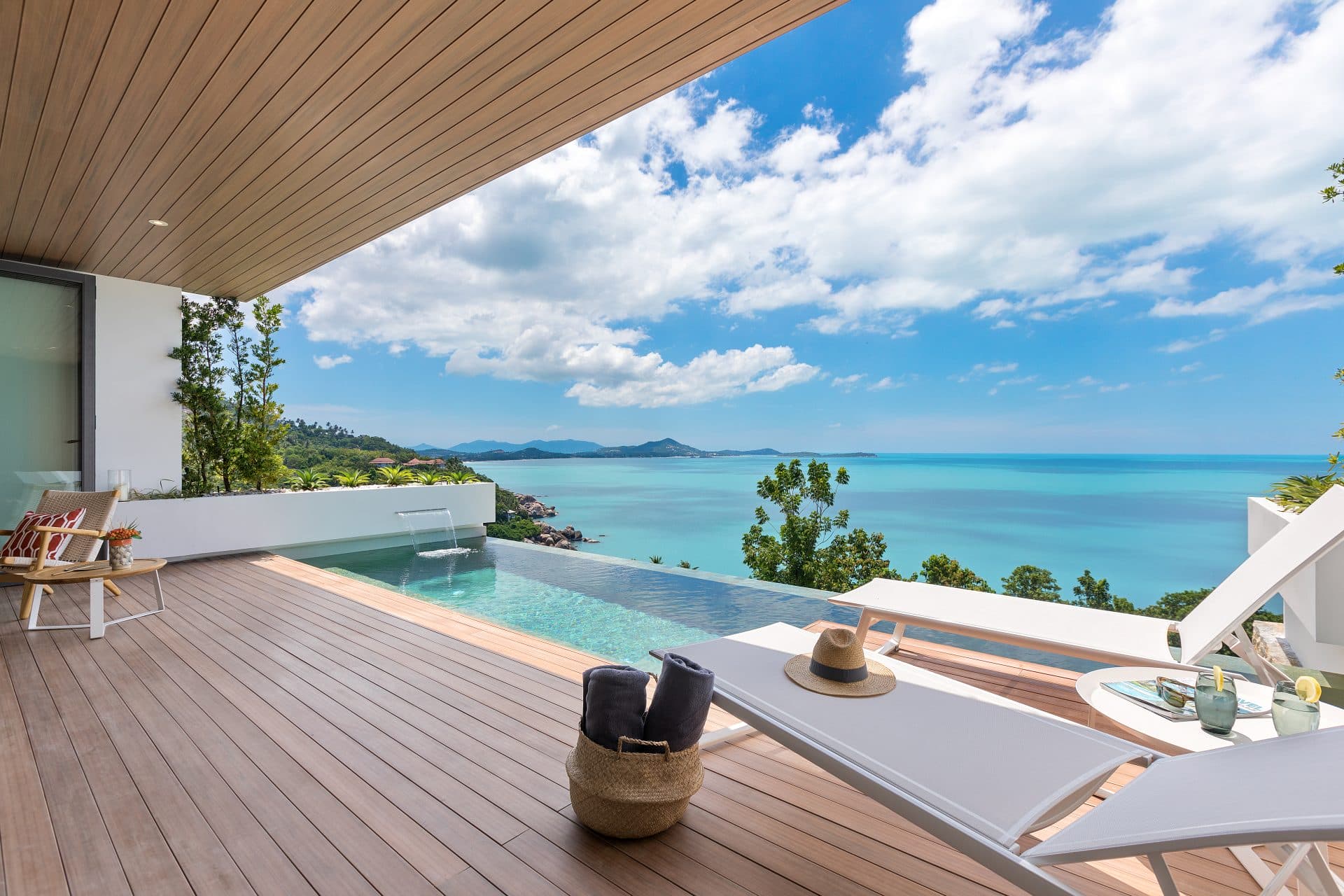
The proportions of each villa differ. The relationship to light differs. Infinity pools extend toward the Gulf of Thailand without visual interruption. Interior walls dissolve into open-air living, and the boundary between inside and outside — between the architecture and the island it inhabits — becomes, in the most considered villas, impossible to locate. You are, at all times, both sheltered and exposed. Held and released simultaneously.
This is not the design language of spectacle. There are no arrival moments engineered for photography, no statement gestures. Sukkho is, in the most deliberate sense, understated. Its confidence lies not in what it shows but in what it withholds.
“Space should never announce itself. The best rooms I’ve ever been in, I don’t remember the ceiling height or the materials. I remember how I felt in the morning light.”
— Régis Thomas
The name is its own kind of manifesto. Sukkho derives from the Thai and Pali word for happiness — not happiness as elation or spectacle, but happiness as ease. As the particular contentment of being exactly where you want to be. It is an unusually honest name for a luxury property. It does not promise grandeur. It promises something harder to deliver: that you will feel, from arrival to departure, entirely at home.
“The name Sukkho means happiness in Thai. Not pleasure, not comfort — happiness. That distinction guided every decision about what to keep, and what to remove.”
— Régis Thomas

Privacy as Architecture
It is worth being precise about what privacy means at Sukkho, because the word has been so thoroughly absorbed by luxury marketing that it has lost most of its content. At most high-end properties, privacy means not being disturbed. A do-not-disturb sign elevated to a philosophy.
At Sukkho, it means something structural — and considerably more interesting.
“Privacy is not about withdrawal. It is about authorship — the rare freedom to shape your own hours, your own silence, your own version of this place.”
— Régis Thomas
Each villa is positioned so that no sightline intrudes from another. Every arrival sequence is independent — no shared reception, no moment of passing another guest in a corridor. The service operates through a single WhatsApp thread: a concierge present precisely when wanted, invisible when not. The effect is subtle, cumulative, and within two days, complete. The ambient self-consciousness of being in a hospitality environment has entirely dissolved. You are, in every practical sense, at home in a place that is entirely yours.
A home that looks out over the Gulf of Thailand. Surrounded by the specific green of a Koh Samui hillside — the coconut palms and tropical forest that Thomas chose, over every other landscape in Asia, as the one he wanted to wake up to. A home that carries, even in its architecture, the character of the island it belongs to.
“Most hospitality is designed so the guest feels looked after. I wanted to design something where the guest feels free. Those are entirely different things.”
— Régis Thomas

The Hotel Asks the Wrong Question
The traditional hotel is organised around service. Its entire apparatus — the concierge desk, the spa menu, the excursions board — exists to answer a single question: what can we do for you? It is a generous question. It is also, Thomas argues, the wrong one.
“The hotel asks: what can we do for you? We ask something different: what do you want to bring back from this place? That question changes everything about how we design the experience.”
— Régis Thomas
The distinction is worth sitting with. A hotel oriented toward what it can do for you is, at its core, oriented toward the guest’s comfort within its walls. A property that asks what the guest will carry home is oriented toward something more lasting — toward the guest’s relationship with the island itself. One is service. The other is something closer to a gift.
This is the animating idea behind Sukkho Privé Access — not a loyalty programme, not a booking incentive, but the practical expression of a conviction: that the most meaningful thing Sukkho can offer its guests is Koh Samui itself, experienced in the company of people who genuinely love it.
“People don’t fly to the other side of the world to stay inside four walls, however beautiful those walls may be. They come to be changed by a place. Our role is to make that possible — to share the Koh Samui we love, not the one that’s been packaged for them.”
— Régis Thomas
Privé Access is available exclusively to guests who book directly with Sukkho — a deliberate choice that reflects Thomas’s belief that the relationship between guest and host is worth protecting from the intermediaries that now dominate luxury travel. The moment a direct booking is confirmed, a dedicated concierge begins not arranging logistics but understanding intentions. What kind of stay? What draws you to this island? What would make this particular week genuinely unrepeatable?
“When someone books directly with us, they’re not just choosing a villa. They’re choosing a relationship. Privé is how we honour that choice.”
— Régis Thomas

A Day at Sukkho
What Privé Access offers is not a menu of experiences. It is, more precisely, a range of ways in which the island can enter your stay — each one arranged personally, each one a genuine encounter rather than an organised activity. To understand what this means in practice, consider a single day.
Dawn
Breakfast arrives at the villa. Not to a table, but to the pool — floating, unhurried, with the Gulf of Thailand turning from grey to gold beyond the infinity edge. There is no particular reason to move. The morning has been returned to you entirely.
Morning
At the Fitness Studio, a Muay Thai lesson begins. Not an introduction, not a resort class, but a session with a champion instructor who has lived this discipline and teaches it as such — its history, its precision, its particular demands on the body and the mind. You leave understanding something about Koh Samui that the island itself couldn’t have told you otherwise.
Midday
Chef Yot arrives. Resident chef at Sukkho, he has spent years learning this island’s cuisine not from books but from its markets, its producers, its grandmothers. He leads the way — through colour and fragrance, through the logic of Thai ingredients, through the specific knowledge of someone who shops here every day. Back at Sukkho, the market becomes a kitchen: a private cooking class, conducted at your own pace, that ends as it should — at the Chef’s Table, where the dishes you have made together become the meal.
Afternoon
The villa reclaims you. A therapist arrives with the quiet efficiency that defines service at Sukkho — present and then invisible. The afternoon slows to the rhythm of a signature in-villa massage, the sound of the sea below, the particular quality of Thai light through open walls. Time stops performing.
Evening
L’Atelier Sukkho. This is where Chef Yot’s vision finds its fullest expression — a fine dining experience that is neither restaurant nor private dinner but something rarer than either. It begins with Miang Kham Revisited: five exquisite bites that reimagine one of Thailand’s most beloved culinary traditions through the lens of a chef who has spent years understanding not just how to cook Thai cuisine, but what it means. Each bite arrives as a small revelation — rooted in heritage, finished with a precision that belongs to a different register entirely.
What follows is five courses that move through the soul of Thai gastronomy with the confidence of genuine mastery — contemporary in execution, deeply faithful in spirit. The ingredients are the island. The technique is the chef’s life’s work. The setting is a table that exists, for this evening, only for you.
Guests who have sat at this table speak about it long after they leave. Some return for it alone.
Another Day
A road trip, crafted entirely around the guest’s own curiosity. A luxury VIP minivan, a private driver, and an itinerary that belongs to no one else — through waterfalls and temples, hidden coastlines and mountain roads, places that most visitors to Koh Samui will never find because they require someone who knows them not as attractions but as home. A half day, or a full one. The island, on its own terms, with people who love it.
These are not curated add-ons.
They are the island, offered with the intimacy of a personal introduction.
The difference between visiting a place and being welcomed into it.

The Island You’ll Come Back To
There is a particular quality to the memory of certain places. Not the memory of things seen or done, but the memory of how you felt in them — and how the place seemed to feel about you. The sense, rare and not entirely rational, that somewhere was waiting for you. That it will wait again.
The guests who return to Sukkho — and a great many do — are not returning because nothing has changed. They are returning because something in them has. Because Koh Samui, experienced this way — slowly, privately, in the company of people who belong to it — has a hold on people that the standard luxury itinerary cannot explain and cannot replicate. The slow life, the genuine warmth of Thai hospitality, the green and the light and the particular pace of an island that has not traded its soul for its success.
Thomas has lived here long enough to know that this is what Koh Samui is. He has built Sukkho to share it.
“What I want, more than anything, is for our guests to feel what I felt when I first understood this island. To leave loving this place. To come back — not because of the villa, though I hope they love it — but because of Koh Samui.”
— Régis Thomas
That is, finally, the proposition. Not a better stay. A real one. The sanctuary that holds you, and the gateway that changes you. Both at once, on a hillside above the Gulf of Thailand, where the coconut palms reach toward a sky that belongs to no other island quite like this.
Come once. You will understand why people come back.
Sukkho Samui Estates
Seven private villas above the coastline of Koh Samui, Thailand. Named Best Luxury Boutique Villa in Koh Samui by the Luxury Lifestyle Awards. Sukkho Privé Access — a curated programme of island experiences — is available exclusively to guests who book directly.
Head to sukkhosamuiestates.com for more information.
For more on the latest in lifestyle and travel reads, click here.
The post Inside Sukkho Samui Estates: The Last Private Place appeared first on LUXUO.