



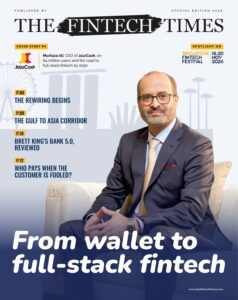
From wallet to full-stack fintech: Murtaza Ali on JazzCash’s path to 2030
Mobile money has shown it can reach people with no bank account. The harder test in emerging markets is whether it can then give them credit, insurance and savings, and carry government payments too.
In Pakistan, JazzCash has become one of the clearest answers, growing from a basic mobile wallet into a platform that handles payments, lending, insurance, merchant services and government disbursements at national scale.
Operating as a standalone entity and partnering with Mobilink Microfinance Bank, JazzCash is a core pillar of VEON’s digital operator strategy. It was recently named among the World’s Top Fintech Companies 2026 by CNBC and Statista in the Payments category.
In this exclusive interview, Murtaza Ali, CEO of JazzCash, discusses the platform’s evolution, the shift to a cashless economy, the role of lending, insurance and social protection in financial inclusion, and the road to becoming a full-stack fintech by 2030.
This interview is the cover story of The Fintech Times Singapore Fintech Festival 2026 Special Edition, distributed at Singapore EXPO from 18 to 20 November 2026. Read the full edition here.

JazzCash began in 2012 as a basic mobile wallet. How would you describe the journey to where the platform stands today?
It has been a steady expansion of what customers needed from us. In the early years the focus was on fundamentals: money transfers, and bill payments. Once that foundation was trusted, we moved into merchant acquiring, digital payments, consumer lending, remittances and a debit card. From there we added a payment gateway, insurance, merchant lending, buy now pay later and cross-border payments.
Today JazzCash serves 64 million users, and one in three adults in Pakistan uses it. None of this was built in isolation. We built each product around a task people already did in cash or in queues, and made it work from a phone.
We did not set out to build a long list of products. We set out to solve the next real problem for the customer.
JazzCash processes the equivalent of 16% of Pakistan’s GDP and one in every three e-commerce payments. What explains this level of adoption?
Trust and convenience, built on a distribution network that is hard to replicate. Our agent and merchant footprint puts JazzCash within reach of people who have never had a bank branch nearby. On top of that, we process more than 16 million transactions a day, up 68% year on year, so reliability has to be constant.
E-commerce is a good example. JazzCash has 2,000+ online merchants including food delivery, ticketing and marketplaces. As volumes grow, so does our responsibility to know who is using the platform. Every merchant and aggregator goes through KYC and due diligence under State Bank of Pakistan rules, and transactions are monitored continuously. Customers don’t choose a payment method for the technology behind it. They choose the one that works every time.
More volume means more responsibility. Every merchant is verified and monitored.
Pakistan is pushing towards a cashless economy. What role does the merchant network play?
It is fundamental, because a wallet is only useful if there are places to spend from it. Pakistan has fewer than 200,000 card terminals for over 250 million people, and a card terminal rarely makes sense for a small roadside (kiryana) store or a home-based business. A printed or digital QR code does, with no hardware at all.
We now have 1.9 million merchants and over 8 million active QR users. We hold a significant volume of RAAST person-to-merchant QR payments, and monthly throughput has grown seven times. More than half of our merchants are onboarded through digital channels, and for those who need guidance, field teams help them get started under the same compliance standards. This work sits within the Prime Minister’s Cashless Economy Initiative, and our Chairman, Aamir Ibrahim, serves on the Prime Minister’s Task Force on Cashless Economy.
When a shopkeeper goes digital, the whole neighbourhood economy moves with them.
Digital lending is often seen as risky in emerging markets. How is JazzCash approaching it?
Carefully, and at scale. We issue more than 280,000 loans every day on an average, and our ReadyCash product won Silver for Banking at Money20/20 USA 2025. Over four million customers use the lending product each month, and 30% of borrowers are women.
These are small, short-term loans that help a household cover an emergency or a small business buy stock. Payments and wallet data help us lend to people the traditional system could not assess. The aim is to build credit history for people who had none, so responsible borrowing leads to better access over time.
Credit works best when it is small, fast, and built on a customer’s own financial behaviour.
Insurance penetration in Pakistan is below 1% of GDP, yet JazzCash sold over 1.3 million policies in a single day. What does that tell us?
That the demand for protection was always there. What was missing was a product that was simple, affordable and available where people already transact. Health insurance in Pakistan has traditionally been tied to formal employment, yet around 75% of the workforce is informal, and most private health spending, about 89%, is paid out of pocket. For a household with no savings buffer, one bad diagnosis can undo years of progress.
So we embedded insurance into the app and into everyday transactions, with products starting from PKR 3 a day, around one US cent, and the Sehat+ health platform backed by nearly 400 panel hospitals. During the 2025 monsoon floods, more than 43,000 policyholders received an instant relief payment directly in their wallets, the first digital claim payout of its kind in Pakistan. Today we reach 17.9 million policyholders and are the number one digital insurance distribution platform in the country, recognised as a winner for InsurTech at The Money Awards 2026.
Financial inclusion is not complete until people are protected, not just banked.
JazzCash is also a major partner for channelling government stipends and welfare. How did that come about?
It started with disaster relief for displaced families in Khyber Pakhtunkhwa in 2021, and grew through our selection as a disbursement partner for the Benazir Income Support Programme, Pakistan’s largest social safety net. BISP pays a stipend to a woman in 12 million low-income households, and for years collecting it meant travelling to a campsite, spending around 10% of the grant on the commute, proving identity in person.
We rebuilt that journey. Beneficiaries are verified with CNIC and biometric checks, receive a free Jazz SIM pre-linked to a wallet, and the money lands directly in their own account. Direct wallet transfers have already reached PKR 20 billion for 1.48 million women, with no agent, no queue and no wait. Across all our government and development sector partnerships we serve more than 3 million beneficiaries, channelling over PKR 100 billion this year alone.
Getting paid should not cost a day’s wages. Dignity is part of the design.
Financial inclusion and poverty alleviation are central to the VEON narrative. What impact are you seeing?
For many customers, JazzCash is the first formal financial service they use, and women hold 35% of our accounts. For many beneficiaries, a government stipend is their first step into the digital economy, and the wallet then becomes a place to save, pay, borrow and get insured.
Poverty alleviation is not one product. It is access to a safe place to save, a way to receive money, credit to start or grow something, and insurance to protect it. When those come through one platform on a phone a person already owns, the barriers fall quickly.
Access to financial services is a foundation for a better life.
What lessons from JazzCash apply to VEON’s other markets?
The core lesson is to start with the customer’s daily need and build around the distribution you already have. Across VEON, 59 million active customers now use our financial services in Pakistan, Kazakhstan and Uzbekistan, and Bangladesh is set to join with regulatory progress there.
Each market is at a different stage, but the playbook travels well: payments first, then the ecosystem around it. The value comes from sharing what works across the Group, including our partnership with Mastercard to scale AI-enabled financial services across four markets.
The model is portable. The customer insight has to be local.
Looking ahead to 2030, what is the vision for JazzCash?
The JazzCash app will work like a personal financial adviser: you talk to it, and it helps you pay bills, make idle money work and borrow when you need to.
Ask “What is due today?” and you’ll see your bills in one place and pay them with one tap or a voice command. If PKR 50,000 has sat untouched since the start of the month, the app will ask whether you’d like to move it into savings or a mutual fund. If a bill falls due before your next income arrives and your balance won’t cover it, the app will offer a small loan, with the cost shown upfront.
This is hyper-personalisation: customers who have never had access to investment or credit products will have it on their own screen, at the moment it matters. For people using AI in a financial app for the first time, trust comes first, so security has to be strict and data has to stay sovereign. We will not scale these features faster than we can secure them.
Your money should not sit idle, and your app should be the first to notice.

About JazzCash
JazzCash began in 2012 as a mobile wallet and now serves 64 million users in Pakistan, with payments, lending, insurance, merchant services and government disbursements. It is part of VEON and partners with Mobilink Microfinance Bank. jazzcash.com.pk
This article first appeared in The Fintech Times Singapore Fintech Festival 2026 Special Edition. Download the full edition (PDF).
The post From wallet to full-stack fintech: Murtaza Ali on JazzCash’s path to 2030 appeared first on The Fintech Times.