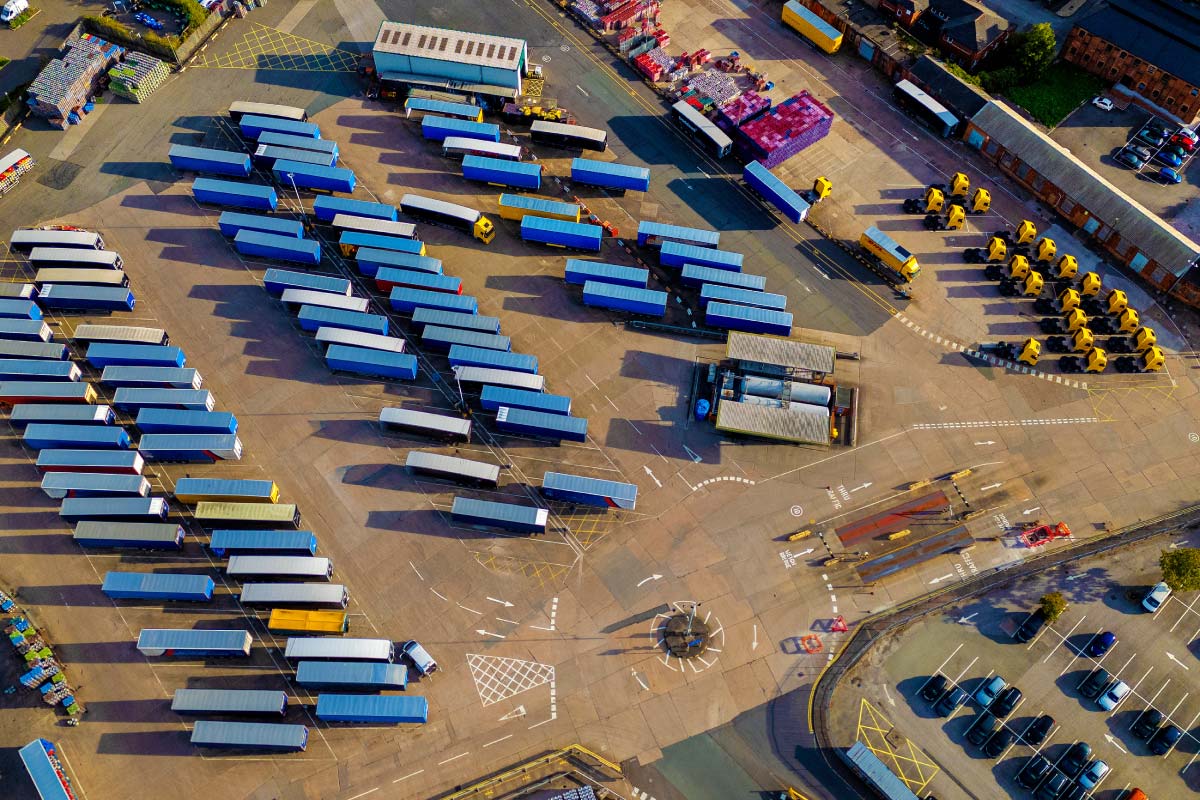
Industrial Outdoor Storage Spans 1.4 Million Acres and Still Is Not Enough
Every gigawatt of data center capacity requires roughly 100,000 truckloads of steel, concrete, generators, and equipment, according to DAT Freight and Analytics. Much of that material needs somewhere to wait before installation. Industrial outdoor storage (IOS), a largely overlooked category of gravel and asphalt yards used to store equipment, materials, and vehicles, has become one of the better-performing corners of commercial real estate. The AI buildout is adding demand for staging space to a market that already has very little of it.
Newmark estimates the sector spans about 1.4 million acres nationally, though the investable share is far smaller. Alterra IOS has put the total value above $1 trillion, with most of that land municipally or government-owned, leaving roughly $300 billion held by small local owners and operating businesses. Vacancy runs around 4 percent, compared with roughly 7 percent for traditional industrial, while annual inventory growth remains below 2 percent.
That scarcity shows up in rents. CBRE puts national rent growth at 32 percent since 2021, while Alterra IOS data shows rents up more than 110 percent since 2020 across the top eight port-adjacent markets, including Houston, Savannah, and Norfolk. Part of the pricing power comes from how little the rent matters to the tenant: yard costs are a rounding error against total data center development budgets.
Capital has arrived accordingly. Brookfield agreed this year to acquire Peakstone Realty Trust for $1.2 billion, J.P. Morgan Asset Management partnered with Zenith IOS on roughly 100 properties across 33 markets, and a Starwood Property Trust venture lent $672 million against a portfolio in August. Catalyst Investment Partners has assembled $1.4 billion over six years in Northern Virginia and Atlanta, financed partly by Blackstone.
But the investment thesis has a supply-side problem. Entitling new outdoor storage is close to impossible in many jurisdictions, where these yards often face opposition over noise, appearance, and relatively low tax revenue per acre. Meanwhile, data center development is consuming some of the existing supply. In Manassas, Virginia, more than 200 acres of outdoor storage will be replaced by data centers, representing over 20 percent of the local supply. The same development boom driving demand for staging space is helping eliminate the land that could provide it.
The scale of hyperscale development complicates the thesis. IOS aggregators typically assemble infill parcels of two to fifteen acres from regional operators and retiring owners, properties well suited to trucking companies and equipment rental businesses. Large data center projects introduce a different set of requirements, particularly when contractors need substantial laydown areas close to construction sites. Cushman & Wakefield put the average data center land purchase in 2024 at 224 acres, up 144 percent from 2022, while a gigawatt campus generally needs 500 to 1,500 acres. Crusoe’s Stargate site in Abilene covers roughly 1,100 acres for 1.2 gigawatts, and Meta’s Hyperion campus in Louisiana spans about 2,250 acres under construction.
A project of that size cannot necessarily solve its staging needs by leasing a dozen scattered eight-acre yards. Contractors may need multiple smaller properties for specific logistics, but large projects can also create demand for substantial, contiguous areas near the site. Developers increasingly secure adjacent parcels alongside substation easements and land reserved for future phases. Parts of the IOS sector have begun shifting toward hubs of 50 acres or more, a different product with different entitlement hurdles. The transition is complicated by an existing inventory in which roughly 60 percent of properties were developed before 2000, with many still unpaved or lacking the drainage, lighting, and security institutional users expect.
The near-term numbers reflect a genuine shortage, but the demand underneath them is less uniform than the rent growth suggests. Yards serving ports and last-mile fleets face structural constraints that predate AI and will outlast it. Yards serving a specific data center campus may be scarce only for the duration of construction, after which the contractor leaves. Upgrading older properties and assembling larger sites also takes capital, time, and potentially new entitlements.
The key question is whether aggregators holding infill portfolios can capture the hyperscale demand bidding up rents, or whether much of that demand will flow to larger, contiguous sites the existing investment model was never designed to assemble. Industrial outdoor storage may be benefiting from the AI boom, but not every yard is positioned to benefit equally.
The post Industrial Outdoor Storage Spans 1.4 Million Acres and Still Is Not Enough appeared first on Propmodo.