The bull case for Nvidia as most S&P 500 stocks slide
A stock market near a record high can make investors feel as if nearly everything is working. Ted Thatcher, a financial advisor with more than a decade in the investment sector, sees a very different picture beneath the S&P 500 Index. He said 82% of the index’s stocks were at least 10% below their own highs, while 60% were down 20%, even as the index itself approached a high. That gap is why he favors Nvidia, Microsoft, and Alphabet over simply buying whichever stocks have fallen the most: A lower price alone doesn’t turn a company into a bargain.
Thatcher, founder and president of Bright Lake Wealth Management, argues that the trade in artificial intelligence has retained the lead in the market because it has offered earnings growth. Meanwhile, high oil prices, inflation pressure, and rising 10-year U.S. Treasury note yields have weighed on much of the rest of the market. His framework has two parts: Keep exposure to the companies benefiting from AI demand now, then add more broad-market exposure if the macroeconomic pressures that have narrowed market leadership begin to ease.
That approach is a view on market conditions, not a one-size-fits-all allocation. Thatcher repeatedly said that portfolio decisions should reflect an investor’s need for income, tolerance for risk, and time horizon. Still, his case offers a useful way to separate a broad-market decline from an opportunity in a particular stock.
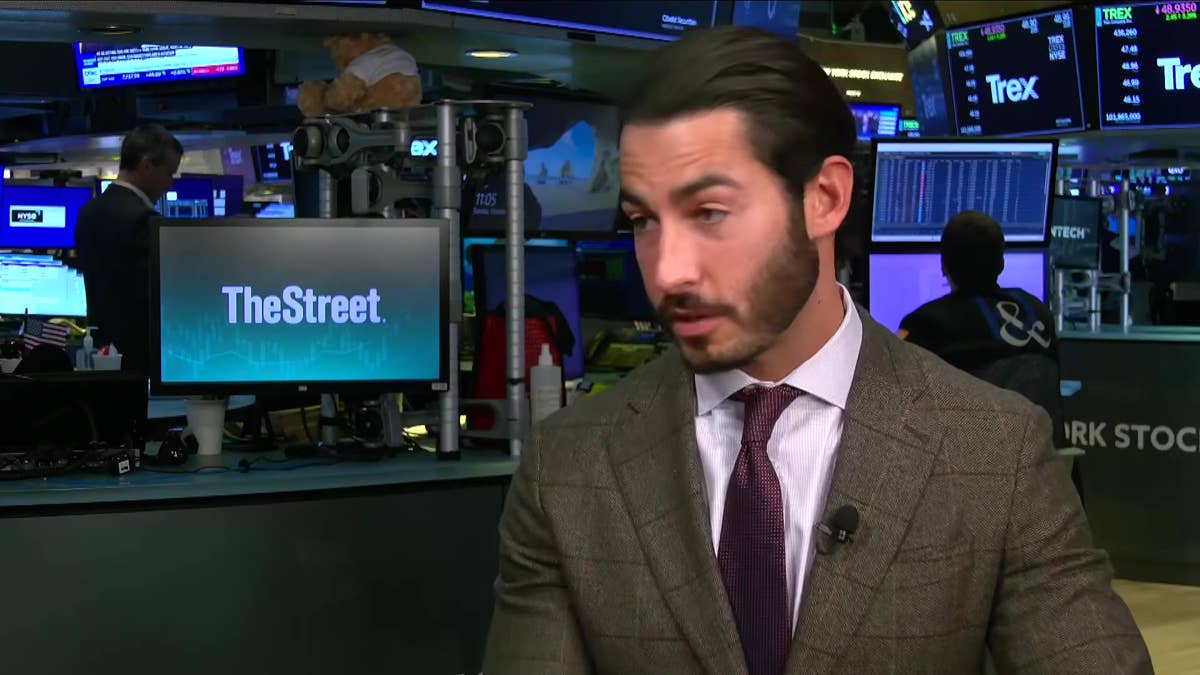
Here is how Thatcher — who spoke in an interview with TheStreet on October 20, 2026 — connects market breadth, AI earnings, oil prices, and portfolio positioning.
Why a high S&P 500 can mask a weak broad market
The S&P 500 is weighted by market capitalization, meaning its largest companies have the biggest effect on the index. Nowadays, information technology — which includes Nvidia and Apple — has the largest weighting among other sectors in the benchmark. A strong run in a small group of giant companies can therefore lift the benchmark even when many smaller constituents are falling. Thatcher described the market since the March 30 lows as one led by roughly 10 companies, with AI-related stocks carrying the leadership burden.
That is the tension in his outlook. The poor performance of many S&P 500 stocks may eventually create opportunities, but he does not treat breadth weakness — meaning more stocks are declining than rising even as the benchmark index gains — as proof that beaten-down shares are cheap. A stock can decline because its outlook has deteriorated, because a sector is under pressure, or because investors are reacting to interest rates and economic uncertainty. The reason for the decline matters as much as the fall itself.
Just because a stock has moved down doesn’t necessarily mean it’s a good buy.
Ted Thatcher, when asked whether the divergence within the S&P 500 created bargains or a warning sign
Thatcher’s explanation for the breadth problem centers on external pressures rather than a blanket indictment of corporate America. He pointed to oil near $100 a barrel, inflation, interest-rate pressure, and higher 10-year Treasury yields. In his view, relief in those areas could widen market participation over time. Until then, he expects the concentration in a relatively small group of AI leaders to remain a source of both performance and volatility.
For an investor, the practical distinction is important. Buying a broad index fund remains a way to own the entire market, including the largest technology companies. But a separate allocation to an equal-weight fund such as the Invesco S&P 500 Equal Weight ETF gives each constituent a more similar influence on returns. That structure can benefit if lagging stocks recover, but it can lag a market-cap-weighted index if the biggest companies continue to dominate.
Why Thatcher keeps NVIDIA, Microsoft, and Alphabet at the center
Thatcher’s preference for Nvidia starts with valuation relative to expected earnings. He said Nvidia was trading at around 23 times earnings based on the prior 12 months, while estimates for future earnings put its forward earnings multiple, or stock price divided by expected earnings per share, in a range from the low teens to the mid-teens. Still, the range reflects differing projections, and forward estimates can be wrong. His point is that a fast-growing company can look expensive on trailing results while appearing less expensive when investors assess expected profit growth.
He also views Nvidia as the most direct beneficiary of sustained spending on AI computing. That is why he believes the company has more upside, even after a period when hedge-fund selling pressure and concern about the broader AI buildout weighed on the shares. His $300 price target was his own forecast, not a guarantee, and it depends on the demand outlook that underpins those forward earnings expectations. (Nvidia closed at $210.96 on October 23, 2026.)
Microsoft represents a different version of the AI case for Thatcher. He praised the company’s restraint in bringing AI products to market and its decision to fund data-center expansion from cash flow rather than leaning on debt. A hyperscaler is a large cloud-computing company with vast data-center infrastructure. Thatcher believes Microsoft’s execution across enterprise and consumer products, combined with that financing discipline, supports his view that the stock has further upside. He cited a target of around $600 a share.(Microsoft closed at $524.51 on October 23, 2026.)
For Alphabet, Thatcher emphasized vertical integration, which means controlling several layers of the product and technology chain. He pointed to Alphabet’s in-house tensor processing units, or TPUs, its hardware, Gemini 4, and its consumer distribution. His thesis is that those pieces can work together: proprietary chips support computing capacity, the AI model provides the service, and Alphabet’s existing distribution can help the product reach users. That is a mechanism-based argument, even though its ultimate success depends on execution and adoption.
The common thread is not that all large technology companies are identical. Thatcher said he also liked Apple’s hardware distribution advantage and viewed Amazon as a strong operator. His three preferred names reflect a judgment about earnings, execution, and AI positioning, rather than an argument that investors should abandon diversification for a handful of stocks.
What would change the AI leadership thesis
A useful investment thesis needs a condition that could disprove it. Thatcher named one: a meaningful slowdown in AI spending by the largest cloud-computing companies. He distinguished that from concern about one neocloud, a newer cloud provider that rents specialized computing capacity. A broad slowdown would be more consequential because demand for Nvidia’s chips and the revenue growth of the major cloud platforms are closely tied to ongoing capital spending on AI infrastructure.
Thatcher cited cloud-growth figures from recent company results as evidence he was watching, including more than 80% cloud growth for Alphabet’s Google and more than 40% growth for Microsoft’s AI segment. Those figures are historical observations from his discussion, not forecasts for future quarters. His view is straightforward: If the largest buyers stop producing strong AI-related growth, investors should reassess the companies whose valuations and earnings expectations rely on that demand.
Until we get relief on oil, you know, fuel prices, I would say, you know, yield pressure and interest rate pressure, the AI trade is going to continue to lead the market.
Ted Thatcher, when asked what could drive the market higher despite oil and interest-rate headwinds
Thatcher’s conclusion is counterintuitive for investors who are uncomfortable with market concentration. He doesn’t argue that concentration is healthy. He argues that it is the condition investors must account for while the macro backdrop limits participation elsewhere. His phrase “price of admission” describes the trade-off: Owning the current leaders can mean accepting greater dependence on a narrow set of companies and sharper reactions to new information.
That dependency also explains his answer when asked which stock he would sell first if the AI case broke. Nvidia is central to his bullish case because it is so closely exposed to chip demand. The same direct exposure that makes Nvidia attractive in a continuing AI buildout could make it vulnerable if demand falters.
You’d have to sell, you probably would have to sell Nvidia because you’d presumably expect, you know, everyone’s buying all of Nvidia’s chips.
Ted Thatcher, when asked which holding he would sell first if the AI trade started to crack
How oil and Treasury yields could broaden the market
Thatcher sees oil as a potential trigger for a broader rally because fuel costs feed into inflation, transportation expenses, and interest-rate expectations. He said he would like to see oil trend down toward the low $80s or high $70s per barrel. That price range is his market signal, not a precise forecast. In his view, a sustained decline could reduce inflation pressure and make investors more willing to own companies outside the AI leaders. (WTI crude oil, the U.S. benchmark, was trading at around $103 a barrel as of October 23, 2026.)
He tied that argument particularly to consumer staples, which are everyday necessities such as groceries and household goods. Thatcher said transportation costs can account for 30% to 40% of the cost of those goods, depending on the analysis used. Lower fuel and diesel costs could therefore improve the cost backdrop for staples companies. He added that consumer discretionary companies could also benefit, but he focused on staples because consumers generally keep buying necessities even when budgets are constrained.
The other part of his macro view is the 10-year Treasury. A Treasury note is U.S. government debt; when yields fall, the prices of existing bonds generally rise. Thatcher said he liked buying the 10-year Treasury at a 5% yield, especially for investors holding cash that is not being put to work. He expects yields to move lower before they rise to 6%, based partly on buying interest from institutions and commercial hedgers. That remains his outlook, and bond prices can fall if yields instead rise.
This is where the strategy becomes more personal. Someone who needs predictable income or wants to reduce portfolio volatility may find a Treasury allocation relevant for reasons that have little to do with a stock-market forecast. Someone with a longer horizon and a higher tolerance for equity risk may make a different choice. Thatcher explicitly said Bright Lake Wealth Management sets bond allocations family by family rather than applying a fixed percentage to every client.
How Thatcher uses the Invesco S&P 500 Equal Weight ETF
Thatcher does not frame the Invesco S&P 500 Equal Weight ETF (which goes by the ticker RSP) as a replacement for the conventional S&P 500 Index. He called it a tactical allocation, meaning a position intended to express a view on changing market conditions rather than a wholesale redesign of a portfolio. He would not sell an existing market-cap-weighted S&P 500 holding simply to make room for RSP, because that holding still includes the technology leaders he favors.
Instead, he would direct new money to RSP as a separate allocation when an investor wants to position for improving breadth over a period of six months, a year, or longer. In a hypothetical $10,000 split among Nvidia, Microsoft, Alphabet, and RSP, he said the three technology stocks would receive 60% to 75% in roughly equal portions, with the remainder in RSP. That example is an illustration of his preference at the time of the discussion, not a model portfolio for every reader.
The sequencing matters. Thatcher expects AI leadership to persist in the short term, and he would then consider increasing the RSP allocation as pressures on oil, fuel, inflation, and rates ease. An equal-weight strategy can provide more exposure to a broad recovery, but a lesser weighting strategy to the mega-cap companies that have driven the index. Investors using it should understand that they are making an active choice about market leadership, even if they hold the fund for diversification.
The takeaway for S&P 500 investors facing a narrow market
Thatcher’s framework starts with a simple discipline: Don’t confuse a falling stock with a cheap stock, and do not confuse a rising index with broad market strength. Investors who share his AI view can decide whether they are comfortable owning companies such as Nvidia, Microsoft, and Alphabet because of their earnings outlook. At the same time, a clear slowdown in AI spending and demand, for example, could change that view.
For investors who want broader participation, the decision is different. Watch the macro conditions Thatcher identified, especially oil, fuel costs, inflation, and Treasury yields. If those pressures ease, an equal-weight S&P 500 fund may be a way to add exposure to the many companies that have not shared fully in the index’s advance. If the pressures persist, market leadership may remain narrow and volatile.
The decision procedure is therefore less about predicting the next daily move in the S&P 500 and more about matching an allocation to a thesis and a risk limit. It may suggest owning a concentrated AI position only if a slowdown in demand wouldn’t force an investor to sell at an unacceptable loss. It may also mean using a broad-market allocation when a different exposure fits the investor’s horizon. And treat political events, price targets, and rapid-fire market calls as inputs to a plan, rather than substitutes for one.
Thatcher’s bullish view depends on AI demand holding up and on macro pressure eventually easing. Investors do not need to accept either premise wholesale. The more durable lesson is to separate the reason a stock has fallen, the source of a company’s earnings growth, and the role that position is meant to play in a portfolio.
Note: The market musings expressed herein are those of the interviewed guest and should not be treated as professional investment advice. Readers should consult a certified financial planner (CFP) for individualized advice based on their available capital, goals, risk tolerance, and time horizon.
Some or all of this content may have been generated by AI. While we strive for accuracy, AI can occasionally produce incorrect information. If you buy something via one of our links, we may earn a commission.