


Germany’s Merz visits Kyiv amid fears of ‘hardest’ winter in war
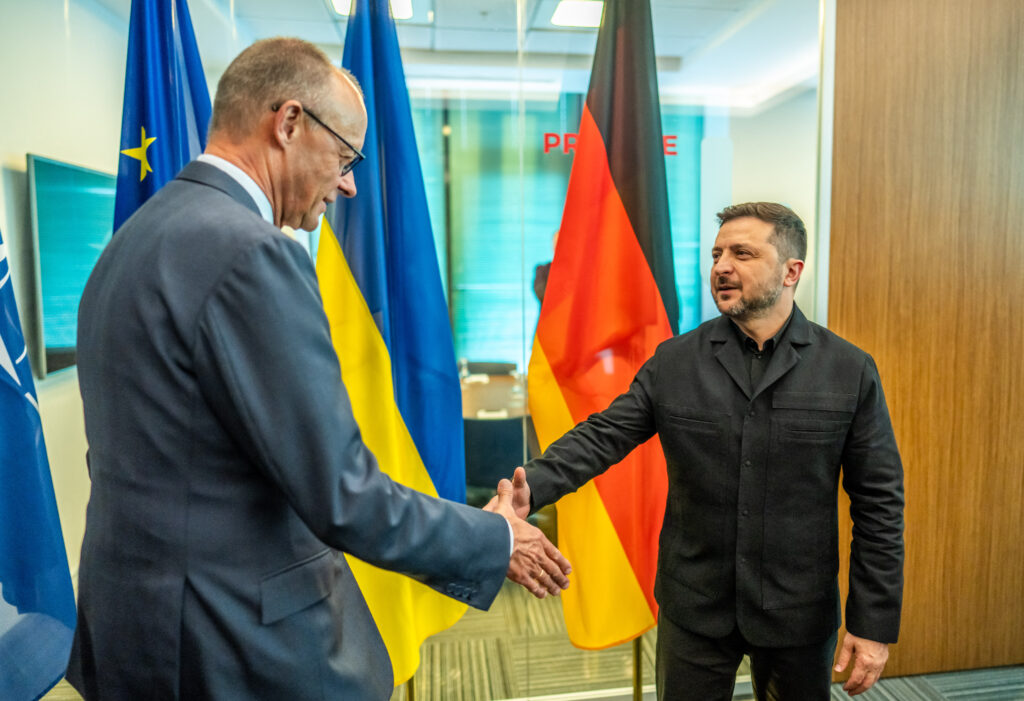
German Chancellor Friedrich Merz arrived in Kyiv for a surprise one-day visit to showcase Berlin’s support for Ukraine amid Russian attacks on the Ukrainian capital that continued after the chancellor’s arrival.
Merz, who is in Kyiv to deliver new military, financial and economic support pledges to Ukraine, is planning to meet President Volodymyr Zelenskyy to discuss support against Russia’s escalating war, particularly in the sector of air defense and long-range offensive weapons, as well as peace initiatives.
A German official said that Berlin will provide Ukraine with a new military support package worth about €1 billion, which includes missiles and drones, as well as satellite technology to help striking military targets in Russia.
Germany will furthermore provide Ukraine with financial assistance for the mass-production of new drones to intercept Russia’s particularly dangerous high-speed jet drones. Berlin will also provide generators, substations, and repair kits worth €350 million to make the Ukrainian grid more resilient against Russian attacks.
Kyiv warned this week that it’s running out of funds to buy weapons to defend itself, highlighting a €24 billion defense funding gap, to which the European Union reacted by accelerating the disbursement of a €45 billion loan. Germany is the biggest contributor to the financial and military support for Ukraine.
Ukraine is facing harsh Russian drone and missile attacks on its infrastructure, power and heating plants as well as other civilian targets, which are feared to further intensify this winter.
In contrast to previous visits from Western leaders, during which Moscow had largely refrained from attacks on the Ukrainian capital, air raid sirens could be heard in Kyiv during Merz’s visit. Kyiv Mayor Vitali Klitschko reported that Russia had struck the roadway of the North Bridge in the city. On Saturday, Russia’s foreign ministry issued a warning against foreign visitors and diplomats and urged them to leave Kyiv.
This is Merz’s first bilateral visit to Kyiv and his second trip as chancellor, after travelling there in May 2025 visit alongside leaders from France, the U.K. and Poland.
“If we fail to stop Moscow, sooner or later the Russian war machine will turn against us”, Merz said upon arrival in the Ukrainian capital, adding: “I will tell President Zelenskyy today, ‘You can continue to count on our help.’”
It comes just a few days after the embattled chancellor vowed to maintain his government’s strong support to Ukraine, despite the rise of the far-right, Russia-friendly Alternative für Deutschland (AfD).
During a speech in Münster, Germany, Merz warned that, “in a few weeks, the fifth winter of the war will begin”, which “likely be the hardest one yet.”

Ukrainians “are bracing themselves for intense ballistic missile attacks, for destroyed power plants and schools, and for damaged apartment buildings and churches. Ukraine must survive this winter, and I am convinced that it will. It can count on our help,” Merz added, highlighting German help such as new interception systems against jet drones or repairs for bombed power plants.
Merz and Zelenskyy held a call on Wednesday, which focused on convincing European and international allies like Japan to deliver more Patriot air defense missiles to Ukraine as well as procuring fresh ammunition for Kyiv’s F-16 fighter jets, which are efficient in downing Russian jet drones with their onboard cannon.
Last month, German Defense Minister Boris Pistorius announced that Germany would transfer Patriot PAC-2 interceptor missiles from its own stocks to Ukraine, and called on other states to follow suit.
Following the attempted drone attack on a Ukrainian cargo plane in Leipzig in August, for which Germany blamed Russia, Berlin announced that its intelligence services would help Ukraine with supplying targeting data for long-distance strikes against Russia’s military as well as its industrial base.
Merz has refused to supply Germany’s prized Taurus cruise missiles to Ukraine, despite calling for it when he was opposition leader. Yet his government delivered financial and technical assistance for the development of Ukraine’s own long-range weapons. On Thursday, Zelenskyy announced the successful test of Ukraine’s FP-7 ballistic tactical missile.
German Economy Minister Katherina Reiche, from Merz’s center-right CDU party, joined the trip alongside representatives from a dozen German energy, chemical and drone manufacturing companies, which will participate in a German-Ukrainian economic forum in Kyiv on Sunday.
There are tensions between Merz and Zelenskyy when it comes to Ukraine’s desire to swiftly join the European Union.
The German Chancellor has voiced skepticism that an EU accession would be possible in the coming years and instead proposed an “associated membership” that would grant Ukraine access to the EU’s single market and an observer status in the Council of the EU, the European Commission and the European Parliament, but without any voting rights.
Zelenskyy, however, has rejected the proposal, saying that Ukraine needs “full and equal” membership.
Merz’s visit comes amid renewed attempts to seek a peace agreement between Russia and Ukraine. German Foreign Minister Johann Wadephul, who met with his Russia counterpart Sergei Lavrov in New York last weekend, has welcomed a U.S. invite for Vladimir Putin to the G20 leaders’ summit in Miami in December, saying it could be a chance for serious negotiations.
However, so far “Russia’s leadership shows no real interest in putting an end to its deeply inhumane fantasies of subjugation and conquest,” Wadephul said on Friday. “It intends to continue the war against Ukraine.”