China Stocks Sink To One-Year Low As Proposed US Curbs Hammer Optical Suppliers
China Stocks Sink To One-Year Low As Proposed US Curbs Hammer Optical Suppliers
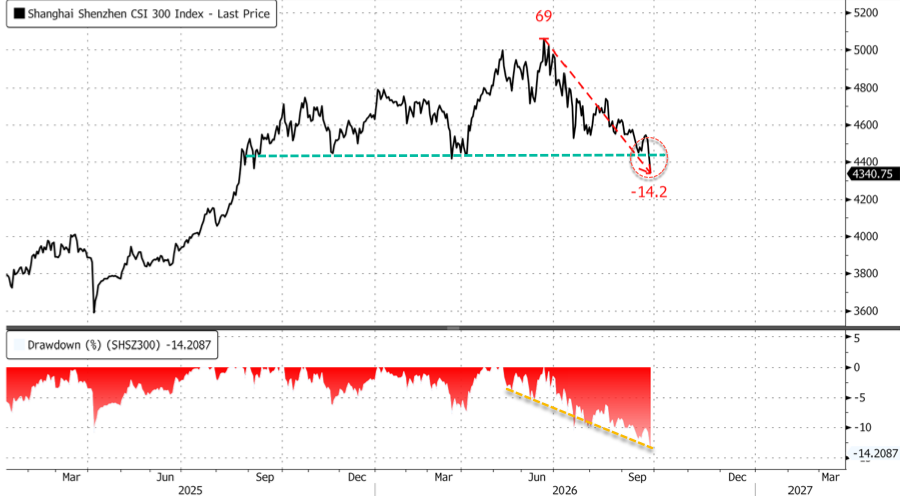
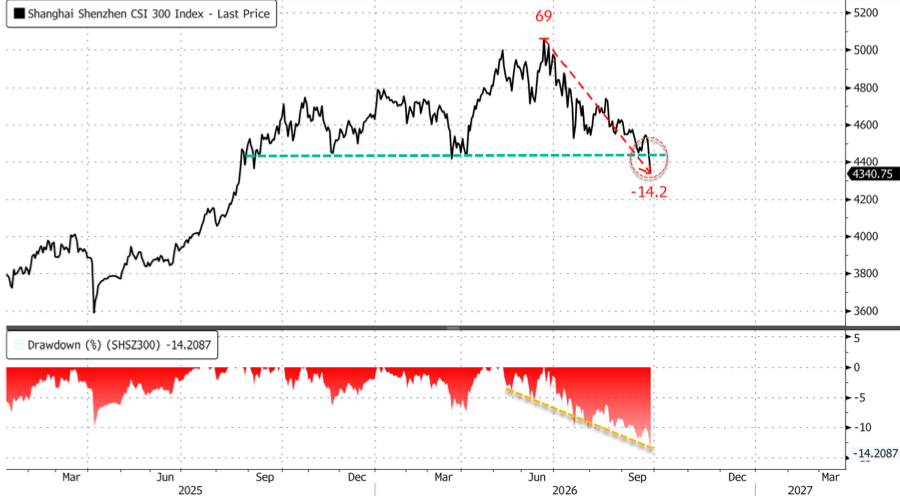
The CSI 300 Index, a leading benchmark tracking 300 of the largest stocks listed in Shanghai and Shenzhen, fell to a one-year low Monday. The index, roughly comparable to the S&P 500, came under pressure as co-packaged optics (CPO) shares sold off following a Reuters report of proposed US restrictions on Chinese optical transceivers used in sensitive government systems and data centers.
UBS’s Lucy Zhang offered clients a first take on the Reuters report and the resulting selloff in Chinese stocks overnight:
China A-shares were under broad-based pressure Monday, led by a sharp selloff in the co-packaged optic (CPO) complex following press reports of fresh US policy restrictions.
Zhongji Innolight fell 9% and Eoptolink dropped 8%, weighing on the broader technology space, as investors reacted to proposed US restrictions targeting Chinese optical transceivers.
The weakness came against an already fragile backdrop following the Trump-Xi summit, which delivered few concrete outcomes. Growth and technology heavy indices underperformed, with the ChiNext Index down 4.5% and the STAR 50 down 4.1%, as selling pressure spread across AI, optical networking, and broader TMT names.
The combination of policy uncertainty, crowded positioning, and limited positive catalysts continues to weigh on market sentiment in the near term. A-share full-day turnover remained at RMB1.7 trn, broadly in line with the August-September average, indicating limited buy-on-dip flows ahead of the long holiday.
Meanwhile, The Information separately reported that Beijing may allow Alibaba and ByteDance to purchase Nvidia’s RTX Pro 5500 chips, potentially intensifying competition for homegrown suppliers.
The onshore benchmark CSI 300 Index closed 2.2% lower Monday, tumbling to levels last seen in August 2025. The decline leaves the index vulnerable to further downside toward 4,000, with limited technical support that could amplify the move.
Last week’s Trump-Xi summit, as described by Barclays senior China economist Yingke Zhou, was “more signaling, less substance,” adding, “The Trump-Xi summit was primarily about stabilizing relations rather than resolving disputes. Beyond a short trade-truce extension, progress was limited. The absence of Chinese CEOs suggests China viewed the summit as a strategic dialogue, not a deal-making exercise.”
Tyler Durden
Mon, 09/28/2026 – 07:20