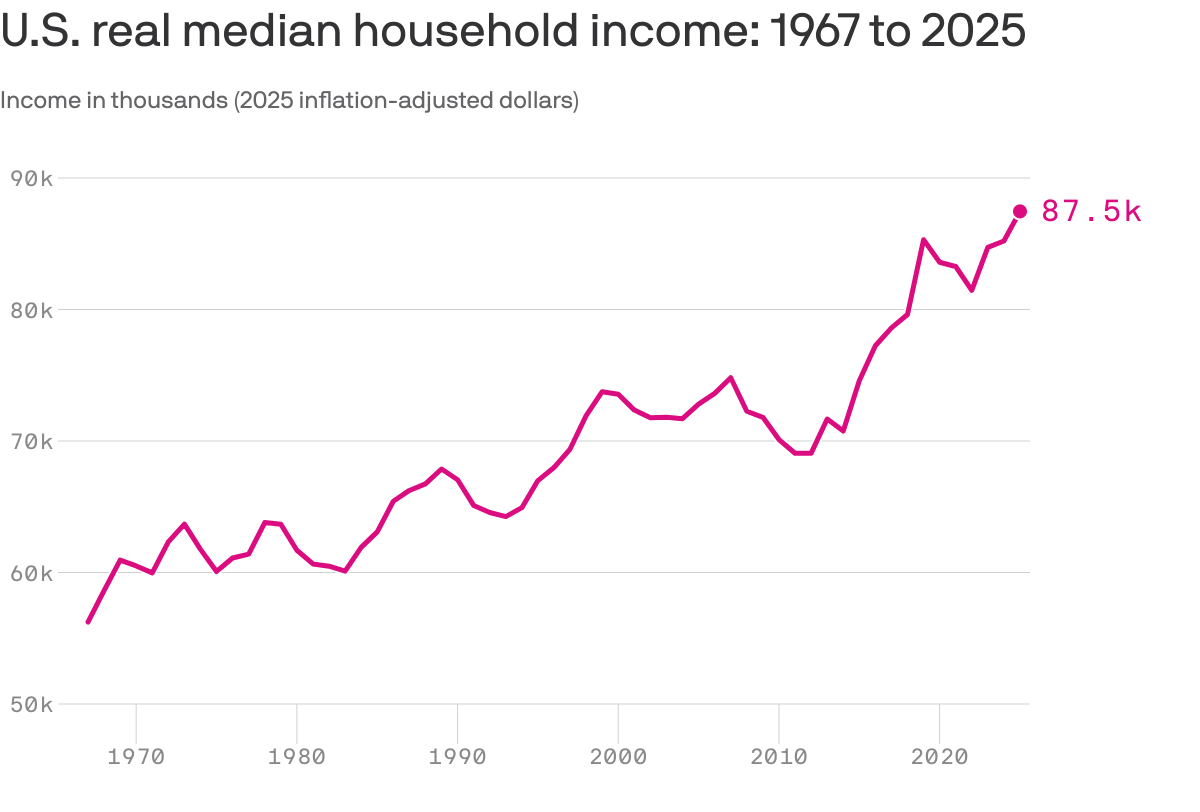
Household income hits record, but lower earners lose ground
U.S. household income hit a record in 2025, but the lowest earners barely shared in the gains, new Census data show.
Why it matters: On paper, Americans look richer than ever. But broader measures of financial security show millions still getting squeezed by medical costs, uneven income gains and a thinning public safety net.
- The 2025 Census report largely captures the economy before the major safety-net reductions in President Trump’s “Big Beautiful Bill” took hold.
- That makes this year’s record income and near-record-low official poverty numbers an important benchmark for measuring what happens next.
By the numbers: Real median household income rose 2.6% to $87,460 in 2025, the highest inflation-adjusted level since Census records began in 1967.
- Median post-tax household income climbed 3.1% to $76,060.
- The official poverty rate fell for a third straight year, dropping slightly to 10.2%, or about 34.5 million people.
- Child poverty fell to a record-low 13.4%, while poverty among Hispanics dropped to an unprecedented 13.9%.
State of play: The economy delivered historic topline numbers without spreading the gains evenly.
- Income among the wealthiest 10% of Americans rose 1.7%, while income among the bottom 10% showed no significant change — indicating that the low-income households largely missed out on the gains.
- Households at the 90th percentile earned about $261,300, more than 13 times the roughly $20,010 earned at the 10th percentile.
- The top fifth of households captured 52.4% of all household income. The bottom fifth reported earning just 3%.
Zoom in: Latinos offer one of the clearest examples of the split-screen economy in 2025.
- Hispanic poverty fell to its lowest level since Census began tracking it in 1973. But the median household income among Hispanics, $73,260, showed no significant change from 2024.
- Meanwhile, 21.8% of Hispanic adults ages 19 to 64 were uninsured in 2025, down a bit from the previous year — but still the highest uninsured rate among the major racial and ethnic groups shown by Census
Yes, but: Big racial income gaps remain even as some groups posted gains.
- Asian American households had the highest median income at $126,300 in 2025, compared with $91,930 for white households and $59,980 for Black American households.
- Black Americans’ household income rose 4.8% from 2024 and whites’ household income rose 3%, while Asian Americans’ household income showed no significant change.
Zoom out: A broader measure of hardship paints a less rosy picture.
- The Supplemental Poverty Measure, which factors in taxes, government benefits, housing, work and medical expenses, held statistically steady at 13.1% — nearly 3 percentage points above the government’s official poverty rate.
- Medical expenses put an estimated 7.7 million more people below the supplemental poverty line in 2025, the Census Bureau said.
Between the lines: Health insurance coverage held steady overall in 2025. The uninsured rate remained statistically unchanged at 7.9%, or 26.7 million people.
- Medicaid coverage fell 0.5 percentage points nationally, from 17.6% to 17.1% of the population — representing about 1.4 million fewer people with Medicaid coverage in 2025 than in the previous year
- Among adults ages 19 to 64, 17.3% had public health coverage — including Medicaid, Medicare and VA/CHAMPVA coverage — down 0.5 percentage points from 2024.
- Census says the decline was driven by a 0.6-point drop in Medicaid coverage among working-age adults.
What we’re watching: The 2025 numbers may represent the last snapshot before major federal safety-net cuts begin showing up in the Census data, Robert Greenstein, a visiting fellow at the Brookings Institution, tells Axios.