Wildfires Are Doing For Alternative Building Materials What Decades of Innovation Could Not
The construction industry has been on the receiving end of disruption attempts for as long as anyone has been paying attention. Modular construction, 3D printing, mass timber, structural insulated panels, and a long list of proprietary systems have all arrived with a compelling case for why wood framing was obsolete. Wood framing is still here. It remains the default for the overwhelming majority of residential and light commercial construction, not because nobody built a better product but because the industry has proven remarkably resistant to changing how it does things. What decades of innovation could not accomplish, catastrophic wildfire losses now appear to be doing. Materials that sat on the shelf for years are finding real adoption in rebuild markets across the West, and the reason has more to do with what has burned than with anything that happened in a lab.
The failures of previous attempts are instructive, though, because they explain why the current moment looks different. “There have been so many companies that have tried to change the construction industry and failed,” said Ken Calligar, CEO of RSG 3-D, which manufactures composite structural panels made of steel trusses and expanded polystyrene encased in concrete. “A lot of those failures is due to putting too much into R&D before they actually have a product that someone wants.” That diagnosis identifies the core problem with how construction innovation has typically been funded. Capital flowed toward companies attempting to reinvent the entire building process, which required simultaneously solving manufacturing, logistics, labor training, code approval, lender acceptance, and insurance underwriting before a single dollar of revenue arrived. The technical achievements were often real. The businesses built around them frequently were not.
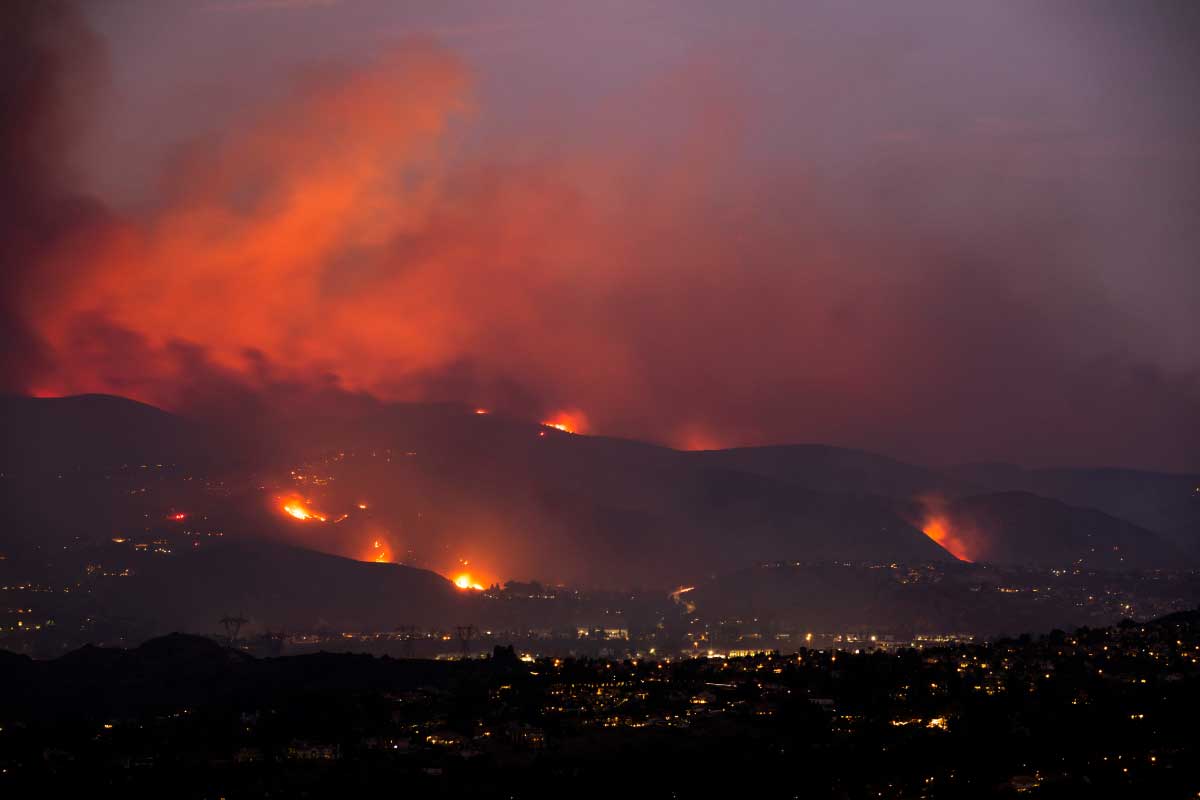
What has changed the adoption curve is not a breakthrough in the technology. It is the scale of what has been lost. The Palisades and Eaton fires destroyed more than 16,000 structures in January 2025, and they arrived on top of a decade in which 15 of California’s 20 most destructive wildfires by structures destroyed have occurred since 2015. The wildland-urban interface expanded by 179,000 square kilometers between 1990 and 2020, roughly the size of Washington state, with homes in those areas growing from 30 million to 44 million. “People finally had a revelation that we can’t continue to build the way we have built,” Calligar said.
That revelation is producing demand for materials that were available and largely ignored for years. Insulated concrete forms, noncombustible prefabricated siding systems, fiber cement products, and composite panel systems are all seeing adoption in rebuild markets at rates that would have been unimaginable before the losses. RSG 3-D’s panel system has existed since 1990 and is only now reaching meaningful scale as California homeowners and developers seek alternatives, including at roughly 80 homes in the Los Angeles rebuild.
The harder lesson emerging from the rebuild is that material substitution alone does not produce a fire-resistant building. “Wildfires create a binary classification. A building is either combustible or it is not,” Calligar said. “You can put nonflammable siding on a house but it could still catch fire if there is a combustible component.” A structure is only as resistant as its weakest assembly, and the failure points are rarely the walls. Vents admit embers into attics. Wood decks ignite and transfer flame to the structure. Eaves trap heat. Landscaping within the first five feet carries fire directly to the foundation. Rethinking a building for fire means rethinking every component that could ignite, which is a considerably larger design exercise than swapping a siding product.
Standards are beginning to enforce that systems-level thinking, which matters enormously for accountability. The Insurance Institute for Business and Home Safety established its Wildfire Prepared Home program in 2022 and has since expanded it to 14 states. The program offers two designation levels, Essential, focused on reducing risk from wind-driven embers, and Enhanced, which adds protection against radiant heat and direct flame contact. Critically, it takes a systems-based approach: homeowners must complete all required mitigation actions in the standard, not just some of them. In June 2026, IBHS extended the program with formal standards for multifamily properties covering duplexes, townhomes, apartments, and condominiums, along with a neighborhood-level standard addressing structure-to-structure fire spread. IBHS also operates the FORTIFIED program for wind and storm resilience, which surpassed 100,000 designations in May 2026.
The significance of those programs is that insurers recognize them. Many carriers now offer premium discounts for designated properties, which converts resilient construction from a values-based decision into a financial one. That shift is what gives the standards teeth. A builder can market a fire-resistant home. A designation lets a homeowner prove it to their insurance carrier, which is a different and far more durable form of accountability.
What may ultimately determine which alternative systems succeed is how little they ask the industry to change. The failures of the past decade largely demanded that builders, framers, subcontractors, engineers, and inspectors all learn a fundamentally new process. That is an enormous amount of friction to overcome for a product improvement, however real. “Some new techniques are just too different,” Calligar said. “We tried to keep panels the same size, keep the framers’ jobs basically the same.” A system that arrives in familiar dimensions and gets installed by crews doing recognizable work faces a fraction of the resistance of one that requires retraining an entire trade.
The fires that have driven this shift have been genuinely devastating. Communities were erased, families lost homes they had lived in for generations, and the rebuilding will take years longer than anyone displaced by it would like. Nothing about that is a fair trade for better building practices. But the industry is emerging from it with a level of seriousness about resilience that no amount of product marketing or venture capital ever managed to produce. Builders are asking different questions. Homeowners are demanding different answers. Insurers are pricing the difference. That is a meaningful change, and it is the one durable thing to come out of an otherwise terrible few years.
The post Wildfires Are Doing For Alternative Building Materials What Decades of Innovation Could Not appeared first on Propmodo.