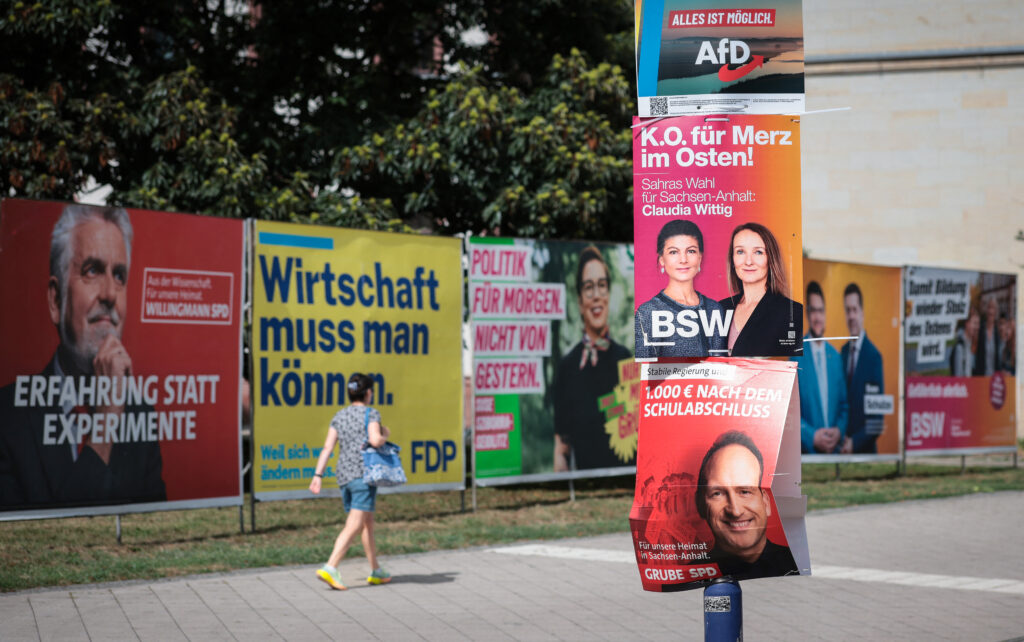
Friedrich Merz will lose Sunday’s regional election — whatever the result
MAGDEBURG, Germany — For Chancellor Friedrich Merz, Sunday’s election in eastern Germany offers no good outcomes — only varying degrees of political humiliation.
The Alternative for Germany, or AfD, is expected to win decisively in the state of Saxony-Anhalt, finishing well ahead of Merz’s conservatives, according to pre-election polls. This result would show, in the clearest terms, the degree to which the far right has strengthened and surpassed mainstream parties in broad swaths of the country.
That humiliation would be even worse for Merz if the AfD wins enough votes to secure an outright parliamentary majority and govern the state alone. At least from the perspective of Germany’s mainstream parties, it would give him an ignominious place in the country’s postwar history as the national leader who presided over the far-right’s first rise to real governing power since World War II.
But the other likely outcomes offer little relief for Merz.
If the AfD falls short of a governing majority in the state — an outcome that appears increasingly likely based on the latest polling — Merz’s second-place Christian Democratic Union will face a series of untenable choices as it tries to cobble together a coalition with left-wing parties. Any such alliance would likely be doomed from the outset, while remaining dependent on far-left or far-right support to pass legislation.
Concerns are also mounting that the AfD may be preparing for this scenario by challenging the outcome of Sunday’s election. The party has already issued press releases casting doubt on mail-in ballots, while its lead candidate, Ulrich Siegmund, has voiced similar concerns on social media.
Whatever the result on Sunday, the election could set off a chain of events for Merz — already a historically weak leader — that could ultimately lead to his downfall, and it’s unclear whether the chancellor has a coherent strategy for dealing with the fallout.
In the lead-up to the vote, Merz almost seemed to be in a state of denial.
“I’m not speculating today about what will happen the day after [the election],” Merz said in a television interview last Sunday. “We’ll assess the situation in light of the election results, and we’ll do everything we can to prevent Saxony-Anhalt from falling into the hands of the radicals.”

But the chancellor comes into the election in Saxony-Anhalt — and two more elections on Sept. 20 — in a precarious position. Already the least popular chancellor on record after 16 months in office, Merz’s fellow conservatives have been quietly debating what would be a remarkable scenario by German standards: replacing the chancellor — a so-called Kanzlertausch, or chancellor swap.
“Given the dissatisfaction, the poll numbers and the fact that there are additional elections coming up next year … the pressure for fundamental change will naturally increase,” said Julian Schache, a CDU politician from Magdeburg, Saxony-Anhalt’s capital. “I could certainly imagine that some will push for Friedrich Merz to step down. But whether that’s the solution remains to be seen.
Already, conservative politicians in eastern Germany don’t want Merz on the campaign trail. In the rare appearances he’s made in the region earlier, he was booed. Angry voters yelled “Pinocchio” and “warmongerer” during a visit this week, after which a planned press statement was canceled.
Scenario 1 — AfD wins power
If the AfD can win enough votes to govern alone in Saxony-Anhalt, it would in some respects be a simpler, easier outcome for Merz’s conservatives.
Some CDU politicians in the state see notable advantages that would give conservatives the benefit of what the AfD has long enjoyed — the ability to attack the government from the comfort of the opposition bench. Conservatives believe an AfD stint in government could well turn into a debacle that would demystify the far right — allowing for a later resurgence of the CDU.
“On the day [Siegmund] becomes premier, he’s finished,” said Alexander Räuscher, a CDU lawmaker from Saxony-Anhalt, referring to the AfD’s lead candidate in the race. “That’s my speculation. He’ll fail as state premier. He won’t be able to fulfill all the promises he’s made.”
But this outcome is still fraught with major risks that could speed Merz’s downfall, because the political pressure on Merz and his conservatives is likely only to further rise after the Saxony-Anhalt election.
The AfD is expected to win a regional election in Mecklenburg–Western Pomerania and is even polling strongly in the left-leaning bastion of Berlin ahead of votes later this month; four additional state elections are set for next year.
CDU lawmakers fear a major loss in Saxony-Anhalt would snowball into further big defeats. It could also lead to open conflict in the party about whether to maintain Merz’s “firewall” around the AfD — the promise not to govern with the far right — which some conservatives believe has only strengthened the AfD by forcing them to govern with left-wing parties.

There are already some signs of open dissent with Merz’s vow not to formally cooperate with the far right, especially in the East.
“Anyone who still talks about firewalls hasn’t recognized the signs of the times,” Michael Kretschmer, the CDU premier of the eastern state of Saxony, said in July.
Scenario 2 — Conservatives forced into minority government supported by the far left
If the AfD fails to win an absolute majority, it will force the CDU to attempt to govern in some form with the remaining parties — likely all of them on the political left, including the far-left Die Linke, or The Left party.
But Merz’s CDU has ruled out any formal cooperation not only with the AfD, but also with Die Linke — which, according to polls, is set to come in third place. As a result, the CDU would likely form a minority government with the center-left Social Democratic Party, set to come in fourth place, and also potentially the Greens.
But given the election math, there would be no clear way out of working with Die Linke in some form, at least while excluding cooperation with the AfD. This would make the CDU dependent on Die Linke’s support to elect its premier and pass legislation.
There’s some precedent for this arrangement. In the eastern states of Thuringia and Saxony, the CDU leads minority governments with formalized support from Die Linke. The far-left party has said it will support a similar arrangement in Saxony-Anhalt, but would demand a price.

But internal CDU resistance to such a constellation is growing. A local CDU group already rejected any governing coalition that could survive only with the “goodwill, toleration or explicit consent” of the Die Linke.
“A model that gives the Left a de facto veto over the entire work of a center-right government is unacceptable,” the paper says.
Ultimately, these politicians contend that governing alongside left-wing parties is actively strengthening the AfD, handing it ammunition to portray conservatives as leftists in disguise.
Such a scenario could leave the CDU fighting, again, over the tactical wisdom of the firewall — and further weaken the party politically.
It would leave Saxony-Anhalt virtually ungovernable. More consequentially for national politics, it could fuel the kind of frustration within the CDU that ultimately brings about Merz’s downfall.