



Plug-In Solar Could Bring Clean Energy to Millions of Renters
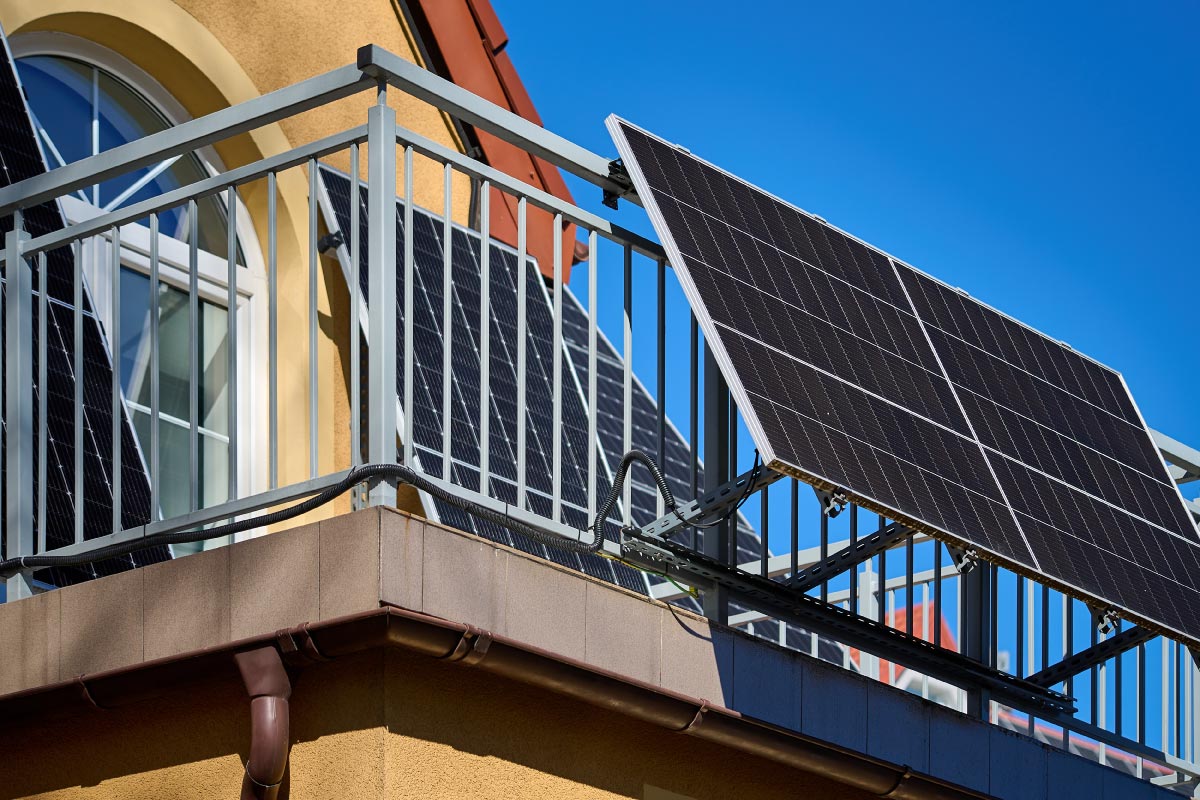
Roughly 70% of American households cannot access rooftop solar. They rent, they live in apartment buildings, their roofs are shaded, or they cannot afford the upfront cost of a conventional installation. That exclusion has been a persistent structural problem for residential solar adoption in the United States, and for most of the past decade there has been no obvious solution to it. Germany found one. Balcony solar, small panel arrays that hang from a railing and plug into a household outlet, has been installed in more than a million German homes, generating roughly 700 megawatts of distributed capacity from apartments and terraces. The technology is simple, cheap, and requires no ownership of a roof. The United States is now in the middle of deciding whether to allow it.
The legislative shift began in Utah, which is not where most people would expect a distributed solar breakthrough to originate. In March 2025, Republican state representative Raymond Ward introduced House Bill 340, which created a new legal category for portable solar generation devices up to 1,200 watts and exempted them from interconnection agreements, utility approval, permitting requirements, and associated fees. The bill passed and was signed it into law. That unanimity is worth noting, because it suggests the appeal of the technology crosses the usual political lines that govern energy policy. Plug-in solar reads as consumer choice and utility deregulation to conservatives and as clean energy access to progressives, which turns out to be a rare and useful combination.
The momentum since has been substantial. Virginia became the second state to enact legislation effective January 2027. Maine followed. By April 2026, the number of states with active plug-in solar bills had jumped from roughly a dozen in mid-2025 to more than 30, including California, New York, Washington, Colorado, Hawaii, New Hampshire, Vermont, Missouri, and South Carolina. New York’s SUNNY Act has passed the legislature and awaits the governor’s signature. The bills generally follow a common template: define plug-in solar as systems between roughly 400 and 1,200 watts connecting to a standard outlet, eliminate the requirement for utility permission, require certification to a recognized safety standard, and classify the systems as household appliances rather than power generation facilities.
That last provision is the conceptual heart of the whole effort. If you can safely plug in a toaster, the argument goes, you should be able to safely plug in a solar panel. The counterargument, made primarily by utilities, is that a toaster consumes power and a solar panel produces it, and household wiring was designed for the former. Power flowing into an outlet from a plug creates several genuine technical problems. Plug-in panels inject power downstream of circuit breakers and other overcurrent protections, which makes those safeguards blind to the additional load. A solar panel’s plug can remain electrically conductive after being unplugged, which is not how any other household appliance behaves. And there are questions about how these systems interact with ground-fault circuit interrupters and what happens during a grid outage.
Those concerns have now been addressed at the standards level, though not in a way that fully preserves the toaster analogy. There are now standards that requires anti-islanding protection, meaning the system shuts down within one second if the grid goes down, protecting utility line workers. It requires touch safety, meaning the plug prongs go dead within a second of being unplugged. And critically, it requires a unique plug and receptacle configuration rather than a standard NEMA 5-15 outlet. That means, by current standards, systems cannot simply be plugged into an existing wall socket. A compatible receptacle has to be installed first, typically by a qualified electrician. The European model, where you buy a kit at IKEA and plug it into any outlet, does not translate to the American standards environment.
This is where the case for skepticism gets serious. The legislation is passing quickly, but the conditions for actual adoption are considerably harder to assemble. No products have yet completed the current certification. American kits cost $1,000 to $2,500 compared to roughly $400 to $800 in Germany, and retail distribution is essentially nonexistent, with sales happening online rather than through the mass-market channels that drove German adoption. The 30% federal Residential Clean Energy Credit expired for property placed in service after December 31, 2025, removing a subsidy that would have improved the economics considerably. The US installed base remains in the low thousands, concentrated in Utah, California, Texas, and Florida.
The largest barrier for the market that matters most, though, is not technical or economic. It is the landlord. Most state plug-in solar legislation removes utility barriers and says nothing about property owners. New York’s SUNNY Act is explicit about this gap, containing no provisions requiring building owners or homeowner associations to permit installation and no anti-retaliation protections for tenants who are refused. In New York City, where roughly a third of the housing stock is co-ops governed by board approval, that omission is close to fatal. Virginia went further, prohibiting landlords with four or more rental units from banning plug-in solar, which is a meaningful provision and one that other states will likely copy. But most legislation has not, and a law that gives renters the right to install solar their landlord can prohibit is a law that changes very little.
If the barriers do come down, the implications for multifamily are more interesting than the small system sizes suggest. A standard 800-watt kit can cover 15% to 25% of a typical apartment’s monthly electricity consumption, mostly by offsetting the always-on baseline load from refrigerators, routers, and standby electronics. At scale across a large building, that changes the load profile of the property in ways that affect how it is designed and metered. Buildings with individually metered units would see resident consumption fall, which is largely a resident benefit. Buildings with master-metered electricity and RUBS-style allocation would see property-level consumption fall, which is an owner benefit, and would raise immediate questions about how those savings get distributed.
Balconies become an energy asset rather than purely an amenity, which affects orientation decisions, railing specifications, and structural load calculations. Weight loads and wind loading for balcony-mounted panels are not trivial, and buildings designed without them in mind may not be able to accommodate retrofits safely. The unique receptacle requirement under UL 3700 means that new construction could reasonably include compatible outlets on balconies as a standard feature, at very low marginal cost during construction and considerable cost as a retrofit. Developers who anticipate this get a leasing differentiator. Those who do not may find themselves with buildings that cannot support a feature renters increasingly ask about.
Plug-in solar in the United States is currently a policy success and a market question mark. The laws are passing, the standards exist, and the demand is real. What has not yet materialized is a certified product at a price point that works, sold through channels that reach consumers, installable in buildings whose owners have a reason to allow it. Germany assembled all of those pieces over roughly a decade. The United States is somewhere in year two.
The post Plug-In Solar Could Bring Clean Energy to Millions of Renters appeared first on Propmodo.