




DERIVSOURCE: Options Gain Ground as Structural Shifts Reshape Listed Derivatives Markets

Options are playing a growing role in risk management, retail participation continues to expand and exchanges are adapting to new products, according to speakers during the Futures Industry Association’s (FIA) Trends in ETD Trading Q2 2026 webinar.
Presenting data on exchange-traded derivatives (ETD) activity during the second quarter, Will Acworth, senior vice president at FIA, said listed derivatives markets recorded broad-based growth during the first half of the year.
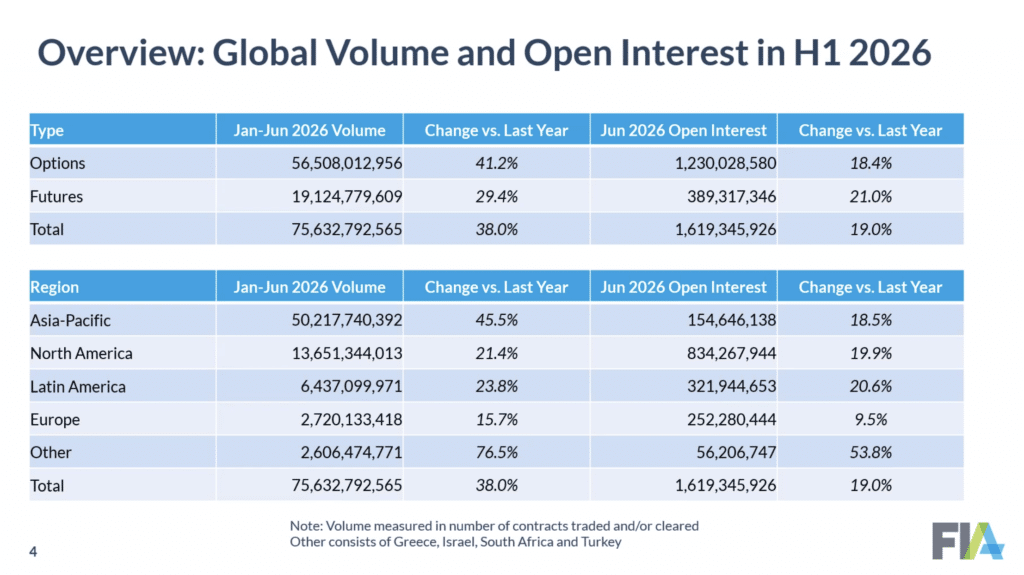
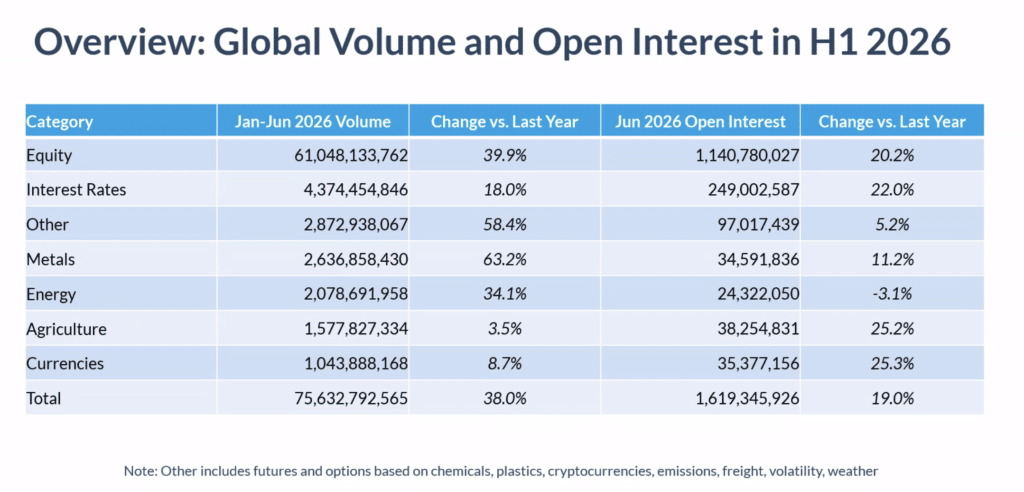

“As you can see, it’s pretty much double-digit growth across the board,” Acworth said.
“Whether it’s by region or by options, futures, open interest, it’s really been a very, very active first half,” he stressed.
One of the clearest trends highlighted during the webinar was the continued shift toward options in commodity markets.
Looking at Brent crude, Acworth said the market has continued “a shift towards options on futures as a way to hedge,” noting that open interest in options now exceeds that of futures.
Guy Wolf, global head of market analytics at Marex, said changing market conditions have altered how participants manage risk.
“There’s been a general shift away from these futures towards using options,” Wolf said.
“The option has a fixed cost… What’s unknown in the future is what amount of liquidity may I need,” he added.
Wolf said heightened volatility over recent years has changed the way firms approach hedging, with options providing greater certainty over upfront costs.
Retail and institutional participation
The webinar also pointed to growing participation from retail traders, particularly through smaller contract sizes.
Acworth highlighted the increase in trading of micro West Texas Intermediate (WTI) crude futures, describing it as “a sign of greater retail interest in commodities.”
He also pointed to rapid growth in smaller energy options contracts, particularly in India, saying the market was seeing “more micros, more retail on this side of the market.”
Wolf agreed that retail participation has become a broader structural trend.
“The rise of retail is clearly a theme in many markets over recent years,” he said, adding that precious metals have been “very much seen as that final frontier of trades we’re seeing out of retail.”
Institutional participation is also evolving, he said.
“I would say that the last two to three years has been the biggest re-engagement by commodity managed money that we’ve seen,” Wolf said, attributing the renewed interest to increased market volatility following Russia’s invasion of Ukraine.
According to Wolf, the events of the past several years have reinforced the importance of commodities within broader investment portfolios.
“I think Russia and Ukraine really changed the perception,” he said.
“The moves we’re seeing in energy prices impacting people on FX books and equity books… there was a realization that you need to understand what was going on within this space,” he added.
Wolf also noted that listed commodity derivatives markets themselves have continued to evolve.
Speaking about European natural gas, he said: “This used to be dominated by swaps around futures. The futures arena has evolved.”
The discussion extended beyond commodities to interest-rate derivatives, where Wolf said changing central bank communication has contributed to greater trading activity.
“For years, the Fed strongly leaned on the concept of forward guidance. A new chairman has decided that’s counterproductive,” he said.
According to Wolf, markets are now adjusting to “this new normal of lack of guidance,” contributing to increased activity in interest-rate futures and options.
Looking across today’s listed derivatives markets, Wolf said increased participation has fundamentally changed how market participants engage with commodities and the associated risk-management tools.
“I think there’s much more engagement with commodities than we’ve seen over the last 20 years,” he said.
“We’ve seen different things going into copper prices, to gas prices around the world, and that requires tools and services,” he said.
Perpetual Futures
The webinar also explored the emergence of perpetual futures, which allow trading outside traditional exchange hours.
Acworth said interest in the products accelerated earlier this year before moderating, but they continue to attract attention from exchanges and regulators.
“There was a big surge in interest when the war broke out… but it’s tailed off since then,” Acworth said.
He added that commercial market participants have raised questions about the potential impact of perpetual futures on liquidity and price discovery, referencing discussions held at the Commodity Futures Trading Commission’s Agricultural Advisory Committee.
Acworth also touched on prediction markets, describing them as an emerging area of interest while noting that they remain relatively small within the broader listed derivatives ecosystem.
“I personally view it as kind of fascinating,” he said.
“But in the overall scheme of things… [it is] particularly small,” he said.
The image for this article was generated using AI.