VOL REPORT: Crossed Wires: Separating Perception From Reality
Crossed Wires: Separating Perception From Reality
Perpetual Futures vs. 0DTE Options: Risk, Utility, and Investor Behavior
Executive Summary:
- As perpetual futures enter regulated US markets, some have drawn comparisons to 0DTE options. But while both products offer leverage and have seen strong growth, particularly with retail, the similarities are largely superficial. Our latest report examines why perpetual futures and 0DTE options are fundamentally different instruments with distinct payoff structures, risk profiles, and investor use cases.
- If leverage is where the comparison begins, convexity is where it starts to diverge. While both products can deliver leveraged exposure, perps are ultimately linear instruments while options are convex. We examine how this distinction translates into dramatically different payoff profiles and real-world applications.
- Equally important is the difference in risk profile: while both options and perps provide leverage, only options allow investors to define their maximum downside risk. Perpetual futures offer symmetric upside and downside exposure, meaning leverage can amplify losses just as easily as gains. By contrast, option buyers can lose no more than the premium paid, and the vast majority of SPX 0DTE option selling activity occurs in defined-risk spreads. In fact, roughly 92% of SPX 0DTE trading takes place in capped-risk structures— a risk profile that is not replicable using perpetual futures.
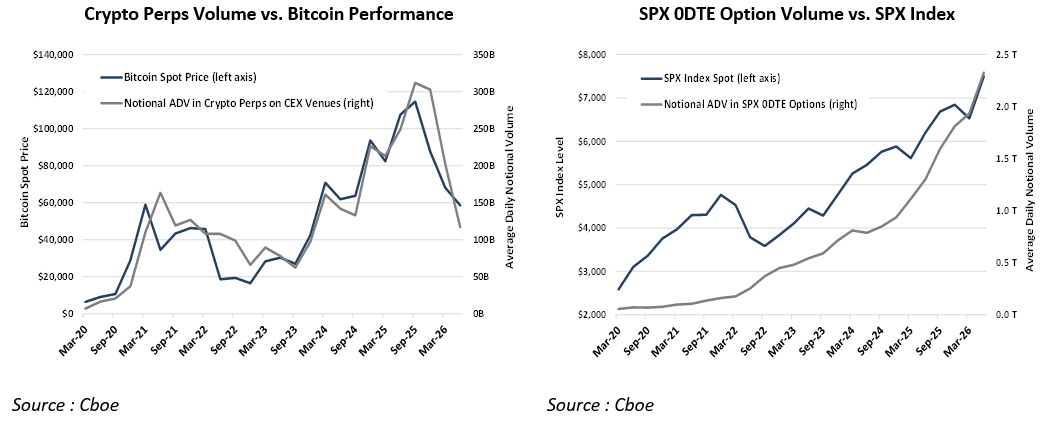
- The data also challenge the notion that both products serve the same audience and purpose: SPX 0DTE options are used by both retail and institutional investors for a variety of purposes ranging from hedging, income generation, and directional trades, while perps are used primarily by retail traders for speculation. This helps explain why trading activity in perps remains closely tied to crypto market performance, while SPX 0DTE option volumes have grown steadily across bull and bear markets alike. See chart below.
- The key takeaway is that perpetual futures and 0DTE options have reshaped their respective derivatives ecosystems for fundamentally different reasons. Perpetual futures are primarily used for continuous directional exposure and leverage, while SPX 0DTE options support a broader range of applications spanning hedging, yield generation, and tactical positioning. Understanding the distinct benefits, risks, and use cases of each – including unique features of perpetual futures such as funding rate dynamics and auto-deleveraging (ADL) – is critical as these markets continue to evolve. For more, see the full report here.