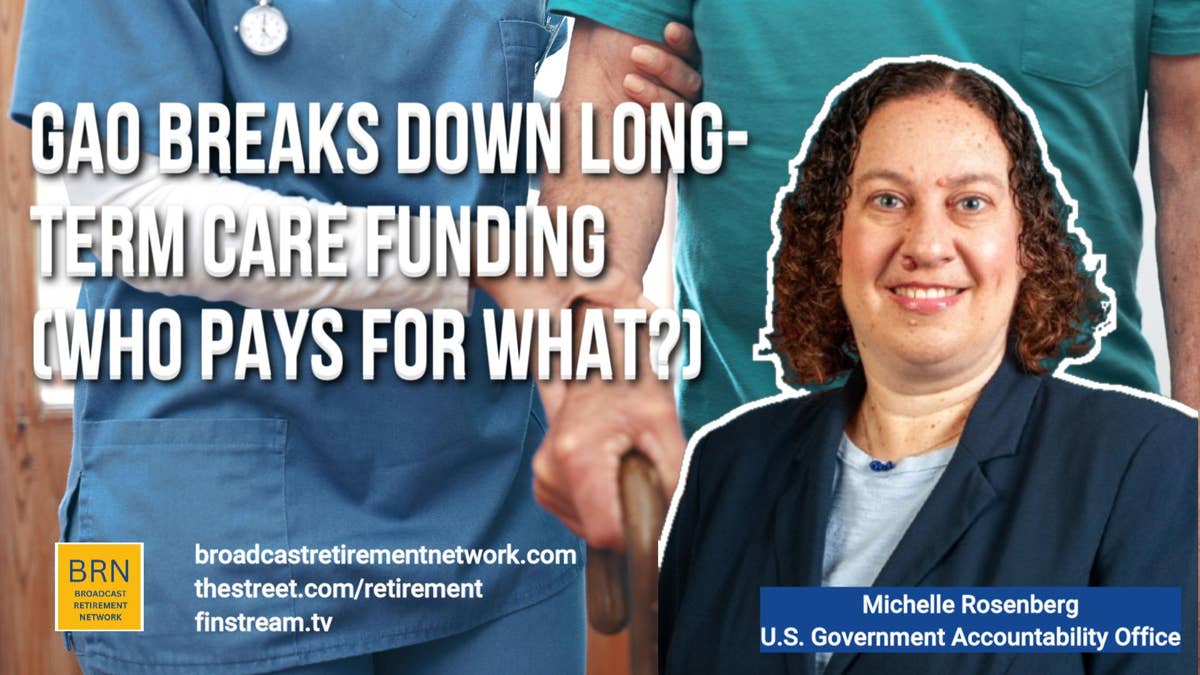
GAO Breaks Down Long-Term Care Funding (Who Pays for What?)
Medicare and Medicaid often get misunderstood when it comes to long-term care—especially assisted living. In this conversation, U.S. Government Accountability Office Director Michelle Rosenberg explains why many people assume their “regular health insurance” will cover long-term services and support, and why that’s usually not the case.
Jeffrey Snyder, Broadcast Retirement Network
Joining me now is Michelle Rosenberg. She’s a director for healthcare at the US Government Accountability Office or GAO.
Michelle, it’s great to see you. Thanks for joining us in the program this morning.
Michelle Rosenberg, Director, U.S. Government Accountability Office
Oh, my pleasure, glad to be with you.
Jeffrey Snyder, Broadcast Retirement Network
And I’m so excited because I love when we get to talk to the GAO because you guys have a, I would say a vital role in government. Before we get started on the report about assisted living and long-term care, do you mind just telling us a little about the purpose of the GAO?
Michelle Rosenberg, Director, U.S. Government Accountability Office
Sure, GAO, we’re known as the congressional watchdog. We are a nonpartisan agency for Congress. So we do research and evaluations looking at federal programs to inform Congress, its oversight and its legislative activities.
Jeffrey Snyder, Broadcast Retirement Network
So you do a lot of work in a lot of different areas, one of which is healthcare. So let’s get into it. And I guess maybe at a high level, what was the interest in doing a piece, a blog post, if you will, research on what Medicare and Medicaid cover as far as assisted living and long-term care?
What drove, if you wouldn’t mind sharing, what drove the rationale behind doing this piece?
Michelle Rosenberg, Director, U.S. Government Accountability Office
Sure, happy to. So our work is mainly driven by Congress. And in this case, Congress asked us to look at federal funding for services in assisted living facilities.
You know, the population is aging. And with that aging, more and more individuals are going to need long-term services and support. So assistance with activities of daily living.
And one possible place to get such service is in an assisted living facility. And that’s often preferable to some of the other alternatives, such as a nursing home. And so I think Congress was really interested in understanding the extent to which federal funds are supporting services in assisted living facilities.
Jeffrey Snyder, Broadcast Retirement Network
And is it, do you have an opinion on whether, I think obviously we have a great federal government. It’s so unique. We just celebrated America 250.
But do you think the general public has a feel for what the various programs like Medicare or Medicaid cover as it relates to these types of programs? Because you’re right. I think I read some statistics.
Like I always quote it, 10,000 people are turning age 65 every day. I don’t know if that’s true or not, but that’s the quote. So do you think the general population anecdotally knows what they have available and what they don’t have available?
Michelle Rosenberg, Director, U.S. Government Accountability Office
I don’t think people are as informed as they could be. I think many people assume that their regular health insurance is gonna cover long-term care, whether that be in a nursing home or an assisted living facility. And it generally does not.
And similarly, I think many individuals, most individuals that need long-term services and support are elderly, are on Medicare. And they think Medicare is gonna cover their nursing home care, their assisted living care. And generally it does not.
Medicaid is actually the biggest payer from a federal level for long-term supports. And as you may or may not know, Medicaid is actually for individuals who are low income. So they don’t have enough money on their own to pay for those services.
Jeffrey Snyder, Broadcast Retirement Network
So does the coverage that’s available differ by the types of care that you may need or you may want? So for example, if you need someone to come into your home to assist you, or if you need to go to a nursing home or assisted living, as you were talking about earlier. So does the coverage vary depending on need, I guess?
Michelle Rosenberg, Director, U.S. Government Accountability Office
It definitely does. Nursing home care is covered by Medicaid. That’s a required benefit that all state Medicaid programs cover.
Medicare, on the other hand, covers skilled nursing facility often after a hospitalization, but not your long-term stay in a nursing home. On the assisted living side, Medicare does not cover assisted living services. It might cover care that you may receive in an assisted living facility such as home health care that it would cover in your primary residence in a normal home, but it doesn’t cover those activities that assist with daily living.
So with bathing, eating, dressing. And then on the Medicaid side, it’s at the state’s option whether or not to cover it. So most states do provide some coverage, but not all states.
Jeffrey Snyder, Broadcast Retirement Network
So that would be where the private, the long, what are called long-term care insurance policies, I guess, unless Congress decides differently, would come in, right? That’s where people would need to purchase some type of policy for the future needs that they may or may not have.
Michelle Rosenberg, Director, U.S. Government Accountability Office
Right, or the reality is most people pay for this care out-of-pocket. So they pay on their own.
Jeffrey Snyder, Broadcast Retirement Network
So the other thing I wanted to ask you, you talked about Medicaid being maybe supporting some of the assisted living programs. Obviously there’s different qualifications for that, but does it also depend on what state you live in? So if I live here and I’m in North Carolina, I grew up in Maryland, I’ve also lived in New York.
In those three jurisdictions, I would imagine that there probably are different rules and different layers of coverage.
Michelle Rosenberg, Director, U.S. Government Accountability Office
That is true for assisted living. Assisted living coverage by Medicaid is that state option and states have developed their programs differently. So I think there are 44 states, including DC, that provide coverage for assisted living for some elderly individuals or people with disabilities.
The other states do not. And the extent to which they cover that varies by state. How many people they cover, what types of services or populations they cover, that can vary by state.
Jeffrey Snyder, Broadcast Retirement Network
Yeah, I don’t know if you, I would assume since you’re in the health industry or in that area for the US General Accountability Office, you’re aware that I think Washington State just launched a new program. I think it’s a long-term care program. Did you, at the time of doing this research, did any of that kind of come into your, not your, but the team’s processing in terms of looking at different ways to cover these types of benefits or what states do and do not cover?
Michelle Rosenberg, Director, U.S. Government Accountability Office
So we were looking at states’ coverage as of 2025. And we reviewed proposals that states had submitted and had been approved by the federal government that the Centers for Medicare and Medicaid Services, which oversees Medicaid at the federal level. So if the program was newer than that, it wouldn’t have been covered in our report.
Jeffrey Snyder, Broadcast Retirement Network
Okay, so maybe, how frequently do you do these reports? Is it every two years, every year, every four years? Is there some frequency?
Michelle Rosenberg, Director, U.S. Government Accountability Office
No standard frequency. It’s really driven by congressional interests and needs, yeah.
Jeffrey Snyder, Broadcast Retirement Network
So with this report, if you wouldn’t mind me asking, Congress requested this, the team at the GAO did the analysis. The report, I’m assuming it’s pretty big and voluminous. It gets shuttled over to the Congress and the committee.
And then do they hold hearings or would they hold hearings? And is that something where you would be involved to kind of testify and kind of walk them through? Because I’m not sure they’re gonna read a big report.
They might read the executive summary, no offense, but they probably won’t, or maybe their staffers will. So what happens with the report next, I guess?
Michelle Rosenberg, Director, U.S. Government Accountability Office
That’s really up to Congress. I mean, it varies by report. Some reports we issue, well, I shouldn’t say, all reports we issue, we provide to our congressional requesters and they’re posted publicly on GAO’s website for the public.
What Congress chooses to do, whether they choose to have a hearing, or it may just be that the report informs their oversight activities. They may decide that based on a report that GAO does that they wanna introduce new legislation or put new requirements in place for facilities or programs. So it’s really driven by Congress and their interests and needs.
Jeffrey Snyder, Broadcast Retirement Network
Okay, it sounds like they’re interested or else they probably wouldn’t have asked for it. So I guess we’ll have to see what comes out of the Congress in the next, I guess, couple of years, if not sooner. Would you mind sharing in terms of future research, some of the things that you’re thinking about, or at least maybe been tasked by the Congress in terms of the healthcare?
I’m not asking for the other areas of government, but are there other reports or other research that you and the team will be doing?
Michelle Rosenberg, Director, U.S. Government Accountability Office
Sure, we actually have other work specifically looking at assisted living facilities ongoing, looking at how state Medicaid programs oversee the health and welfare of Medicaid beneficiaries in assisted living facilities. So once these individuals, Medicaid is funding their care, how are they making sure that these individuals are receiving quality care, being treated well? So that’s one of the other things we have in this space going on.
Jeffrey Snyder, Broadcast Retirement Network
Yeah, I would imagine they’re gonna keep you pretty busy because whatever the number of people getting older, we have an aging America, this is gonna be a hot topic. I think they’re gonna keep you pretty busy, Michelle.
Michelle Rosenberg, Director, U.S. Government Accountability Office
Yeah, no, I think so. And we have worked that really crosses the entire federal landscape, and including in the healthcare space. So other work looking at the Medicaid program, the Medicare program more generally, not necessarily just related to long-term care or assisted living.
Jeffrey Snyder, Broadcast Retirement Network
Well, it’s great work and obviously informing the right people in the Congress. So we’ll have to see what comes of it. Michelle Rosenberg, it’s great to talk to you.
Thanks for joining us, great work. And we look forward to having you back on the program again very soon.
Michelle Rosenberg, Director, U.S. Government Accountability Office
Thank you, it was great to be with you.