The sounds of Tokyo have stories to tell – if you learn to listen
On my first trip to Tokyo in the late 1990s, I bought a minidisc player and a small microphone. Then I set out to record sounds around the city. When I walked into a central Tokyo pachinko parlour, I was met with a wall of sound as chaotic as it was beautiful. I stayed longer than I intended, just listening.
That experience introduced me to Tokyo’s very particular relationship with sound, which is layered and complex, and unlike any other place that I’ve visited. Since that trip, my field-recording practice has taken me around the world. I’ve created site-specific soundtracks for buildings and public spaces, and worked with architects and developers in cities from London, Oslo, Singapore and Beijing. At the centre of my work with Mscty Studio, which I founded in 2010, is the idea that if cities sound better, people feel better. Sound is as fundamental to good urban life as clean air or safe streets.
You can learn a lot about a place just by listening. Now that I live full-time in Tokyo, the city is not just my home – it’s my school too.
The FamilyMart jingle
Take the Familymart jingle. Step into one of these chain konbinis (convenience stores) and you’re greeted by what might be Japan’s most recognised piece of functional music. It’s cheerful and bright, sitting somewhere between a doorbell and a lullaby. A shop attendant might hear the melody hundreds of times over the course of a shift or an office worker might hear it once on their way home – but the jingle has the same effect. People have a real affection for it. That’s a harder thing to achieve than it sounds, and most businesses haven’t bothered to try.

Train station melodies
Every Tokyo Metro train station has its own departure melody that is chosen for how they affect passenger stress and behaviour on the platforms. Many of the melodies have been composed by serious musicians: Minoru Mukaiya, who wrote more than 170 of them, was also the keyboardist in celebrated jazz-fusion band Casiopea. Each piece is short enough to avoid irritating commuters, yet long enough to signal that it’s time to move.
Sonar and the city
Take a train to somewhere like Kagurazaka or Koenji, and you’ll hear a different tapestry of sound. In the quieter parts of Tokyo, the sounds of daily life weave through the atmosphere. Head to a café in the morning and you might hear temple bells cut through the whir of coffee grinders while the sound of a tofu maker’s water sloshes out a rhythm. Walk through narrow streets after a spring rain and you’ll hear a serene silence that only happens after a big storm. These are sounds that build into something special: a distinct arrangement that tells you exactly where you are – if you know what to listen for.
Intersection of sounds
It’s impossible for a city of some 14 million people to have a curated soundscape everywhere. There are plenty of spaces where no one has thought about sound at all. Visit one of the city’s many construction sites, a crossing in Shibuya at rush hour or a department store’s basement food hall, and you’ll be treated to a cacophony of footfall, cookery, voices, cars and clattering machines of all kinds.
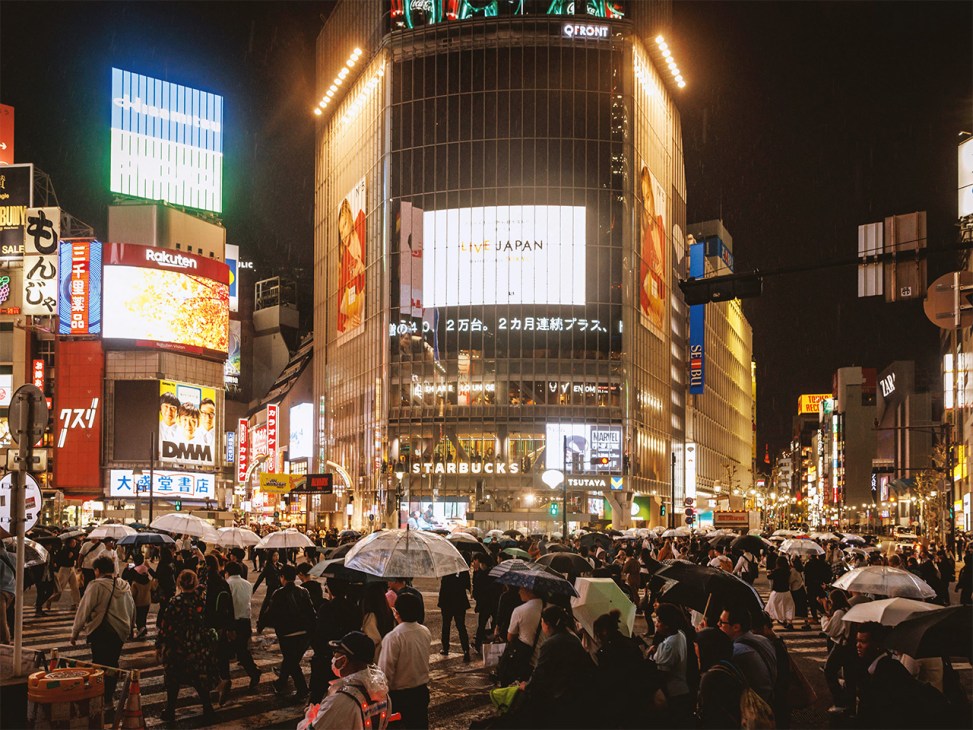
But if you stop long enough to listen, a place’s story begins to emerge. And while Tokyo sounds much the same today as it did when I first started making minidisc recordings back in the 1990s – some things have disappeared. Once ubiquitous, the garakei (push-button flip phone) with the clickety-clack of its physical buttons, the snap of its clamshell case and the custom ringtones people chose with care, has largely disappeared. It has been replaced by the near-silent smartphone. But something else has arrived. Walk through Asakusa or Nakameguro today and you’ll hear a sound that wasn’t common 25 years ago: the persistent clatter of rolling suitcases on stone and pavement. It’s percussion in a city that has welcomed record numbers of tourists in recent years.
When I listen to Tokyo, I hear both its history and its future. The music of this city has become so familiar to me but I still notice new notes.
Nick Luscombe is a broadcaster for BBC Radio, presenter of Monocle Radio’s ‘Tokyo Music Hour’ and sound artist based in London and Tokyo. He is the founder of Mscty Studio; mscty.space
The post The sounds of Tokyo have stories to tell – if you learn to listen appeared first on Monocle.