Trump threatens trade with Spain
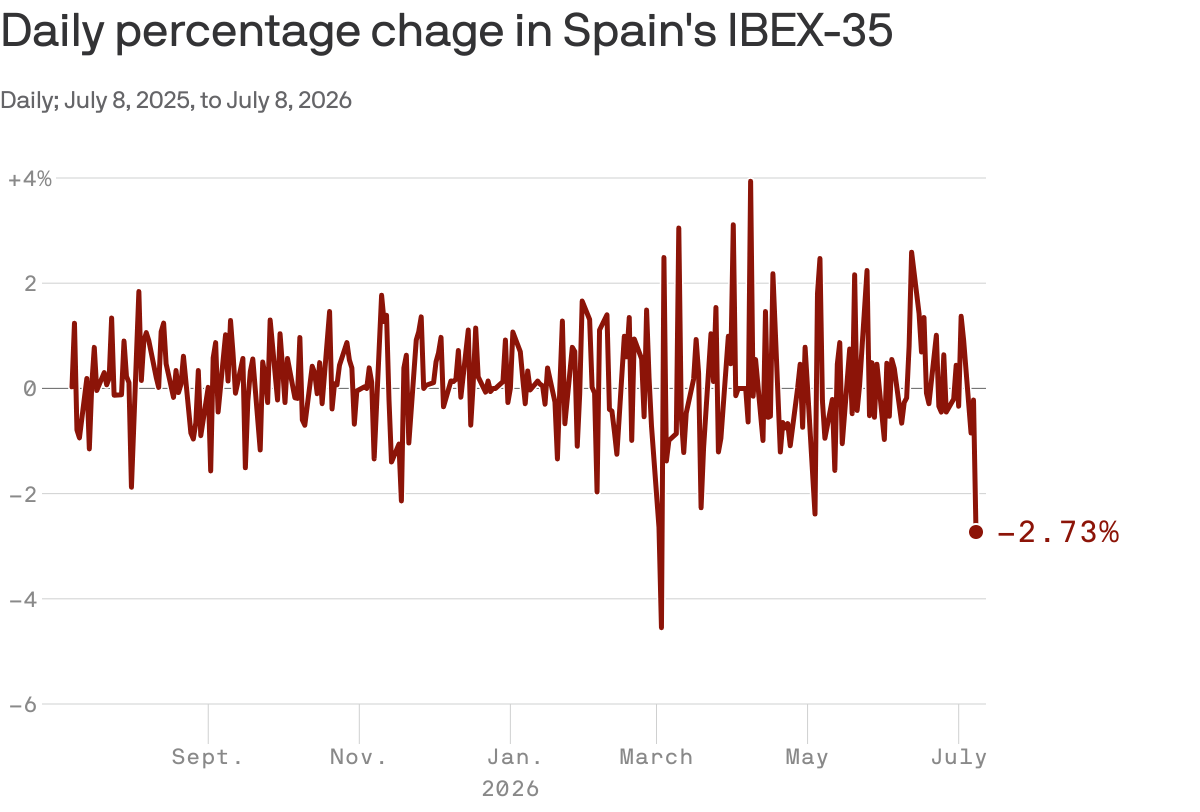
President Trump’s threat to “cut off all trade” with Spain was immediately a market event — at least in Europe.
Why it matters: Well into Trump’s second term, foreign investors aren’t totally dismissing the president’s trade threats, even if the legal authority, the path to implementing them and the ultimate outcome remain unclear.
- The U.S. Supreme Court narrowed one of Trump’s most aggressive trade authorities. But trade tensions are still flaring up in ways that financial markets are adjusting to.
- Top economic officials suggest they are willing to explore how to translate the president’s trade demands into policy.
Driving the news: “We don’t want to do any trade business with Spain anymore,” Trump said, re-escalating a monthslong feud over NATO spending and Spain’s stance on Iran.
- Spain’s benchmark stock index fell 2.7% Wednesday, the biggest one-day drop since Trump last threatened a trade embargo on the nation in March.
- The premium investors demand to hold Spanish government debt relative to Germany’s climbed to its highest level this month, a sign that investors saw Spain as a riskier bet.
The intrigue: Any attempt to embargo a single member state would seemingly blow up the trade deal between the U.S. and the European Union, which was recently enacted by European politicians.
- Broad U.S. trade embargoes have historically targeted geopolitical adversaries.
- A White House spokesperson did not respond to a request for comment.
The other side: A top Spanish official said the nation has a “very positive economic relationship with the U.S.”
- The U.S. sends more goods to Spain than it gets, a dynamic that should please an administration trying to use trade policy to address trade deficits.
- Trump did target Spanish black olives with an “anti-dumping” tariff during his first term. That was rolled back somewhat — and a nationwide trade cutoff would be far more sweeping and legally murkier.
The bottom line: Overseas investors did not dismiss Trump’s threat outright, even if they are not fully betting it ultimately becomes policy.
- In the U.S., any disruption to Spanish imports would layer on more inflationary risk — for pharmaceuticals to olive oil — just as renewed tensions in the Middle East threaten to keep energy costs elevated.