



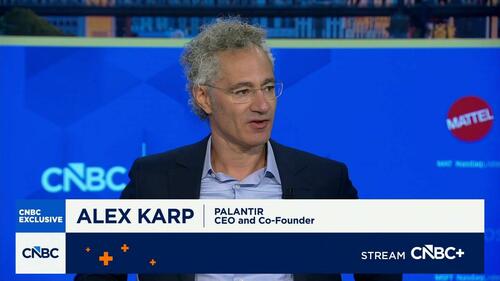
‘Something Has Gone Completely Wrong’: Palantir’s Alex Karp Goes Ballistic On OpenAI, Anthropic
‘Something Has Gone Completely Wrong’: Palantir’s Alex Karp Goes Ballistic On OpenAI, Anthropic
On Wednesday, Palantir CEO Alex Karp delivered a blistering critique of frontier AI labs, accusing them of having an “effing insane” business model that leaves enterprises paying escalating token costs for limited value while risking their proprietary data and intellectual property. He said that top AI labs such as Anthropic and OpenAI were misleading corporate partners – “overselling” the risks of AI while at the same time offering their most powerful models to companies and governments worldwide.
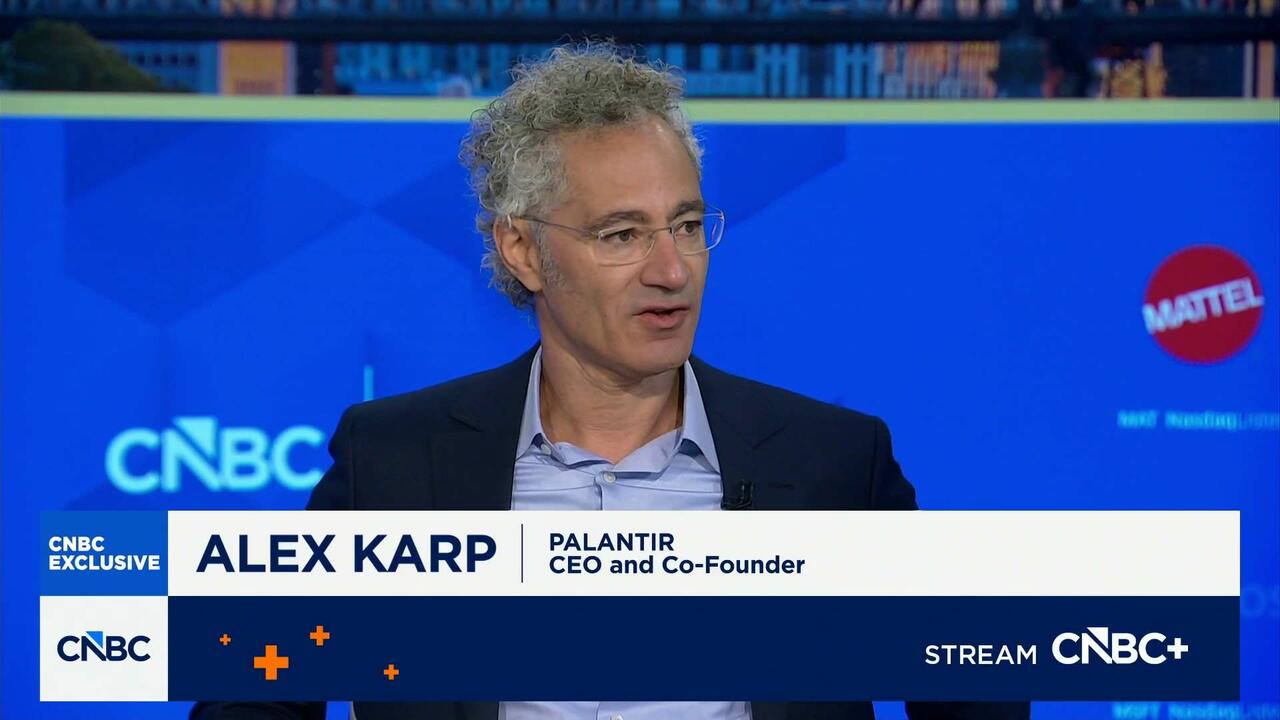
When CNBC host Becky Quick said “You sound pretty angry,” Karp replied: “This is the voice of American business that is being channeled through me,” he told CNBC, joking later that he might “get kicked out of the room.”
Karp’s comments come amid a “revolt” against U.S. AI labs – driven by a combination of high costs, questionable ROI, and increasing regulatory headwinds which have driven some major U.S. companies to cheaper Chinese alternatives, creating multiple pressure points for OpenAI, Anthropic, and others.
“Something Has Gone Completely Wrong”
Karp slammed the token model used by Anthropic and OpenAI – saying “I’m not throwing shade at them, but something has gone completely wrong,” he said. “The basic view among enterprises in this country is I’m going to chillax and waste my time with tokens.”
He argued that that labs were overselling risks while simultaneously pushing powerful models, and that companies were effectively paying a “wealth tax” that transferred their “alpha” (competitive advantage) to third parties. On national security, he warned: “Are we really going to outsource the battlefield of this country to the consensus view in Silicon Valley? That is effing insane.”
Palantir CEO Alex Karp on what customers actually want, the real business of frontier labs, and the importance of open source models:
“What the technical customers want is control over their compute, their models, their data stack, and their alpha. They want to know they own the… pic.twitter.com/2hvTx7VSyj
— Palantir (@PalantirTech) July 1, 2026
The remarks aligned with a 9-point “AI sovereignty” manifesto Palantir posted on X the day before, which criticized “tokenmaxxing” for incentivizing disposable scripts over robust systems and urged institutions to retain control over their data, model weights, and competitive edge.
Via X:
Our thoughts on the importance of AI sovereignty.
1. Your AI sovereignty dictates your institution’s future. Sovereignty is the precondition for choice. Relinquishing sovereignty transfers the future choices of your institution to others, who are likely to exploit it for their gain and your loss.
2. Data retention is your treasure. Transfer it at your own peril. Your ability to win is dictated by your ability to recognize and use your unique edges, and you keep winning by compounding the underlying data to generate new insights. Transferring that data hands over access to your pre-existing winning plays and yields the means of production for new ones.
3. Tokenmaxxing hijacks your value orientation and decreases your institutional fortitude and intelligence. The pursuit of high token usage incentivizes disposable scripts over robust software — with the addictive feeling of false progress. There is a reason why those selling tokens refuse to charge based on value.
4. Controlling your weights is controlling your fate. Weights are the distilled form of hard-won, accumulated institutional knowledge. If you let others control your weights, you are allowing them to migrate the alpha of your business to theirs.
5. There is no contradiction between sovereignty and alpha. The architecture that maximally preserves sovereignty is one that enables institutions to own their tribal knowledge, and to compound it as alpha.
6. Politicizing the technical issues involving sovereignty is what your adversary wants. Techno-politicization is the wellspring of false sovereignty. Techno-politicization drives decisions that seem to reduce dependency, but ultimately limit agency — especially on the battlefield in the West.
7. Real expertise is existential. Allowing politics or favoritism to determine your technical decisions rewards whoever is best at politics, not whoever is right. Listen to those closest to the problems, not those speaking most compellingly about them.
8. Learn from institutions that are winning or that have consistently delivered. Institutions facing existential threats do not have the luxury of making technical decisions based on political preferences.
9. Only listen to institutions, countries, and people who have a proven record of being right. A track record of correctness is the best and only signal for future correctness. Judging something as right or wrong based on who you like is exceedingly misguided.
“Controlling your weights is controlling your fate,” the manifesto stated. “If you let others control your weights, you are allowing them to migrate the alpha of your business to theirs.”

Karp noted Palantir’s expanded Nvidia partnership, which enables custom, sovereign AI deployments where customers retain control over compute, models, data, and weights – a direct counter to the metered frontier API model.
Watch CNBC’s full interview with Palantir CEO Alex Karp
The Cost-Driven Shift To Chinese Models
As we’ve been noting, high token prices and mixed returns have prompted several U.S. companies to adopt or explore Chinese open-weight models:
- Microsoft is considering a Microsoft-hosted, fine-tuned version of China’s DeepSeek V4 (or another open-source model) as a lower-cost engine for its Copilot Cowork agentic tool, as it moves toward usage-based pricing.
- Coinbase CEO Brian Armstrong revealed the company cut internal AI spending by nearly 50% by defaulting engineers to Chinese open-weight models (Zhipu AI’s GLM 5.2 and Moonshot AI’s Kimi series) via an internal gateway, while maintaining high usage.
- Cursor, a fast-growing AI coding startup, built its Composer 2 model on top of Moonshot AI’s Kimi K2.5 (backed by Alibaba).
Data from OpenRouter shows Chinese models capturing a rapidly growing share of global token consumption – in some periods exceeding 60% among top models – as enterprises seek cost relief without fully sacrificing capability.
Karp had warned against underestimating China’s progress; these examples illustrate the trend in real time.
Watch the entire interview below:
here is the entirety of Palantir CEO Alex Karp’s televised nervous breakdown this morning on CNBC pic.twitter.com/gzD8debrKB
— Aaron Rupar (@atrupar) July 1, 2026
Tyler Durden
Thu, 07/02/2026 – 10:15