AI Adoption Outpaces Network Readiness in Financial Services
Financial services firms are advancing their artificial intelligence strategies, but many are less confident their networks are prepared to support the technology, according to a new Cisco survey of more than 3,400 senior IT and network leaders worldwide, including 513 from the financial services sector.
The survey titled “Financial services in the age of AI: The network built for millisecond-level performance” found that 78% of financial services respondents are more confident in their AI strategy than in their network’s ability to support it. At the same time, 47% said they are already upgrading their networks to stay ahead of the competition, the third-highest rate among the industries surveyed.
According to the report, AI is reshaping financial services across customer engagement, fraud detection, operations, compliance and decision-making. It said the technology is creating new traffic types, new attack vectors and greater demands on network performance, bandwidth and resilience in campus and branch environments.
The report stated that AI workloads differ from legacy applications because they are often highly interdependent. It said that a minor network disruption can affect automated decision-making and real-time fraud detection systems, resulting in delayed transactions, failed authentication or inaccurate AI-driven recommendations.
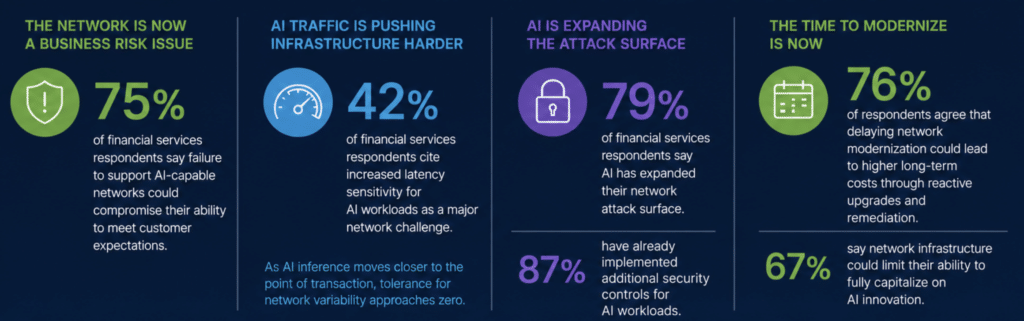
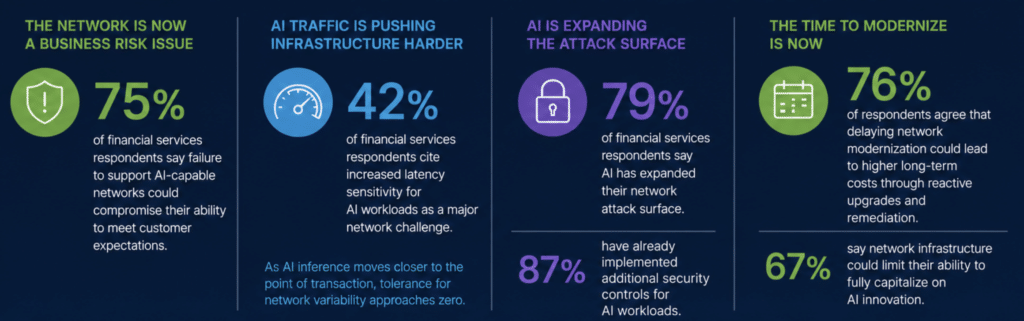
Seventy-five percent of financial services respondents said failure to support AI-capable networks could compromise their ability to meet customer expectations.
The report also highlights changes in network traffic associated with AI adoption.
According to Cisco, generative AI is shifting traffic patterns from predictable requests to “bursty interactions” that require significant bandwidth. It added that agentic AI introduces frequent machine-to-machine communications that require consistent, low-latency connections across distributed campus and branch environments.
Among financial services respondents, 42% identified increased latency sensitivity for AI workloads as a major network challenge.
The report said applications including real-time fraud detection, algorithmic trading and instant payments rely on millisecond-level performance, adding that “even minor network variability can erode customer trust and trigger compliance failures.”
One senior director of enterprise networks in the financial services industry described how AI is changing network investment priorities.
“Networks have evolved from a cost center to an innovation platform,” the executive said. “Due to new demands from AI, we are now thinking more deeply about how to modernize and make the network platform more capable to offer the capabilities business is asking for. It has become more of an innovation platform now, and we are investing more.”
Security also emerged as a key focus in the survey. Seventy-nine percent of financial services respondents said AI has expanded their network attack surface, while 81% said security risks will increase as AI moves beyond generative use cases.
The report said agentic AI introduces risks that traditional perimeter-based security architectures are not designed to manage. It also stated that financial institutions operating under regulatory frameworks such as DORA, Basel IV and emerging AI regulations must demonstrate that AI-driven processes remain transparent, resilient and compliant with evolving data sovereignty requirements.
Eighty-seven percent of respondents said they have already implemented additional security controls for AI workloads.
The survey also found that 76% of respondents believe delaying network modernization could lead to higher long-term costs through reactive upgrades and remediation. In addition, 67% said current network infrastructure could limit their ability to fully capitalize on AI innovation.
Rather than recommending a complete replacement of existing infrastructure, the report said financial institutions should adopt a phased modernization approach that addresses the most critical bottlenecks first.
“The goal is to avoid the cost and disruption of reactive upgrades while improving the network’s ability to support growth,” the report said. “By doing so, CIOs and IT leaders will put themselves in a better position to support the business with confidence as AI expectations continue to rise.”